US House rejects effort to defund mandate on anti-drunken driving tech in cars
Published in Political News
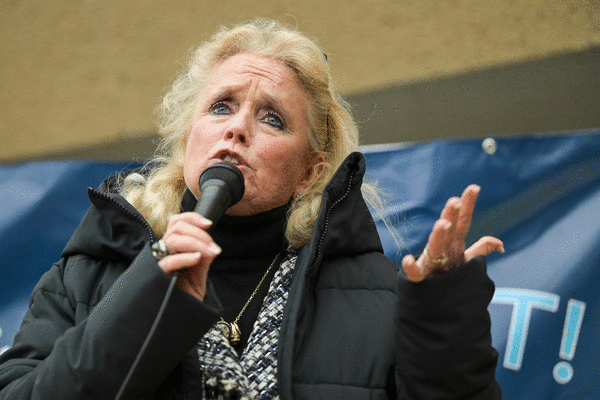
WASHINGTON — In a bipartisan move, the U.S. House on Thursday voted 268-164 to reject an effort to block funding for a provision in federal law requiring automakers and federal regulators to install lifesaving, anti-drunken driving technology into new vehicles.
The 2021 provision, adopted as part of the bipartisan infrastructure package, was pushed by U.S. Rep. Debbie Dingell after the 2019 deaths of the Abbas family from Northville, who were killed by a drunken driver in a wrong-way collision on I-75 in Kentucky while returning to Michigan from vacation.
Kentucky U.S. Rep. Thomas Massie, a Republican, cited civil liberties and privacy concerns in his attempt Thursday to amend a transportation-related appropriations bill to prohibit any funding in the legislation from being used to promulgate rules related to new alcohol detection and driver behavior monitoring systems.
Massie portrayed the provision as having the potential to bring to life a "bad science fiction movie" in which your car monitors your driving, then disables itself and leaves you stranded when it thinks you're "not doing a good job."
"So the car dashboard becomes your judge, your jury and your executioner. Imagine this," Massie said during debate on the House floor, posing a scenario where someone swerving in a snowstorm could be stranded on the side of the road with a disabled vehicle.
"My question is, how do you appeal your sentence once your car, the technology in your car, has judged you to be incapable of driving? ... There's going to be so many false positives. The technology is unworkable."
Dingell, D-Ann Arbor, defended the technology mandate Thursday and contended that more people would be killed by drunken drivers if Massie's amendment were to pass.
"We have too many people that are killed by drunk drivers. Drunk drivers should not be able to get behind the wheel of a vehicle, and we passed legislation that says (the Department of Transportation) needs to promulgate regulations to address that," Dingell said during a panel at the Washington, D.C., Auto Show.
"I don't want to go backwards. I want to keep moving forward with the safety developments that the companies are investing in."
Dingell's bill, adopted as part of the infrastructure package passed by Congress in 2021, purposefully did not require a specific type of anti-drunken driving technology to give automakers and regulators flexibility on the best way to approach curbing a deadly practice on U.S. roads.
The law set a Nov. 15, 2024, goal to finalize standards, but two deadlines have passed without the National Highway Traffic Safety Administration taking regulatory action.
An impatient Dingell last month introduced a new bill that would quickly order car and truck makers to add alcohol detection and driver behavior monitoring systems in thousands of vehicles while talks over a long-term regulatory solution continue.
Massie's amendment would bar NHTSA from continuing its work on finalizing the standards related to the advanced alcohol monitoring technology for the rest of the year. He tried to pass a similar amendment last year, Dingell said.
His amendment was supported by GOP U.S. Reps. Scott Perry of Pennsylvania and Chip Roy of Texas. Both Massie and Perry warned of due process violations. They noted that 31 states already use ignition interlock technology to deter drunken drivers on their roadways.
Perry warned of a slippery slope that would link the driver-monitoring technology in the car to automatic notification of the police when the car has been disabled.
Next, Perry said, "they're going to be shutting your car off when they decide, whatever they decide from wherever they decide it."
"Punishing everybody for this crime, whether they've committed or not, if they're going to commit it or not, should be unconstitutional," the Pennsylvania congressman added.
"We all want to get to the problem, and we're happy to work with everybody on all sides to deal with it. But you cannot punish convict, punish convict and punish everybody in the country for the sake of the ones that do things that they shouldn't do."
House Democrats stood in defense of the provision, warning that it could jeopardize the larger compromised appropriations bill that covers spending for the rest of fiscal year 2026 for federal departments of Labor, Health and Human Services, Education, Transportation and Housing and Urban Development, among other purposes.
They noted that more than 30 people in the United States die each day in drunken driving crashes on average and more than 12,000 people a year.
"Using the appropriations process to delay or in any way impede the development of technology to prevent drug driving is inappropriate and reckless," said Rep. James Clyburn, a South Carolina Democrat.
Rep. Frank Pallone of New Jersey, the top Democrat on the House Energy and Commerce panel, acknowledged his GOP colleagues' concerns about privacy but insisted the technology being developed does not track a vehicle's location or collect, use, or store any data that would compromise the privacy of its occupants.
"If privacy is a concern, and my friend should weigh in on the rulemaking process," Pallone said. "It's not right, though, to prevent impaired drivers from illegally operating vehicles and causing fatalities. That should be a non-partisan issue, and the work on that needs to continue."
_____
Staff Writer Grant Schwab contributed.
_____
©2026 The Detroit News. Visit detroitnews.com. Distributed by Tribune Content Agency, LLC.










































Comments