Senate passes spending package with Homeland Security punt
Published in Political News
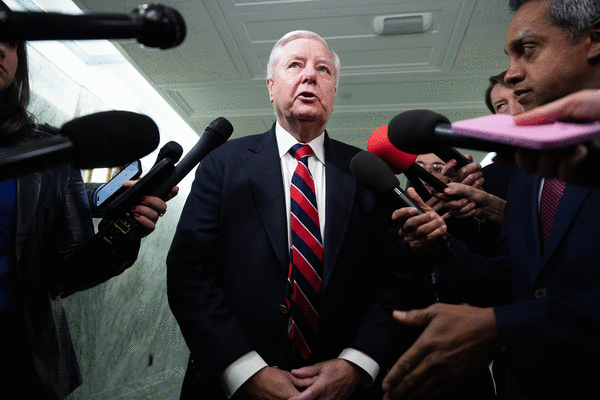
WASHINGTON — The Senate on Friday passed a $1.2 trillion spending package to fund a slew of federal agencies through September, alongside a two-week stopgap measure for the Department of Homeland Security to buy time for bipartisan negotiations on immigration enforcement tactics.
Senators voted 71-29 to send the revised package — which also includes the full-year Defense, Labor-HHS-Education, Financial Services, National Security-State, and Transportation-HUD funding bills — back to the House for another vote, while extending Homeland Security funding through Feb. 13.
The punt on a full-year Homeland Security bill, which the House had included in its initial package last week, forces the House to hold another vote, which could occur as early as Monday. Current funding for many federal agencies is set to expire Friday night, ensuring at least a brief partial government shutdown until the House can clear the revised package for President Donald Trump’s signature.
The undoing of what was once a six-bill package came after the fatal shooting of intensive-care nurse Alex Pretti in Minneapolis last week by federal immigration agents, triggering a revolt by Democrats against Homeland Security Department funding until new restrictions are imposed on federal agents.
But with the polarizing Homeland Security bill set aside for now, Democrats and Republicans touted the long-delayed deal, which covers the lion’s share of discretionary spending for the fiscal year that began last October.
“When we pass this package and when it is signed into law, on top of the previous packages, we will have funded 96% of all of government,” Appropriations Chair Susan Collins, R-Maine, said on the floor before the final vote.
A challenging House vote lies ahead, however. The House Rules Committee could meet as soon as Sunday in hopes of advancing a rule for floor consideration of the bill, though rule votes are often party-line, which would require near-unanimous House GOP buy-in because of the chamber’s razor-thin margins, and some hard-line conservatives have already raised objections to the package.
With enough Democratic support, the chamber could also consider the bill under suspension of the rules, a streamlined process that requires a two-third majority. But that route is likely to prompt pushback from conservatives, in part because some lawmakers successfully negotiated changes to the rules for the 119th Congress that are intended to limit use of the suspension process to mostly noncontroversial bills.
A path to Senate passage was cleared Friday after Sen. Lindsey Graham, R-S.C., agreed to lift a hold he had placed on the bill that had slowed things down for about a day.
In return for lifting his hold, Graham won commitments from Senate leaders for future votes on two pieces of legislation he is seeking, though he didn’t push to have them included in Friday’s spending package.
Graham demanded a guarantee for a vote in the next two weeks on a bill that would criminalize the behavior of local officials who lead “sanctuary cities” that don’t help enforce federal immigration policy.
He also sought a vote on a yet-to-be-introduced proposal that would bar federal investigators from acquiring the telephone records of members of Congress in court-sanctioned probes without notification. Graham didn’t put a deadline on that vote, but was pushing for consideration in a timely manner.
That request grew from the Arctic Frost investigation into attempts to overturn the 2020 election, during which federal investigators searched Graham’s phone records along with those of several other GOP senators without their knowledge.
“There has to be a remedy to this miscarriage of justice, and I will continue to seek one,” he said in a statement announcing his decision to release his hold.
Lawmakers in both parties were granted amendment votes on a range of proposals as part of a unanimous consent agreement to speed up the process of floor consideration in hopes of minimizing the length of the funding lapse.
A pair of amendments from Sen. Mike Lee, R-Utah, would have gone after earmarks, with one striking a $500,000 earmark from Sen. Charles E. Schumer, D-N.Y., for the New Immigrant Community Empowerment organization, while another would have eliminated all $7.5 billion worth of earmarks from the bill. Those amendments were tabled on votes of 58-42 and 67-33, respectively.
A third Lee amendment would have struck a provision providing $12 million in funding for the U.S. African Development Foundation, a federal agency that provides grants to community groups in Africa. That amendment was tabled 58-42.
An amendment from Sen. Eric Schmitt, R-Mo., which was defeated on a voice vote, would have blocked funding for the National Endowment for Democracy. A similar amendment also got a vote in the House as part of a deal for floor consideration, and the amendment came up short in that chamber as well.
Sen. Rand Paul, R-Ky., offered an amendment that would have stripped nearly $5.2 billion in funding for refugee and entrant assistance from the Labor-HHS-Education bill. That was defeated, 32-67.
On the Democratic side, Sen. Bernie Sanders, I-Vt., offered an amendment that would have clawed back the funding included in the 2025 budget reconciliation law for the Immigration and Customs Enforcement agency, which won an extra $75 billion from that measure, while reversing some Medicaid cuts. His amendment was rejected on 49-51 vote, falling 11 short of the 60 required for adoption.
An amendment from Sen. Jeff Merkley, D-Ore., would have blocked the use of so-called pocket rescissions, a legally contested budget tool used by the Trump administration to claw back previously appropriated funds in the closing days of a fiscal year. That move also came up short, with a motion to waive a budget point of order on the amendment defeated on a 47-52 vote.
The core of the dispute over the Homeland Security bill — Democrats’ push for further guardrails on immigration agents — remains unresolved, and some lawmakers are doubtful that a two-week runway will be enough to strike a new deal on a full-year spending bill.
The duration of the continuing resolution was a major hangup in the Senate earlier this week, as both sides were far apart on how much time was needed to negotiate potential changes to the existing DHS funding bill.
Some Democrats pushed for a stopgap bill as short as a “few days” to two weeks, while Sen. Christopher S. Murphy, D-Conn., ranking member on the Homeland Security Appropriations Subcommittee, argued no continuing resolution was necessary for the agency.
“People are getting killed in Minneapolis. We need to show some urgency about fixing the problem,” Murphy told reporters earlier this week. He also argued lawmakers could “negotiate a set of reforms in the next few days.”
Democrats on Wednesday unveiled their demands for changes to policies for Immigration and Customs Enforcement and Customs and Border Protection agents, saying that their proposals are common-sense and within reason.
They want to see additional restrictions on federal agent patrols such as tighter warrant requirements and collaboration with state and local law enforcement. They’re also looking for accountability through a uniform code of conduct that aligns with local law enforcement, a ban on masked agents and requirements for officers to carry identification and wear body cameras.
The White House opposed those proposals almost immediately, but the Trump administration and some congressional Republicans have held the door open for further negotiations.
Many Republicans say they preferred a stopgap that would run at least four weeks to buy time for discussions, and GOP appropriators are already raising doubts about the chances of a deal on substantive changes by mid-February.
Sen. Katie Britt, R-Ala., chair of the subcommittee that controls Homeland Security funding, notably expressed skepticism Friday about both sides agreeing to a potential “legislative fix” within the allotted time. “I think the timeline is really challenging,” she said.
Asked what she thought was possible to achieve in two weeks, Britt said, “Nothing. … It takes two weeks to get a bill across without cooperation.”
“That’s why I thought a longer amount of time was better,” she said, while adding Republicans will “certainly work in good faith to try to see what’s possible, but we’re going to stand with our law enforcement officers and stand with enforcing the law.”
_____
©2026 CQ-Roll Call, Inc., All Rights Reserved. Visit cqrollcall.com. Distributed by Tribune Content Agency, LLC.


















































Comments