NY judge appears unswayed by Trump bid to move Stormy Daniels hush money case to federal court
Published in Political News
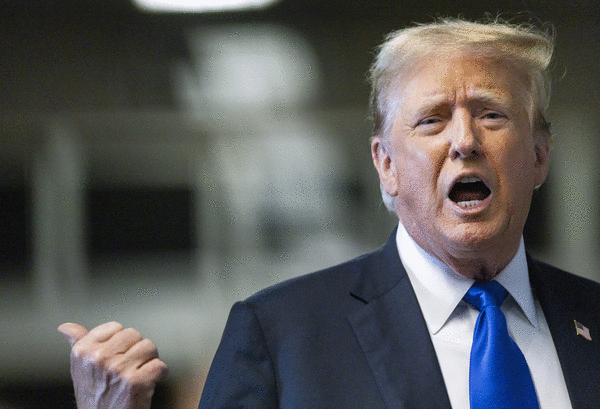
NEW YORK — A Manhattan judge appeared unconvinced by President Donald Trump’s third bid to move his hush money case to federal court at a hearing Wednesday, where his lawyers squared off with Manhattan District Attorney Alvin Bragg’s office.
The renewed bid, if successful, could allow Trump to try to get his historic criminal conviction thrown out on the ground of presidential immunity and fast-track an appeal to the U.S. Supreme Court’s conservative supermajority.
Manhattan Federal Judge Alvin Hellerstein, who reserved decision, appeared unswayed by Trump’s position, saying he’d sought “two bites at the apple” by first trying in state court to get his conviction tossed on account of the Supreme Court’s July 2024 decision on presidential immunity and, when that didn’t work, refocusing efforts in federal court.
The judge said the strategy led Trump to miss the 30-day window to raise the matter federally, without a “good cause” excuse.
Pushing back, Trump attorney Jeffrey Wall contended the president’s legal team had been under the gun with his sentencing fast approaching, arguing “any sensible litigant” would proceed the same way.
“Not so,” Hellerstein said.
“Not so.”
A jury of twelve New Yorkers on May 30, 2024, found Trump guilty of 34 counts of falsifying business records, determining he orchestrated an illegal scheme to sway the results of the 2016 election by directing his then-fixer Michael Cohen to silence porn star Stormy Daniels about a sexual tryst with Trump. He is separately appealing his conviction in state appeals courts.
A month after the verdict, the Supreme Court issued its immunity decision, granting sweeping legal protections to presidents that shielded them from criminal prosecution for actions taken while in the White House.
Trump took that decision to the trial court, arguing it meant that Bragg’s office shouldn’t have been able to present evidence of Trump’s “official acts” and asking Manhattan Supreme Court Justice Juan Merchan to set aside the guilty verdict. Trump argued jurors shouldn’t have heard about conversations he had as president with White House staffers Hope Hicks and Madeleine Westerhout, as well as posts from his governmental social media account taunting Cohen.
When Merchan ruled against Trump, the president took another tack, in August 2024 asking the federal courts to let him move his case there. By that time, Hellerstein said Wednesday, Trump’s right to pursue a federal forum was time-barred.
“That [was] a decision on your part. You didn’t have to do that,” Hellerstein said, calling the strategy “fatal.”
“You made a choice, and you sought two bites at the apple.”
Trump first tried to move his case to federal court in the months after his 2023 indictment. Hellerstein rejected that initial effort, finding evidence overwhelmingly suggested the matter was purely personal, “a coverup of an embarrassing event.”
The Clinton-appointed Hellerstein, 92, remained unconvinced after the immunity decision came down more than a year later, denying Trump’s second effort to let the case proceed on a federal track in September 2024. He said nothing within the decision by the nation’s high court affected his previous conclusion that the hush money payments were unofficial acts.
Trump challenged Hellerstein’s decision at the Manhattan-based 2nd Circuit U.S. Court of Appeals, which, in November, vacated it and sent it back for reconsideration. The appeals court found Hellerstein “bypassed what we consider to be important issues,” but made no recommendation on the right course of action.
On Wednesday, the district attorney’s chief of appeals, Steven Wu, said the case was not about Trump’s official actions, but New York laws he broke in his private life.
Hammering home the point, Wu noted that one portion of testimony Trump was challenging concerned a conversation with Hicks in which he expressed he was “glad the story of the hush money payments came out during the presidency rather than the campaign” because it could have hurt him in voting booths.
“It’s utterly incidental that that conversation happened to take place at the White House,” Wu said.
Wall, from the Sullivan & Cromwell law firm, argued that the DA’s decision to introduce evidence relating to Trump’s time in office was enough to make the case a federal one. He said Trump’s team wanted Hellerstein to adopt Merchan’s judgment, so they could appeal it federally.
The attorney argued the matter of presidential immunity and how it applied in the case “should be decided by this court, then the 2nd Circuit, then the Supreme Court.”
Hellerstein did not indicate when he would rule.
“I’m working all this out in my mind,” the judge said, conceding some of the arguments before him hadn’t “ever been made in any case before.”
The hush money case was the only one of four criminal matters brought against Trump between his presidencies that made it to trial, with the federal cases accusing him of plotting to overthrow President Joe Biden’s 2020 victory and hoarding stolen classified documents dismissed.
He was sentenced to an unconditional discharge in the New York case in January 2025 and formally became a convicted felon 10 days before his return to power.
Among Trump’s first actions as president were appointing his hush money lawyers to the senior-most positions in federal law enforcement.
_____
©2026 New York Daily News. Visit at nydailynews.com. Distributed by Tribune Content Agency, LLC.













Comments