Trump's calls to 'nationalize' elections have state, local election officials bracing for tumult
Published in Political News
President Donald Trump’s calls this week to “nationalize” elections capped a year of efforts by his administration to exercise authority over state-run elections. The demands now have some state and local election officials fearing — and preparing for — a tumultuous year ahead.
“I don’t think we can put anything past this administration,” Oregon Democratic Secretary of State Tobias Read told Stateline in an interview. “I think they’re increasingly desperate, increasingly scared about what’s going to happen when they are held accountable by American voters. So we have to be prepared for everything.”
Ever since Trump signed an executive order last March that attempted to impose a requirement that voters prove their citizenship in federal elections, the federal government has engaged in a wide-ranging effort to influence how elections are run. Under the U.S. Constitution, that responsibility belongs to the states.
Then came Trump’s remarks on a podcast Monday that Republicans should nationalize elections and take over voting in at least 15 places, though he didn’t specify where. In the Oval Office the next day, the president reaffirmed his view that states are “agents” of the federal government in elections.
“I don’t know why the federal government doesn’t do them anyway,” Trump told reporters on Tuesday, despite the Constitution’s clear delegation of that job to states.
Across the country, election officials are watching recent developments and, in some instances, grappling with how the Trump administration’s moves could affect their preparations for November’s midterm elections, which will determine control of Congress. Local election officials say they are considering how they would respond to the presence of federal law enforcement near polling places and what steps they need to take to ensure voting proceeds smoothly.
Several Democratic election officials, and some Republicans, have spoken out. Placing voting under control of the federal government would represent a fundamental violation of the Constitution, they note.
The U.S. Constitution authorizes states to set the time, place and manner of elections for Congress but also allows Congress to change those regulations. The elections themselves are run by the states.
“Oh, hell no,” Maine Democratic Secretary of State Shenna Bellows said in a video statement posted to social media about federalizing elections. Bellows, who is running for governor, said she would mail the White House a pocket Constitution, “because it seems they’ve lost their copy.”
The U.S. Department of Justice already has sued 24 states and the District of Columbia to obtain unredacted voter rolls that include sensitive personal information that it says is needed to search for noncitizen voters. The Department of Homeland Security wants states to run their voter rolls through a powerful citizenship verification tool. Those opposed to the demand say sharing the data risks the privacy of millions of voters. Many fear the administration could use the information to disqualify eligible voters, challenge the legitimacy of a victory in a closely contested midterm election, or use the information to target political enemies.
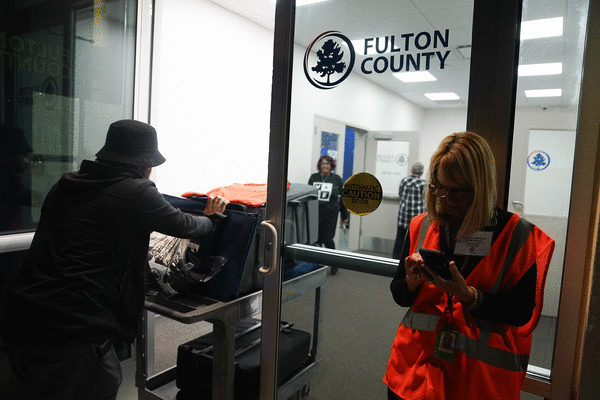
In recent weeks, U.S. Attorney General Pam Bondi linked the presence of federal immigration agents in Minneapolis in part to Minnesota’s refusal to turn over its voter rolls. And the FBI seized ballots from an elections warehouse Fulton County, Georgia — a state that was a central focus of Trump’s push to overturn his 2020 election loss.
“I think it does affect our planning as far as, what if there is some sort of federal law enforcement presence on Election Day or before or after? So that definitely factors into our planning,” said Scott McDonell, the Democratic clerk in Dane County, Wisconsin, which includes Madison.
Ingham County, Michigan, Clerk Barb Byrum, a Democrat running for secretary of state, said she and other election administrators conduct tabletop exercises and keep emergency plans for numerous scenarios. Those used to focus on floods, power outages and cyberattacks.
“Now, unfortunately, it’s turning into the president of the United States meddling in elections,” Byrum said. “We will be prepared. Voters will hopefully not see anything different at their polling locations. … But we need to be diligent.”
Pamela Smith, president and CEO of the election security nonprofit Verified Voting, said election officials and their lawyers need to study up on laws and regulations, including chain-of-custody requirements for ballots.
David Becker, director of the nonpartisan Center for Election Innovation & Research, which operates the Election Official Legal Defense Network, said more than 10,000 lawyers have been recruited who are ready to provide pro bono legal assistance or advice to election officials.
When Stateline asked Read whether he anticipates Oregon facing federal pressure over its voter rolls, the secretary of state said he was set to meet this week with county clerks in the Portland metro area “to talk about that very question.” Read’s office later confirmed the meeting took place.
Oregon’s largest city, Portland, has been a focus of the Trump administration. Last year, Trump deployed federalized Oregon National Guard members to the city after protests outside an Immigration and Customs Enforcement facility. And federal agents last month shot two people in a hospital parking lot. Portland is a self-described sanctuary city that does not aid the federal government in immigration enforcement.
The concern in Oregon comes after Bondi on Jan. 24 sent a letter to Minnesota Democratic Gov. Tim Walz after federal agents killed Renee Good and Alex Pretti in separate shootings in Minneapolis that were captured on video.
Bondi’s letter outlined three “common sense solutions” that would help end the “chaos” in Minnesota, she wrote. One of those solutions called for the state to provide the Justice Department with its full, unredacted voter rolls.
Minnesota Democratic Secretary of State Steve Simon has called Bondi’s letter an “outrageous attempt to coerce Minnesota” into handing over the data. Simon hasn’t provided the voter list, but White House border czar Tom Homan is pulling 700 immigration agents from Minnesota amid outrage over their presence. Roughly 2,300 agents will remain in the state.
In North Carolina, Durham County Director of Elections Derek Bowens called Trump’s rhetoric and recent federal actions concerning. Bowens, a nonpartisan official appointed by the Durham County Board of Elections, said that as long as the rule of law persists, a “constitutional guard” will protect election administration.
Still, Bowens, who oversees elections in a largely Democratic area in a presidential swing state, said he and other local officials are preparing to prevent potential “intrusion” into the process.
“I’m not at liberty to divulge what that would be in terms of security protocols, but that’s definitely in the forefronts of our minds,” Bowens said in an interview, adding that he would be working with local emergency services officials “to make sure we’re positioned to ensure everyone that is eligible has unfettered access to the ballot box.”
Trump wants federal control
Trump appears to be crossing a line from urging Congress to set additional election requirements into wanting the federal government’s hands on states’ election administration infrastructure, said Barry Burden, a professor of political science at the University of Wisconsin-Madison and the director of the Elections Research Center at the university.
“That would be brand new,” Burden said.
After Trump called for nationalizing elections during Monday’s appearance on the podcast of Dan Bongino, a right-wing media personality who was previously a top FBI official, the White House said Tuesday that the president had been referring to legislation in Congress that would require individuals to show proof of citizenship to register to vote. The bill has passed the House but is stalled in the Senate.
But Trump late Tuesday doubled down on his original comments during an unrelated bill-signing ceremony in the Oval Office. He suggested the federal government should take a role in vote counting.
“The federal government should get involved,” Trump said. “These are agents of the federal government to count the votes. If they can’t count the votes legally and honestly, then somebody else should take over.”
Even before Trump’s nationalization comments, Democratic state chief election officials and some Republicans had refused to turn over copies of voter rolls containing driver’s license numbers, date of birth and full or partial Social Security numbers after the Justice Department began demanding the data last spring.
Federal judges in California and Oregon have ruled those states don’t have to provide the data; numerous other lawsuits against other states are ongoing.
Missouri Secretary of State Denny Hoskins, a Trump-supporting Republican who campaigned for office on calls to hand-count ballots, told a Missouri House committee on Tuesday that he wouldn’t provide the state’s full voter list without a court order. He said his office had only shared a public version of the voter rolls; Missouri hasn’t been sued by the Justice Department.
The Trump administration has previously confirmed it is sharing records with Homeland Security, which operates an online program that it uses to verify citizenship. The Justice Department has also offered some states a confidential agreement to search their voter lists.
“Clean voter rolls and basic election safeguards are requisites for free, fair, and transparent elections,” Assistant U.S. Attorney General Harmeet Dhillon wrote in a statement to Stateline.
“The DOJ Civil Rights Division has a statutory mandate to enforce our federal voting rights laws, and ensuring the voting public’s confidence in the integrity of our elections is a top priority of this administration.”
But U.S. District Court Judge David O. Carter, a Clinton appointee, wrote in a Jan. 15 decision that the voter roll demands risk a chilling effect on Americans who may opt not to register to vote over concerns about how their information could be used. He dismissed the Justice Department’s lawsuit seeking California’s voter rolls.
“The taking of democracy does not occur in one fell swoop; it is chipped away piece-by-piece until there is nothing left. The case before the Court is one of these cuts that imperils all Americans,” Carter wrote in a 33-page decision.
Some Republicans oppose nationalization
Amid Trump’s call for nationalizing elections, some Republican election officials have broken with the president even as they have avoided criticizing him directly. State control has long been a central tenant of conservatism, though Trump has challenged elements of Republican orthodoxy over the past decade.
Hoskins, the Missouri secretary of state, told state lawmakers on Tuesday, “I personally don’t believe we should nationalize elections.”
Georgia Republican Secretary of State Brad Raffensperger in a news release on Monday urged lawmakers to focus on strengthening state administration of elections. He said that was better than “moving to federalize a core function of state government.”
Raffensperger, who is running for governor this year, was famously targeted by Trump following the 2020 election to overturn his loss in Georgia. In a phone call, Trump told Raffensperger he wanted to “find 11,780 votes” — the size of his loss in the state. Raffensperger refused to aid Trump.
Five years later, Raffensperger now faces pressure from Georgia state lawmakers to provide the state’s unredacted voter list to the Justice Department. The Georgia Senate on Monday passed a resolution calling on the secretary of state to fully comply with the department’s request.
Georgia Republican state Sen. Randy Robertson, the resolution’s lead sponsor, said during a state Senate committee hearing last month that federal law supersedes limits on data sharing in Georgia law. He didn’t respond to an interview request.
In a statement to Stateline, Raffensperger said that state law is “very clear” that officials aren’t allowed to turn over the information. “I will always follow the law and the Constitution,” Raffensperger wrote.
The Georgia Senate vote came less than a week after the FBI searched the Fulton County elections warehouse and seized ballots. Fulton County, which includes much of the Atlanta metro area, was where Trump was indicted on charges of conspiracy and racketeering related to his efforts to overturn the state’s 2020 presidential election. The case was dismissed last year.
The Justice Department didn’t answer a question from Stateline about whether it plans to seek search warrants for other election offices.
On Wednesday, Fulton County filed a motion in federal court demanding the return of the seized ballots and other materials, Fulton County Board of Commissioners Chair Robb Pitts, a Democrat, said at a news conference. The motion also asks for the unsealing of the affidavit used by the FBI to support its search warrant application.
“We will fight using all resources against those who seek to take over our elections,” Pitts said. “Our Constitution itself is at stake in this fight.”
____
Stateline reporter Jonathan Shorman can be reached at jshorman@stateline.org.
____
©2026 States Newsroom. Visit at stateline.org. Distributed by Tribune Content Agency, LLC.













































Comments