Supreme Court weighs legality of gun ban for drug users
Published in Political News
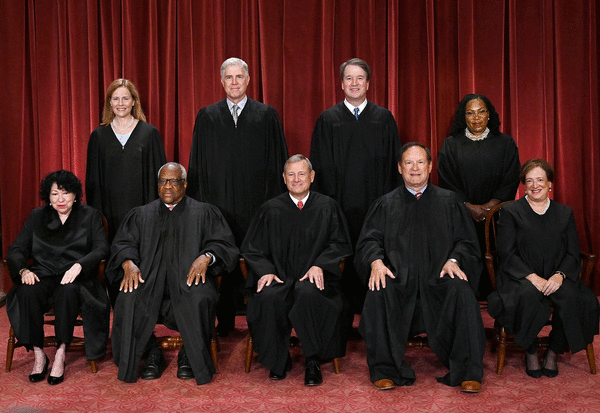
WASHINGTON — The Supreme Court is set to hear arguments on March 2 over a federal law that bans drug users from buying or possessing firearms, the latest in a string of cases where the conservative-controlled court is positioned to reshape gun control laws nationwide.
The Trump administration asked the justices to overturn a ruling from the U.S. Court of Appeals for the 5th Circuit, which found that the law infringed on Second Amendment rights.
The law prohibits anyone who is “an unlawful user of or addicted to any controlled substance” from buying or possessing a firearm.
As the justices decide the case, they could end up making broad pronouncements about Congress’ ability to prohibit categories of people from owning firearms, or a smaller decision about whether, in an era when most states have legalized medical cannabis in some form, the statute is too vague to be enforced.
Eric Ruben, an associate professor of law at Southern Methodist University, said that since the Supreme Court expanded gun rights in a decision several years ago, the justices have not yet ruled on Congress’ ability to prohibit broad categories of people from having guns — the “backbone” of federal gun regulation.
“There’s a question about whether or not Congress has the power to draw categorical distinctions about which people are too dangerous to possess firearms,” said Ruben, one of a group of Second Amendment legal scholars who filed a brief in the case.
The case began when federal agents said they found cocaine, cannabis and a pistol during a search of a home and charged the defendant in the case, Ali Danial Hemani, with violating the law.
The 5th Circuit sided with Hemani and held that the nation’s history did not support disarming sober people based on past drug use. Hemani or other defendants would have had to be under the influence at the time of their arrest with a firearm, the 5th Circuit ruled.
The case is the latest in a series of firearms law cases taken by the Supreme Court since the conservative majority expanded gun rights in the 2022 case of New York State Rifle & Pistol Association Inc. v. Bruen, which held that gun restrictions had to have historical examples to pass muster under the Second Amendment.
Two years ago, the justices upheld a federal gun possession ban for defendants subject to some kinds of domestic violence restraining orders in United States v. Rahimi. The majority in that case said courts can use analogues, rather than exact historical examples, when examining gun restrictions.
Ruben noted that, in the Rahimi case, the majority found the prohibition to be lawful because a judge had made a specific finding that the defendant was dangerous, but the court didn’t decide about the broad categories in current federal law.
Other areas of the same law include a firearm prohibition for felons, undocumented immigrants, dishonorably discharged veterans and others.
“In order to uphold this law, the court would have to approve that broad-brushstroke approach that Congress makes,” Ruben said.
The Justice Department, leaning on colonial-era laws banning “habitual drunkards” from owning firearms, argued in a brief that there’s a long U.S. tradition of prohibiting gun ownership from people who are irresponsible and can be a danger to themselves or others.
“That restriction is temporary and limited: a person regains his ability to possess arms as soon as he stops habitually using drugs,” the DOJ brief said.
The law has also reached a tension point as more states have legalized medical cannabis in some form, and the Trump administration has contemplated rescheduling the drug.
“Indeed, if ‘habitual drunkard’ had been broad enough to encompass anyone who drank beer, wine, or spirits with meals a few days a week, then by the government’s logic much of the Founding generation — not to mention tens of millions of Americans today — could have been deprived of the right to keep a firearm in the home for self-defense,” Hemani’s lawyers argued in a brief.
Cannabis quandry
Several gun violence prevention groups, including Brady, came out in defense of the background check system that includes the substance-use possession ban. Brady’s chief legal officer, Doug Letter, said siding with the 5th Circuit would undermine the purpose of the federal ban on gun possession for people with substance abuse problems.
Police could stop a defendant with a severe abuse problem and a weapon but have no authority to charge them, Letter said.
“That would be a real serious problem just because that person is not right then intoxicated, or if it is a drug, high,” Letter said.
Letter said it would make it difficult or impossible to administer the background check system if the Supreme Court moves away from the broad categories of gun bans into individualized assessments of whether particular people are “dangerous” to society. The current system runs tens of thousands of checks each day, Letter said.
“For that system to work you need to have clear lines. You can’t have ‘Does this person seem dangerous to you?’” Letter said.
Letter, who formerly served as general counsel for the House of Representatives, said it would be a “very serious problem” in Congress if the Supreme Court sided with the 5th Circuit.
Matthew Cavedon, director of the libertarian-leaning Cato Institute’s project on criminal justice, argued that the Supreme Court should limit the law, which currently leaves the specifics of its enforcement up to the Bureau of Alcohol, Tobacco, Firearms and Explosives and the whims of prosecutors.
Cavedon said the Trump administration’s nascent efforts to reschedule cannabis underlines the arbitrary nature of the law.
“Americans have a constitutional right to keep and bear arms. That right cannot be left up to the whims of legislators or bureaucrats,” Cavedon said.
Cavedon pointed out that millions of people across the country use cannabis regularly in states where it has been decriminalized or fully legalized, and that the federal government still considers it a dangerous drug.
“Something like one out of five American adults, according to surveys, have used marijuana in the past year. There’s no way that that many people just casually lose their constitutional rights based on that,” Cavedon said.
Congress has on occasion considered legislation to change federal treatment of cannabis, including in a bill introduced in the 117th Congress that would have provided a carveout to the law for people who use cannabis in states where it is legal. Congress also has occasionally considered legislation to allow banks to provide services to cannabis-based businesses.
“These are the kinds of things that Congress should be doing. They haven’t yet, unfortunately, and so what that means is, yep, now this is going to the Supreme Court, who will decide what to do with this,” Cavedon said.
The justices are expected to issue a decision in the case by the conclusion of the term at the end of June.
The case is United States v. Ali Danial Hemani.
©2026 CQ-Roll Call, Inc., All Rights Reserved. Visit cqrollcall.com. Distributed by Tribune Content Agency, LLC.
















































Comments