How Marco Rubio's reshaping of US foreign policy was forged in Florida
Published in Political News
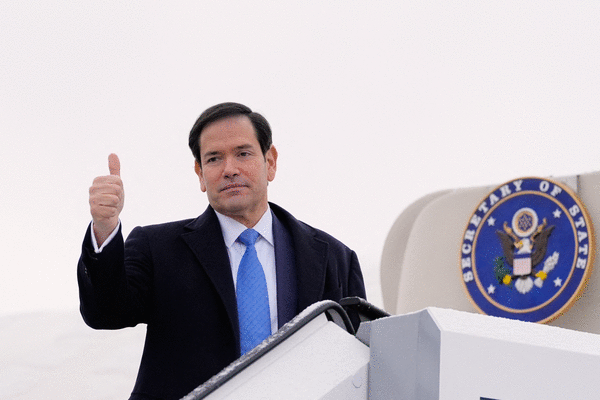
It’s not just that Marco Rubio is eclipsing other Cabinet members in President Donald Trump’s second term.
Or even that he has reignited long-dormant speculation that he could become president.
It’s that Rubio, in little more than a year, is becoming arguably the most consequential U.S. secretary of state in decades by ditching the last vestiges of the post-World War II international order in exchange for regime change and spheres of influence.
The capture of Nicolás Maduro of Venezuela and the bombing of Iran are the latest mile markers of a U.S. foreign policy racing ahead with none of the constraints that tamed global conflict over the last 80 years.
As much as this transformation reflects Trump’s impulsive style, it would be an oversight to ignore the influence of Rubio, 54.
Trump himself characterized the 2003-2011 Iraq War as a “big, fat mistake” and vowed in his campaign that his deal-making prowess would keep America out of wars.
There’s also the “America First” sect in MAGA, populated by the likes of Tucker Carlson and Vice President JD Vance. It opposes prolonged military entanglements overseas and ride-or-die alliances with Israel and Europe in favor of nativism at home and embracing authoritarians abroad.
“This is not the United States’ war, ” Carlson said last week, one of the many conservative commentators to criticize the Iran attack. “This war is not being waged on behalf of American national security objectives to make the United States safer or richer.”
But since January, Rubio’s neoconservative interventionist worldview has been clearly winning over Trump, a nod to skills he honed during his eight years in the Florida Legislature.
The Tampa Bay Times this month spoke to a half-dozen Republican and Democratic legislative leaders who witnessed Rubio’s climb through the state House of Representatives.
“When I heard he got this job, I thought it would suit his skill set,” said Dan Gelber, a Miami Beach Democrat who was the minority leader in the House when Rubio was speaker from 2006 to 2008. “He reads the room exceptionally well. I was impressed by his ability to navigate competing pressures.”
Gelber, who went on to serve as Miami Beach mayor, said he had little, if anything, good to say about the other members of Trump’s Cabinet. “But Marco?” he added. “He’s not easy to dislike.”
Rubio rises in Florida
Rubio arrived in Tallahassee in 2000 as a 28-year-old lawyer whose political experience was as a West Miami commissioner.
With incumbents tossed out for the first time because of the debut of term limits, Rubio’s freshman class was the largest in history, making up more than half of the total 120 seats in the House. Even in that crowd, party leaders immediately saw his potential.
“He could get up and speak about anything without a note in front of him,” said Mike Fasano, Pasco’s tax collector who was then House majority leader. “He had a gift, he still does, of attracting people to him.”
The House speaker in Rubio’s first year, Tom Feeney, said leaders noticed his discipline early. During the 2000 Bush v. Gore legal battle over ballot-counting in Florida that would decide the presidency, state House Republicans limited those who could talk publicly about the recount.
“Marco was one of the few people we trusted,” Feeney said. “He was a good messenger on a very high-stakes issue.”
Having grown up among Cuban exiles and other immigrants in Miami who fled authoritarian regimes, Rubio had another characteristic setting him apart. While most lawmakers come to Tallahassee with parochial concerns, Rubio was contemplating the world beyond.
“Foreign policy in South Florida is a daily issue,” said U.S. Rep. Mario Diaz-Balart, who was in the Florida Senate when Rubio first arrived in Tallahassee. “You have a large Cuban community that’s there because of (former Cuban President Fidel) Castro. You have a large Venezuelan community that’s there because of (former Venezuelan Presidents) Hugo Chavez and Maduro. You have Nicaraguans and Colombians. You can’t live in Miami without living foreign policy.”
It wasn’t until after Rubio rode a tea party wave and beat former Gov. Charlie Crist in the 2010 U.S. Senate race that he threw himself professionally into foreign affairs.
As Florida’s junior senator, he helped author an immigration reform bill that would have provided a path to citizenship for some immigrants living in the country without legal authorization.
It was a confusing time for the GOP. After incumbent Democratic President Barack Obama defeated Republican Mitt Romney in 2012, some Republicans thought the party had to soften its image with Hispanic voters. At the same time, another strain in the party grew hostile toward immigrants. The birther movement, which grew out of Trump’s questioning of Obama’s citizenship, targeted Rubio for a time.
Ultimately, the anti-immigrant passions won out, and Rubio turned against his own legislation.
Frustrated by the gridlock in the Senate, Rubio embarked on a bid for the presidency.
It didn’t end well for Rubio. Looking back, those who admired his equanimity in Tallahassee felt he let himself down by taking potshots at Trump during a 2016 presidential debate.
“If you were to ask him what his greatest regret was, I think he’d tell you it was his ad hominem attack,” Feeney said.
Through a spokesperson, Rubio declined to be interviewed for this story.
Like others who blistered Trump — such as Vance and current Defense Secretary Pete Hegseth — Rubio has since repaired his relationship with the president.
Rubio pivoted that same year and won reelection to the Senate, where he continued to add foreign policy credentials. He saw himself as an heir to Ronald Reagan as he crusaded against communism abroad.
That meant standing up to Russian President Vladimir Putin and supporting Ukraine, siding steadfastly with Israel, and pressuring the authoritarian regimes in Iran, Venezuela and Cuba.
When Trump tapped him eight years later to be his secretary of state, Rubio had become the leading statesman of the Republican establishment.
Balancing act
Almost from his start in Trump’s Cabinet, Rubio seemed intent on ingratiating himself with the president, even if it meant abandoning causes he had supported as a national security hawk.
Overnight, Rubio went from calling Putin a tyrant and championing Ukraine “as long as they were willing to fight” to regarding the Russian dictator as a reliable negotiating partner and the Ukraine war as a stalemate that needed to be settled.
He played enforcer to Trump’s immigration policies, supporting the deportation of people who had fled countries led by communist regimes, such as Cuba and Venezuela.
He oversaw the gutting of $40 billion in annual aid to nations around the world, soft power the U.S. had deployed since World War II on programs like the Marshall Plan to support human rights and counter the pull of communism.
As Rubio rejected the same foreign policy tools and strategies he had once utilized, his former colleagues in Florida theorized that he was playing a long game with Trump of giving America Firsters what they want — up to a point.
“He’s balancing in a way that’s hard to do,” said Feeney, who served in Congress from 2003 to 2009.
“He understands what his role is,” said Diaz-Balart. “The secretary of state doesn’t establish the foreign policy, the president does.”
A consistent hardliner on Venezuela, Rubio received much of the credit for the Jan. 3 military strike that captured Maduro and his wife. The U.S. now controls the country and its vast oil reserves, which it is withholding from Cuba — an embargo that’s further weakening that regime.
During the State of the Union a month later, Rubio was the only Cabinet member Trump mentioned and complimented. The president suggested history will regard Rubio as the best secretary of state. The rest of his Cabinet, meanwhile, is in turmoil. Trump’s firing this week of Kristi Noem, his Homeland Security secretary, could be the first in a string.
“My guess is that (Rubio) has tremendous credibility with the president at this point,” said Tom Lee, who was Florida Senate president when Rubio was two years from House speaker. “He’s the star of the Cabinet. Unlike others in the administration, he’s not a cheerleader. He’s supportive, he steers the ship, but he lays low and defers to the president.”
Fasano said the key is what Rubio doesn’t do.
“Hegseth attacks people,” he said. “When did you see Marco do that? He’s been really quiet, but I’d say over the last few weeks, he’s become the most influential Cabinet member.”
The Iran bombing, which killed Ayatollah Ali Khamenei, was viewed as another triumph for Rubio, even as it drew more fire from those on the right suspicious of nation-building.
“With this Iran thing, I don’t see how the math works in our favor,” said Matt Walsh, a conservative commentator and self-described American Firster, in an X post. “Or at least it seems highly unlikely that it will work in our favor. And so I’m against it.”
For now, at least, Rubio has a growing record of foreign policy wins.
“It was a stunning 10-out-of-10 success with Venezuela,” said Patrick Hulme, a foreign policy professor at the University of Florida. “Nobody killed. You get Maduro in a crazy risky raid. From that, Rubio gets more trust from the president. You could draw a direct line from the Maduro raid to the Iran attack.”
But the risks are great and, with no clear succession plan or long-term strategy of what comes next, the Iran war could easily slip into a quagmire or intensify into an expanded conflict, Hulme said.
“If this Iran invasion goes south, who knows?” Hulme said. “You can see Trump saying, ‘This Rubio guy pushed me into this,’ and gets rid of him. But if it goes well, success builds upon success, and we’ll be in Cuba by the end of the year.”
©2026 Tampa Bay Times. Visit tampabay.com. Distributed by Tribune Content Agency, LLC.


Comments