Mexico rejects electoral bill, Sheinbaum's first defeat in Congress
Published in Political News
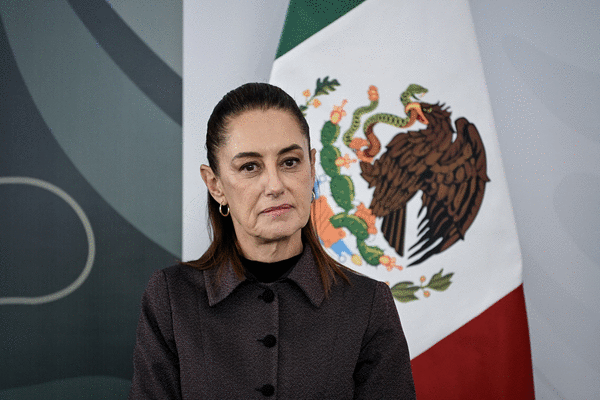
MEXICO CITY — President Claudia Sheinbaum’s attempt to overhaul Mexico’s electoral system fell short of the needed support for approval in the lower house of Congress on Wednesday, marking the first legislative setback in her agenda of priority reforms.
The bill garnered 259 votes in favor, 234 against and one abstention, but well short of the two-thirds vote needed for passage of a constitutional reform, after an unusually short legislative debate.
Sheinbaum has criticized what she sees as excessive spending on elections and political parties, while critics including from a pair of smaller parties within her ruling coalition argued the proposal amounted to a power grab.
The reform package would have cut government funding for election authorities and parties by 25%, while eliminating the 32 senators selected based on a long-standing proportional representation scheme. It also sought to change the rules for electing lawmakers by proportional representation in the lower house.
Opponents of the reform argued that changes to the proportional representation system posed particular risks to the country’s democracy by helping Morena further strengthen its already dominant role in Mexican politics.
The rejection of the long delayed reform came as little surprise, given that in recent weeks the allies of the ruling Morena party had made it clear that they wouldn’t endorse the changes. They strongly rejected any reductions in public funding and the prospect of fewer seats in Congress. Morena alone doesn’t have the two-thirds majority needed to amend the constitution.
Ricardo Monreal, Morena’s leader in the lower house, acknowledged even before the reform was first introduced in Congress about a couple weeks ago that he had no hope of approving it. He urged everyone to move on.
“We will not achieve a super majority, and I am neither a magician nor an alchemist, I am a realist,” he told reporters last week. “We must conclude the process, whether good or bad, successful, approved or not, but turn the page and move on to other legislative instruments that can actually benefit us.”
The overhaul of the electoral system had long been championed by Sheinbaum’s predecessor and mentor, Andrés Manuel López Obrador, who, despite being very popular, was never able to get it approved. Lopez Obrador, known as AMLO, insisted that institutions like the Supreme Court or Mexico’s INE electoral authority were thwarting democracy rather than protecting it.
AMLO’s animosity toward the electoral authority dates to his his narrow loss in the 2006 presidential and his bigger defeat in 2012. He won legislative approval for an electoral overhaul that slashed INE’s budget in 2022, but it was later blocked by the Supreme Court as unconstitutional.
During discussion of the reform on Tuesday night, allies of the ruling party warned that they could not support it, arguing that further changes were needed for both large and small parties to benefit.
Last year, Sheinbaum formed a special commission to draft an electoral reform proposal, headed by leftist Pablo Gómez, a divisive figure even within Morena. After months of work, the commission failed to present a bill acceptable to the coalition’s allies and the president took it upon herself to finalize it.
A Significant Defeat
“The defeat is significant because it highlights that the legislative coalition has limits, something that perhaps seemed unthinkable a few months ago, and that Morena did not negotiate well enough before presenting the initiative,” said Arantza Alonso, an analyst at risk intelligence company Verisk Maplecroft.
But Alonso thinks the legislative defeat won’t affect Sheinbaum’s governing agenda going forward. “The reform is not directly related to issues that matter greatly to citizens, like security, the economy or the relations with the U.S., so Sheinbaum’s approval won’t be significantly affected.”
At their most recent assembly, Morena leaders touted the electoral reform as a legislative priority, but cautioned that it shouldn’t come at the expense of the coalition’s survival ahead of next year’s midterm election.
“Perhaps it’s more important for the coalition to remain united and think about the 2027 midterm elections than to push through a reform that will divide its allies,” said Juan Carlos Villarreal, a political scientist at the Autonomous University of Mexico State.
Days ahead of the voting, Sheinbaum herself began to address the possibility of a rejection of the reform, saying that she did her job by sending a bill and it was the legislators themselves who weren’t willing to give up privileges.
“It is now up to each legislator.” she told reporters on Wednesday. “I am very satisfied to have submitted the initiative, I am fulfilling a commitment I made to the people.”
As with other reforms rejected in the past, especially during AMLO’s administration, Morena lawmakers are already talking about a fall-back plan. Sheinbaum herself confirmed hours before the final voting in the lower house that after the outcome she will present other initiatives.
“Success is not final, failure is not fatal, and we will continue to stand up for democracy,” Monreal said during the debate. “Ideas that come from the people eventually become law sooner or later.”
©2026 Bloomberg L.P. Visit bloomberg.com. Distributed by Tribune Content Agency, LLC.



















































Comments