Matthew Boyd's 1st opening-day start with Chicago Cubs ends early in 10-4 loss to Washington Nationals
Published in Baseball
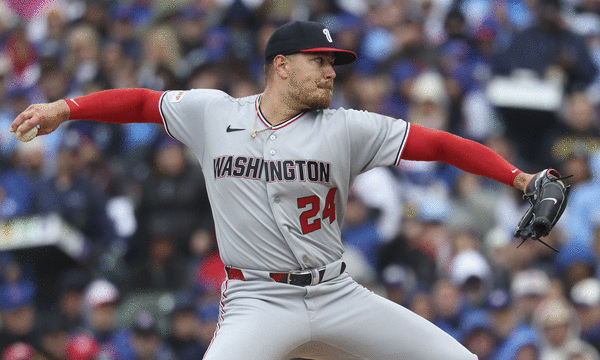



CHICAGO — Two hours before throwing the first pitch of the Chicago Cubs season, Matthew Boyd found a spot along the dugout railing at Wrigley Field.
For 10 minutes, Boyd took in the scene as the flags whipped above the center-field scoreboard, Cubs infielders took grounders and stadium workers finished final preparations before 39,712 fans streamed into the ballpark. It’s not uncommon for Boyd to make the trek from the clubhouse to the dugout on his start day for solitary reflection and embracing the environment.
Getting his first opening-day start with the Cubs made Thursday’s pregame journey to the home bullpen under the left-field bleachers extra special. Despite the cool, windy elements, the Wrigley vibes set the stage for what is expected to be another playoff season for the Cubs.
“I think last year was really good for them,” president of baseball operations Jed Hoyer said Thursday. “They had a great season, but it ended in a bitter way and they spent the whole winter thinking about it and talking about it. And sometimes that’s the best catalyst for a good season is the disappointment of the year before at the end but also the confidence that the season gave them. So I think that combination is really powerful, and I can kind of feel that with this group.”
For three innings against the Washington Nationals, Boyd pitched like the veteran who earned his All-Star honor a year ago. He struck out seven of the first 10 batters he faced through three innings — then the game got away from Boyd. The Nationals tagged him for five runs in the fourth, and the Cubs’ lack of timely hits off starter Cade Cavalli and the Nationals bullpen doomed them in a 10-4 loss.
Through three innings, Boyd produced 16 whiffs, tying the most he had in any start last season. But he lost command of his four-seam fastball in the troublesome fourth, struggling to stay behind the baseball, which led to too many over the middle of the plate for the Nationals to do damage against.
“Honestly, I just needed to make an adjustment faster and I wasn’t able to,” Boyd said. “That’s kind of the story of the game, unfortunately. That was the difference-maker, gave them a big enough lead to kind of roll with it. And that’s just on me.
“The energy out there was great. It’s so fun to be back at Wrigley, and the fans are electric, the energy that they bring. It was a real special day regardless of the results.”
The Cubs finished 4-for-19 with runners in scoring position and left nine on base. Alex Bregman collected his first hit as a Cub with a single in the seventh.
“You’re going to your bullpen in the fourth inning, some bad things have happened if that’s the case, and that was the case,” manager Craig Counsell said. “We were in the game a little bit with all the runners on base we had every inning … the next hit was kind of missing.
“Obviously you’re down a little bit, you’ve got to string together a rally, we just never could do that.”
The Cubs briefly took a 2-1 lead in the third thanks to RBI singles from Michael Busch and Pete Crow-Armstrong, who combined for five of the team’s eight hits. The Nationals immediately responded with their barrage in the fourth against Boyd and right-hander Ben Brown with a six-run frame that the Cubs struggled to chip away at.
Busch became the first Cubs hitter to reach base safely at least four times and record two or more extra-base hits on opening day since Kosuke Fukudome on March 31, 2008.
An opening-day loss doesn’t define the trajectory of a season. The Cubs know there are lofty expectations, externally and internally, and they inherently will face challenges over the course of the next six months.
“There’s nothing you can do or say that’s going to make it go away, people can read the projections, they can see the players on the field, so you can’t make it go away,” Hoyer said. “You might as well go the other direction and really embrace it and realize that the reason people are saying that is because people think we’re good. I think our team thinks we’re good. It can really kind of fuel a team that has those expectations that they want to live up to them, and they want to come to the ballpark every day to prove people right so it’s a positive.
“What’s the flip side of it? You can’t always be the gritty underdog that overachieves and after you’ve won and we have a lot of talent, you’re going to be facing real expectations. I think that’s a great thing.”
_____
©2026 Chicago Tribune. Visit at chicagotribune.com. Distributed by Tribune Content Agency, LLC.





Comments