Mike Moser's unique road to Nuggets coaching gig, from family of adoptees to international journeyman
Published in Basketball
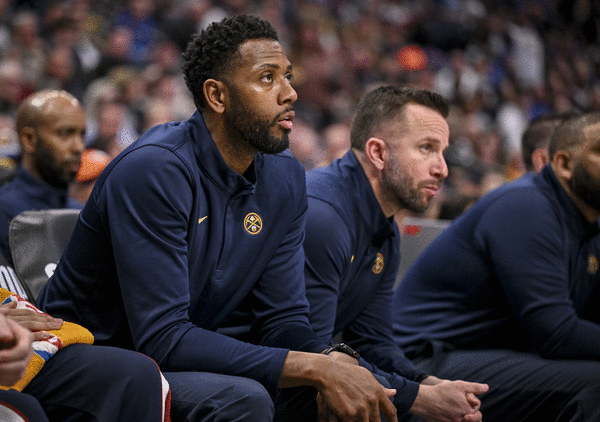
DENVER — Lizzy Evans’ view of her big brother is clearer than ever this year. When the Nuggets are on TV, her focus is at the top of the frame, where she can usually spot him on Denver’s sideline. Beaming, she takes photos of him through the screen. He’s easier to find now that he’s in the foreground.
“He’s on the front of the bench!”
Mike Moser might be the least instantly recognizable of David Adelman’s new assistant coaches this season, next to longtime NBA players like Jared Dudley and JJ Barea. But that’s only because his road to Denver was a little less conventional, requiring a little extra perseverance.
“I think he always had coach qualities in him. He’s so positive. He’s always finding a silver lining in everything,” said Tasha Schwikert Moser, his wife and a former Olympic bronze medal-winning gymnast. “Any team he’s been on, as a coach or player, when he walks into the room, there’s just this energy he brings, and it permeates the room. It impacts his teammates. It impacts his colleagues. It’s motivating, right? I tell him all the time, you can’t teach that. It’s just in you. People want to be around him.”
Most recently, the 35-year-old Moser worked on Ime Udoka’s staff in Houston until Adelman, another fellow Oregonian, offered him a step up last summer — his first front-of-bench coaching job in the NBA. He’s been assisting Dudley with the Nuggets’ defense this season and working closely with players, who speak highly of his vibrant personality. (Just this week, Cam Johnson credited him as one of the people who’ve kept instilling confidence in him amid a slump.)
A rising star in Portland
Before he entered the coaching ranks, though, Moser came from a tight-knit family of adoptees in Portland, Ore., and a journeyman playing career overseas. Born in Dallas, he was adopted and relocated to Portland by Jeanne Moser when he was a month old. Jeanne was a single mom at the time, but she raised five adopted children with help from her sister. They all came from different backgrounds. Moser grew up around siblings from Haiti, Mexico and Brazil.
“It’s such a unique situation,” Lizzy said. “I’ll be 30 next month. You go into the adult world and you start meeting other people and talking to them, and I’m still like, I’ve never really met a family like mine.”
They hung out at Roses Ice Cream, a local family business owned and operated by Jeanne. It had originally belonged to her parents. In 1997, the place shuttered, but she endeavored to bring it back a decade later in northeast Portland. She gave it a second life for a few years before it closed again, selling burgers and shakes in cozy confines with help from her children and other relatives. Posters of the “Michael,” the rising star athlete of the family, were plastered on the walls.
Throughout middle school and high school, his schedule was so packed with basketball games and practices and camps that he got out of working shifts. “But one thing about Michael,” Lizzy said, laughing, “is he was there eating.”
He was the celebrity on the walls and the most loyal customer in the establishment. Most Division I recruits hold signing day ceremonies at their high schools to announce their college plans. Moser signed to play at UCLA while he was at Roses.
He made vital future connections while making a name for himself at Grant High School, winning a state title in 2008. He was a top player on the AAU team founded by Udoka, a local mentor. One of his rival high schools was coached by Adelman. “We had some really good battles back in the day,” Moser said. “He loves to trap people. He would trap the hell out of me. So occasionally, they would sneak out a win.”
An international journey
Moser had dreams of playing in the NBA. Injuries interrupted them. After a strong 2011-12 season at UNLV, he decided to stay in school one more year rather than take his chances in the draft. “I suffered an injury that kind of messed up my ability to shoot for the next year,” he remembers. He got to be part of an NCAA Tournament team that season alongside No. 1 overall draft pick Anthony Bennett, but his shooting splits declined. He transferred for the second time in 2013, picking Oregon, “and I spent the next year trying to prove I could shoot and could play again.”
Moser found his way into a Summer League deal with the Boston Celtics after going undrafted out of college. He played well with Marcus Smart and Kelly Olynyk, earning a training camp invite. He turned it down. The money was better overseas than it would be in the NBA D League. He signed a contract in Lithuania, beginning a five-year career of hopping from country to country.
“Eastern Europe was very interesting. I thought, ‘Oh, I’m gonna go here and dominate.’ And that was absolutely not the case,” Moser said. “I’m a tempo guy. I like getting up and down. And this was a very slow, old-school, methodical. Throw it in the post. Split action. Not too different from how we play (in Denver) now. … Eastern European coaches tend to be a little tougher than the West, that’s for sure. Funnily enough, some Serbian coaches.
“I had multiple coaches that didn’t speak any English. … Maybe your teammates would help. But sometimes they wouldn’t, because you’re coming for their spot, and they weren’t really interested in helping you take the food off their family’s table.”
In the absence of direct translation, Moser learned to abide by the universal languages of basketball and anger.
“I remember thinking, ‘I don’t know what we’re doing. I don’t know what’s going on. I just know I get yelled at when I do this, and I get yelled at when I do that,’ so stay away from those things,” he said, laughing.
Back in the U.S., he and Tasha were starting a life together. They had met at UCLA, where he rode the bench for a year and Tasha was an NCAA champion, then started dating a couple of years later when they crossed paths again at UNLV. Tasha was in law school, so she couldn’t follow him to Europe. After the first year of long-distance, he proposed.
They were in and out of long-distance for the first few years of their marriage, as she began her law career and he played stints in Israel, Finland and France. Training camps for most of his teams were held in late August or September.
“I usually would skip that and just take the fine, just to be home,” Moser said. “And you’d hop back around Christmastime. Maybe there would be a break in between if you were lucky, with the FIBA windows. … But she was doing all that, getting her education, navigating being a first-time mom, having her husband on the other side of the world. So that was hard.”
He was still trying to find a path toward an NBA career. One offseason, he played Summer League with the Atlanta Hawks. Another, he went to Phoenix for a training camp opportunity, only to tear his meniscus there. He suffered an ACL injury back in Europe, adding to the sense that he might be out of luck.
Ironically, it was Tasha who talked him into prolonging his career one more season in 2018, when they were juggling two children in Las Vegas.
“The season before — at that point, he’d had the two knee surgeries — he was like, ‘I feel like I’m in pain all the time, and it’s starting to become not fun,'” she recalled. “‘And you and the kids are back in the States. Going back and forth is tough. I feel like I’m missing all the moments and all the firsts.’ I remember sitting down with him. I was like, ‘Look, right now you have an injury and you’re in pain, and it’s easy to say you’re done because you’re going through a low time, a lull. But you need to call it quits when everything is going good. Because I don’t want you at 35 or 40 to have regrets that you didn’t keep going and finish on your own terms.'”
Moser took her advice. He signed on for one more year in Bourg-en-Bresse, France. His health didn’t abandon him this time. He played well. About halfway through the season, Tasha remembers him telling her, “I think I’m ready.” He was more at peace with it. A possible career in coaching was on his mind. Udoka was an assistant in San Antonio at the time, eager to help Moser get in the door. He applied online for a player development job with the Dallas Mavericks instead to land his first NBA gig.
“He had this thing. He was strong on, ‘I want to get the opportunity myself,'” Tasha said. “He knew he had connections, but ‘I want to say I started out on my own.’ … He was proud of that.”
Moving up the coaching ranks
It was the beginning of another nomadic half-decade that led him to Denver. Moser lost his job in Dallas when the pandemic hit. He forayed into women’s college basketball, joining the staff at Oregon. A week after he moved his family there, Udoka tried to hire him in Boston. “Tasha said call back in a year,” Moser told him. Udoka did, finally uniting them. Only another Portland hoops figure could eventually pull Moser away from Udoka in Houston.
“I knew Ime since I was 14 years old. I think I met DA when I was 16. … These guys were pouring into the city and pouring into kids,” Moser said. “If you look around the league, there are a lot of coaches from Portland, a lot of players from Portland. We’re not a huge city. We’ve just got a lot of people that really care.”
Moser wants to pay it forward in the same community. While he was playing overseas, he also briefly started a nonprofit to run basketball camps for underserved youth in the city. It didn’t last long, but Tasha said they’d love to try again someday when they have more time to put into it.
Lizzy still dreams of reopening Roses eventually. It’s been more than a decade since it closed for the second time. Jeanne Moser died in 2024. The adoptees she brought together are still close. “I grew up with kids I didn’t know, but today, I call them by brothers and sisters,” Moser said. He and Lizzy still go on trips together when they have time.
Tasha and the children (now three) remain situated in Houston, where she’s an associate AD leading name, image and likeness advancement at Rice University. She had just started the job a couple of months before the Nuggets hired Moser. “He’s living his dreams,” she said, “being an NBA coach.” He’s been getting weekend visits.
He knew what he was signing up for. He’s been a journeyman before. And the commute from Las Vegas to Lithuania is a little easier than it used to be.
____
©2026 MediaNews Group, Inc. Visit at denverpost.com. Distributed by Tribune Content Agency, LLC.






Comments