Sam McDowell: There is one party most responsible for the Chiefs' move to Kansas
Published in Football
KANSAS CITY, Mo. — On an early February morning in 2020, hundreds of thousands of people flocked to downtown Kansas City, single-digit wind chills be damned, to converge on a celebration they’d been waiting a lifetime to enjoy.
They arrived from all walks of life, those young and those old, those rich and those poor, those Black and those white, those hailing from Missouri and those from Kansas, but they had a commonality.
They wore red.
They were there for the Chiefs.
It might have been their only commonality. But in Kansas City, that’s always been enough.
For a half-century, the Chiefs have transcended what separates us.
On Monday, they drew the line themselves.
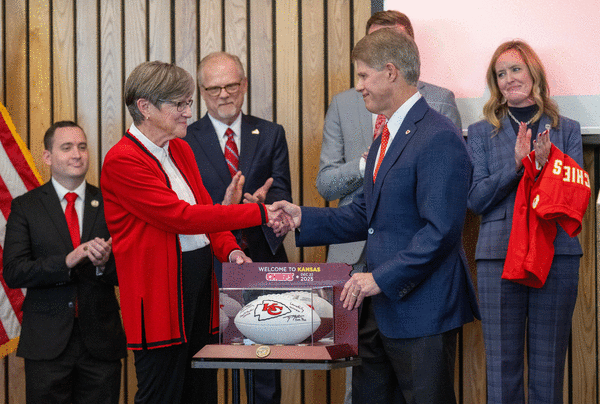
The Chiefs are packing up and moving across the state line to Kansas — where a $3 billion stadium, $300 million practice facility and fancy team headquarters await. At long last, they have put an end to a years-long conversation that for the past 18 months strategically and intentionally pitted the home states, cities and counties of their fan base against one another.
It literally pitted one Kansas City against another Kansas City.
The Chiefs held hostage the community’s most prized asset for more than a year after running an unsettling campaign built on threatening those who supported them most. And on Monday, they recouped for it the most luxurious reward this community has ever offered. The state of Kansas, with its supercharged STAR bonds program specifically designed for such an occasion, will provide 60% of the funding for the projects, which adds up to nearly $2 billion in public money.
Somewhere in Wyandotte County, Kan., the Chiefs plan to build a domed stadium, capacity north of 65,000, but probably not much north of it, with a blueprint to use a spectacular new venue to lure Final Fours, college football playoff games and perhaps even a Super Bowl.
It will sit 19 miles but a world away from Arrowhead Stadium, the place they call home but their fans consider closer to a sanctuary.
The house that Lamar Hunt built will come crumbling down, 50-some years of memories along with it, the bill for its demolition sent to Jackson County, Mo., where the first stage of grief is apparently finger-pointing at how anyone could let such a thing happen.
But whatever you think of this decision — a bright and glitzy future or the bulldozing of a storied and connected past — let’s be abundantly clear about who is responsible for it.
The Chiefs.
And let’s be abundantly clear about why they made this decision.
Money.
The offer from the state of Kansas included more cash, and a more obvious and easier path to it, and the Chiefs made a business decision to take the bag. That’s what team president Mark Donovan bluntly called it — a business decision. The leaders in Missouri understand that, he said.
The Chiefs are most certainly entitled to make a business decision, but they’re less entitled to suggest that their proposed $700 million mixed-used district in Olathe that sends them the profits will turn citizens into the “beneficiaries,” as owner Clark Hunt framed it.
Those are not beneficiaries. They’re called customers.
And they’ll have to spend time winning some of them back.
Considering the pushback from educated economists that is sure to follow the jobs and financial estimations Kansas touted Monday, there is but one unquestioned beneficiary.
The Chiefs.
And they took a remarkable ride to get there.
After Jackson County voters turned aside their half-assed renovation project, the Chiefs ran a master class in turning a family of billionaires into those standing on the street corner with their pockets out. The scene in Topeka on Monday opened surreal in nature: The Chiefs officially secured $2 billion in public funding, and then entered the news conference to a rousing standing ovation as some sort of appreciation for accepting it.
If we could all be so lucky.
They left the other side of State Line Road arguing that the Missouri politicians, who attempted to package together an offer surpassing $1 billion earmarked for a team valued at $6.2 billion, weren’t doing enough.
Sorry, but when did we decide to grade and vote for our elected officials based on how sweetheart of a deal they offer our resident billionaires?
The Chiefs had a complicated but compelling offer to remain at Arrowhead Stadium, if that’s truly what they desired. They aren’t required to desire it, at least not more than $2 billion for a shiny new object. The Missouri offer was less lucrative and required still more work, but it was compelling. Actually, Donovan called it “unprecedented,” even.
They chose not to take it. They determined unprecedented wasn’t enough.
They were not shoved out the door by their landlord and left to find another place to live. They kicked the door down themselves and stormed out, suitcase in hand, with barely a courtesy heads-up to those they were leaving behind.
The state of Missouri interrupted summer vacations for a special session specifically targeted to respond to the Kansas STAR bonds legislation — and both legislative branches passed the bill. For all the hurdles to finding support at the Jackson County level, its nine-member legislature still put the Chiefs’ and Royals’ combined measure on the April 2024 ballot weeks before they even had leases or community benefits agreements written. The city got involved despite having no ownership over the existing asset itself.
There is this noise, if not prevailing sentiment, that the Chiefs gave Kansas City, Jackson County and the state of Missouri a chance to keep them. No, the taxpayers gave the Chiefs a chance to produce something that would inspire them to vote in their favor. And the Chiefs instead returned unimaginative upgrades to a tailgating experience that fans have already figured out pretty well on their own.
After 58% of voters denied that packaged deal with the Royals, the Chiefs got what they really wanted: a bidding war that encouraged everyone else to pick a side and forget they brokered the battle in the first place. It turned out that no matter what, both sides of the coin would come up Chiefs.
Kansas Gov. Laura Kelly had the, uh, creativity to suggest that swiping the Chiefs from Missouri didn’t violate any sort of border war truce. But the 18-month battle leaves behind winners and losers, a literal state line between them.
The Chiefs organization, at least until recently, hasn’t been a stranger to providing heartbreak. But those in the stands at least felt that together. They won together, and they lost together.
The repercussions of Monday’s announcement are no longer about we. They have sparked a passionate argument among their own.
Some are celebrating what a new stadium could bring. The Chiefs are promoting it as a community asset. It probably will be. It opens new opportunities.
But some people are hurting right now. Some who built lifelong relationships inside Arrowhead. Some who cherish the connections to those they’ve lost. Some who married there. There is real meaning inside that place, even if they know no good thing lasts forever.
In its destruction, the Chiefs will have to repair a frayed relationship with those who considered the stadium’s location in Missouri part of their identity.
Clark Hunt said he’d top the list of those who will miss the place. That could be true.
About six hours after he spoke in Topeka, the State Capitol remained illuminated in Chiefs red — the same color that has packed Arrowhead Stadium for a half-century.
Kansas won the war its governor says didn’t exist.
Missouri lost another NFL team.
But while we’re distinguishing the winners and losers once more, let’s add something else to the list.
The money won. It always wins.
And so do those already flush with it.
©2025 The Kansas City Star. Visit kansascity.com. Distributed by Tribune Content Agency, LLC.





Comments