Brad Biggs: Finding edges in the running game fuels Ben Johnson's evolution of the Bears offense
Published in Football
CHICAGO — Offensive play callers have been dubbed innovators, gurus or geniuses over the last couple of decades for their ability to develop intricate passing attacks.
It has put many of those designers on the fast track to head coaching opportunities as many teams searching for their next leader are on a quest to find the next great quarterback whisperer.
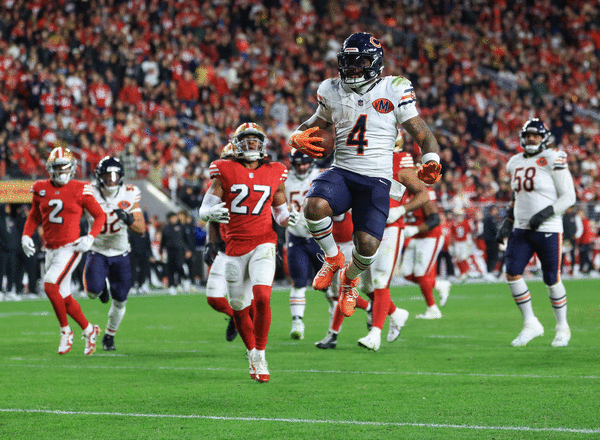
The Chicago Bears landed on Ben Johnson last January, and he has been lauded for his work developing Caleb Williams in Year 2 while instilling a running game that ranks third in the NFL entering the final weekend of the regular season and might be the thing that truly has given the offense an edge and identity.
In the always evolving world of the NFL, things have swung back around to power football for some teams, the Bears for sure, and the team’s ability to make a deep run in the playoffs could be based on the ability to win with the offensive line and ground game.
It’s all about matchups, and while the Bears have a trio of exciting and talented wide receivers — Rome Odunze, D.J. Moore and rookie Luther Burden III — they also have remarkable versatility with tight ends Cole Kmet, rookie Colston Loveland and even Durham Smythe.
The adaptability of the skill-position players allows Johnson to dictate matchups and create advantages both on the ground and through the air. Go back to the Week 10 meeting with the New York Giants at Soldier Field when the Bears were first-and-goal at the 8-yard line midway through the first quarter.
Kmet was the tight end in 11 personnel (one running back, three wide receivers, one tight end), and the Giants countered by bringing nickel cornerback Dru Phillips on the field. When Kmet lined up as a fullback in the backfield, that brought Phillips into the box.
On the weak side iso run to rookie Kyle Monangai, the 6-foot-6, 257-pound Kmet easily put Phillips (5-11, 180) on the seat of his pants, clearing a path on the right side for a touchdown.
“In today’s NFL, everyone is looking for advantages in the passing game,” Kmet said. “But the big advantages and ways to get an edge are in the run game. I really believe that.”
The 250-pound linebackers that used to roam the middle of the field are endangered species. They’ve been replaced by leaner, faster linebackers with better coverage skills. On most downs, defenses are in some sort of sub package with an extra defensive back, whereas 20 to 25 years ago defenses lived with three linebackers on most downs.
“You have to be faster,” said Bears linebackers coach Richard Smith, who has coached the position for most of his 37 seasons in the NFL. “It’s a faster game. There aren’t any more 250-pound headbangers.”
When Johnson was hired, he brought with him a motto that was used in Detroit for wide receivers: “No block, no rock.” That was his way of letting wide receivers know they were crucial to the success of running plays. With a versatile trio of tight ends, the Bears can do a lot. Kmet and Loveland are skilled enough as wide receivers to make 13 personnel (one running back, three tight ends, one wide receivers) look like 12. They can make 12 personnel look like 11. Or they can line up and play old-school, smashmouth football.
And if you recall something Johnson said before the kickoff of the season, that is what really gets him juiced.
“I’ve got an affinity more so for the run game than what people might realize,” Johnson said. “I spend more time and I dabble in that maybe more than I do the passing game.”
The Bears tormented the Philadelphia Eagles defense three weeks after the win over the Giants, rushing for 283 yards in a 24-15 demolition on Nov. 28 at Lincoln Financial Field. They ran the ball 47 times, the Bears’ most in a non-overtime game since Dec. 14, 1991.
Johnson threw the kitchen sink at Eagles defensive coordinator Vic Fangio with an array of unique ways to used the tight ends to trap, lead and insert, creating a variety of two-back sets. The Bears routinely got numbers to the play side and employed motion and misdirection to create hesitation at the second level for a good group of Eagles linebackers.
“With some of the bigger linebackers, the advantage was in the pass game because those guys couldn’t cover,” Kmet said. “Well, a lot of those guys can cover now if you are continually going after them in the run game, people don’t like that. It takes a disciplined play caller to stick with it like Ben, whereas a lot of other play callers, they want to throw it.”
Former Bears wide receivers coach Todd Haley, who had highly successful stints as the coordinator in Arizona and Pittsburgh and had the league’s top-ranked rushing offense when he was the head coach of the Kansas City Chiefs, marvels at what Johnson has done with the Bears ground game.
“We know the league is cyclical and college football kind of forced it into more spread offenses because of what they’re running and the bodies coming out of college,” Haley said. “The biggest thing to me, even with the Bears, is they have gotten under center. That’s the key. If you can get under center and run downhill, that brings play-action. You can’t get a real fake when you are in the shotgun and the back is sitting next to the quarterback. That does nothing to affect linebackers. It doesn’t help the offensive line because they are skating sideways all the time.
“It’s definitely come back to a little more power football, and under center and that’s a huge thing. You ask any defender would they rather see the quarterback in the gun or under center, he’s going to say in the gun because it just puts him such a bigger conflict of assignment. Do you you come downhill? Now, if you’re going to take a step, that opens up everything in the middle of the field.”
Haley said once an offense can establish the run — or a legitimate run threat — the defense is on its heels. He said the demise of Sunday’s opponent, the Detroit Lions, can be traced to the offense’s struggle to run the ball in the second half of the season. The Lions ranked sixth in rushing last year with Johnson calling plays, and with struggles on the interior of the offensive line, the Lions have dipped to 15th. They have totaled 74 rushing yards or less in four of their last seven games.
“All of a sudden, the Lions became a pedestrian drop-back passing offense that is average,” Haley said.
The Bears have been versatile all season. To Haley’s point, they’ve run 49.6% of plays under center, the fifth-highest percentage in the league behind the Los Angeles Rams (59.7%), Seattle Seahawks (55.8%), 49ers (50%) and Buffalo Bills (49.8%). The Bears have run 328 plays with 12 personnel (31.2%), the fifth-most in the league, and 83 in 13 personnel (7.9%), also the fifth-most.
D’Andre Swift enters the regular-season finale with 1,047 yards, and Monangai has 769. If Monangai gets 31 yards against the Lions, it will mark the first time the Bears have had two 800-yard running backs since 1978, when Walter Payton had 1,395 and Roland Harper 992.
Williams, who has 3,730 passing yards, is closing in on Erik Kramer’s franchise record of 3,838 and has a decent shot at reaching 4,000 against a depleted Lions secondary.
The foundation of what Johnson has installed is based on the ground game and the many ways the Bears can get after opponents running the ball. It’s the thing that is fueling a rush to the postseason. It might just be genius.
____
©2026 Chicago Tribune. Visit chicagotribune.com. Distributed by Tribune Content Agency, LLC.





Comments