Next stop Hammond? Indiana lawmakers approve Chicago Bears stadium bill, taking a big step.
Published in Football
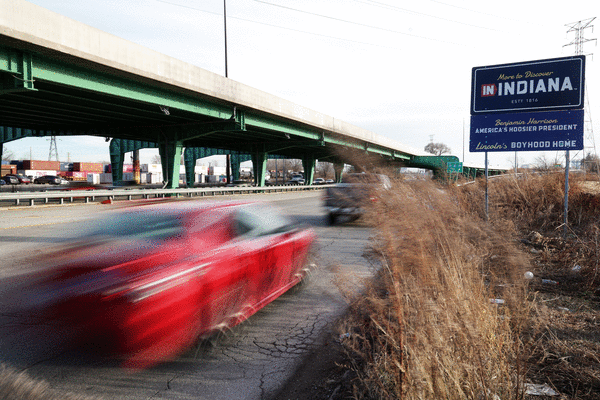
CHICAGO — Indiana lawmakers took another step Thursday toward potentially luring the Chicago Bears to the state, as a key committee approved a plan to create an agency that would build a new stadium for the team.
The Indiana House of Representatives Ways and Means Committee, which oversees state spending, voted 24-0 to establish a northwest Indiana stadium authority empowered to issue bonds to finance, construct and lease a stadium for the Bears near Wolf Lake in Hammond.
The move comes as Republican Gov. Mike Braun and GOP lawmakers in Indianapolis have acted quickly to encourage the NFL charter franchise across the border, a development that would be a significant economic advantage for “The Region,” as northwest Indiana is called, as well as a political victory against Democratic-dominated Illinois. Republican House Speaker Todd Huston sponsored the measure, having called it “an incredible economic opportunity.”
As Indiana moved swiftly, Illinois lawmakers on Thursday morning canceled a hearing in Springfield on proposed legislation that could help keep the Bears in Illinois. A spokesman for Illinois Gov. JB Pritzker said in a statement on social media that the Bears requested the Illinois hearing be paused.
Under the Indiana plan, the Bears would pay $2 billion toward the construction costs. The Bears would have to investigate whether the site meets all its requirements for a stadium before signing any deal, just as they did when the team made similar offers for sites in Chicago and northwest suburban Arlington Heights.
“There’s a shared commitment between both these parties to make this happen,” Huston said. “We have work to be done to bring this all to fruition and making sure that we get I’s dotted and T’s crossed, but they’re willing to make a significant investment.”
Indiana would issue a bond for the construction of the stadium, to be repaid through the city of Hammond’s admissions tax and a Professional Sports Development Area (PSDA) specialized tax district, Huston said.
The state used a similar approach to finance the Lucas Oil Stadium for the Indianapolis Colts. The state appropriates within its budget to ensure bond holders know the state has the money, but the state hasn’t had to use that money because the admissions tax and tax district have funded the bond, Huston said.
To further support infrastructure costs, Huston said the state will renegotiate its lease with the Indiana Toll Road. The state has also asked Lake and Porter counties to adopt a 1% food and beverage tax and for Lake County to pass a 5% innkeepers tax, Huston said.
The Bears issued the following statement in response:
“The passage of SB 27 would mark the most meaningful step forward in our stadium planning efforts to date. We are committed to finishing the remaining site-specific necessary due diligence to support our vision to build a world-class stadium near the Wolf Lake area in Hammond, Indiana. We appreciate the leadership shown by Governor Braun, Speaker Huston, Senator Mishler and members of the Indiana General Assembly in establishing this critical framework and path forward to deliver a premier venue for all of Chicagoland and a destination for Bears fans and visitors from across the globe. We value our partnership and look forward to continuing to build our working relationship together.”
The action keeps the pressure on Illinois lawmakers to come up with a counter-proposal.
The Illinois House Revenue and Finance Committee was scheduled on Thursday morning to hold a hearing on a bill as the next step in potentially allowing the Bears, or any developer of a sufficiently large “Mega Project,” to negotiate long-term property tax agreements with local taxing bodies. The Bears have said they need that clarity so they can use their own money to build a new $2 billion stadium in Arlington Heights.
But that hearing was canceled at the Bears’ behest, so tweaks to the legislation could be made, Pritzker said.
Pritzker said he was “surprised, dismayed, very disappointed” by the Bears’ statement about Indiana after a three-hour meeting on Wednesday between his office and team officials in which they “mostly agreed on a bill that would move forward this morning.”
Then, the Bears said Thursday that their statement on Indiana was “not some confirmation that they’re moving to Indiana but rather that Indiana had asked them to say that they’re going to move forward with the negotiations in Indiana,” Pritzker said, adding it was disappointing the Bears “would put that statement out but not say anything about the advancement that’s been made in the state of Illinois.”
“We’re waiting to hear from the Bears what they’d like to do next, because they’ve essentially stopped things in their tracks until we hear more,” Pritzker said.
State Sen. Bill Cunnigham, a Democrat from Chicago who attended Wednesday’s meeting in Springfield with the Bears, said that based on the tone of that meeting, the team’s statement Thursday morning about its efforts in Indiana was unexpected.
“Good progress was made in this meeting yesterday, and that’s why many of the participants in that meeting were surprised this morning to see the statement that the Bears put out,” Cunningham said Thursday. “And I’m hopeful that it doesn’t damage the negotiations, but it might.”
To move to Arlington Heights, the Bears need to convince state lawmakers who represent the city of Chicago to support legislation that would allow the team to leave the city limits.
Despite the outside pressure from Indiana’s overtures and his recent acknowledgment of “progress” in Illinois’ discussions with the team, Pritzker has said his principles on the issue haven’t changed. The proposed megaprojects legislation in Springfield could help the state retain and attract a variety of businesses, not just the Bears, he told reporters after his Wednesday budget and State of the State address.
“There are some principles that I have laid out that we are following, and that continues; nothing has changed about that,” Pritzker said. “That is to say, this deal should be as it would be with any business coming to the state of Illinois or another one expanding in the state: has to be good for the taxpayers. This has to create enough economic opportunity, it has to create enough economic growth that the taxes that come from that over the years are good for the state, as well as lots of jobs and opportunity.”
Indiana state Sen. Ryan Mishler, the author of that state’s Bears stadium bill, said the amendment to Senate Bill 27 — the financial elements presented by Huston — reflected the conversations state leaders have had with the Chicago Bears.
“I think everyone out there knows, just crossing over the line into Indiana saves companies millions of dollars and that’s due to our tax stature and our business environment. I just look forward to this continued partnership with the organization,” said Mishler, a Republican from Mishawaka.
Braun said in a statement after the hearing that the parties involved established “a broad framework for negotiating a final deal ... contingent upon site due diligence proceeding smoothly.”
Hammond Mayor Thomas McDermott called the proposed stadium a “once-in-a-generation” opportunity.
Hammond is a 20-minute drive from Soldier Field, McDermott said, and northwest Indiana residents consume Chicago news and entertainment, which means many are Bears fans.
“Basically, Hammond will do whatever it takes to help make this project a success. Hammond is uniquely positioned for this moment,” McDermott said.
Previously, Pritzker has said the state won’t pay for a stadium, but expressed support for helping to pay for $855 million in requested infrastructure, such as new expressway ramps and utilities. As Chicago lawmakers have been reluctant to help the team leave the city, some have said the team should pay for more than half a billion dollars in debt left from the 2003 renovation of Soldier Field.
The clock is ticking. Bears President and CEO Kevin Warren had wanted to break ground last year, with a three-year construction period. As the Tribune first reported in December, Warren said Arlington Heights remained the “most viable” site, but the team was considering northwest Indiana after inaction by Illinois lawmakers.
State Sen. Mark Walker, a Democrat from Arlington Heights, wasn’t surprised by the Bears news out of Indiana and said it shows the team is “acting responsibly.”
“They have to look at their options,” he said. But he also reiterated why Arlington Heights is the better option for the Bears.
“It’s close to the Bears season-ticket holder base. It is a big property that you can do a lot with and you can create other kinds of revenues from. It has rail-highway access ... and its own train station,” Walker said. “I think what they don’t understand about Indiana is that a lot of the infrastructure challenges there are much bigger to become close to matching what Arlington Heights already has.”
The Illinois legislative session runs through May, often with lawmakers making deals at the last minute, and it may take time to hammer out an agreement with the team. Republican Indiana legislative leaders have said they want to finish a Bears deal by the intended end of their session, Feb. 27.
The Bears’ Soldier Field lease runs through 2033. They could leave early by paying a penalty of $81 million this year, or lesser amounts if they left in future years, but any additional amount would depend on negotiations with lawmakers.
As a comparison, after fighting in court, the Cleveland Browns recently agreed to pay $100 million to the city and pay to demolish their lakefront stadium for a new domed facility in suburban Brook Park.
The Bears project that a stadium deal would create thousands of jobs and billions of dollars in economic development, with an enclosed facility allowing for many other events. Economists generally are skeptical of such projections, warning that public subsidies for sports stadiums are bad deals for taxpayers.
©2026 Chicago Tribune. Visit at chicagotribune.com. Distributed by Tribune Content Agency, LLC.




Comments