Indiana governor signs Chicago Bears stadium bill into law as Illinois inches closer to a tax deal
Published in Football
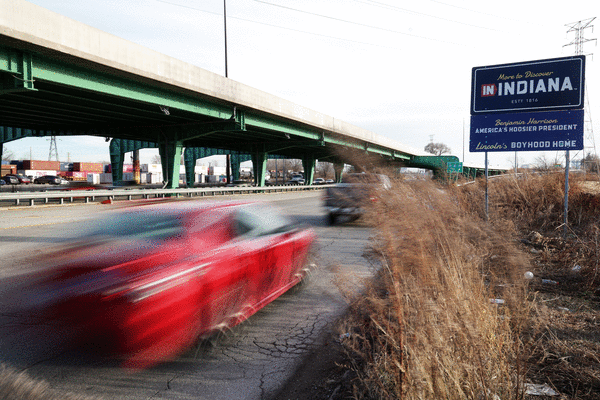
Indiana Gov. Mike Braun signed a bill that outlines a financial structure for a Chicago Bears stadium in Hammond about an hour after the state Senate gave the bill its final approval on Thursday, while Illinois lawmakers were inching closer to a tax deal to try to keep the team in the Land of Lincoln.
“We made it clear from the beginning that Indiana is open for business. I’m thrilled to sign Senate Bill 27 to create the framework to build a new world-class stadium in Northwest Indiana. Now let’s get this across the goal line,” Braun said in a statement on social media with a picture of him signing the bill.
After Braun signed the bill into law, the Bears sent out a statement: “Indiana has taken important steps over the last few months, and we are grateful for the leadership reflected by Governor Braun signing SB 27, establishing the framework for a stadium development in Northwest Indiana. We continue to work on the necessary due diligence and appreciate the ongoing engagement with Indiana state and local leaders.”
However, Illinois lawmakers were not ready to declare game over.
At the Illinois State Capitol, the House Revenue and Finance Committee on Thursday approved legislation in a 13-7 vote that would allow the Bears to negotiate a special payment to local taxing bodies in lieu of property taxes — key legislation that the team says it would need to aid in its move to Arlington Heights.
The Illinois bill would require businesses with mega development plans, like the Bears, to enter into an agreement for making special payments in lieu of property taxes for at least 20 years.
In response to the bill’s preliminary approval, the village of Arlington Heights issued a statement calling it “an important step in keeping the Bears in Illinois.”
“Based on the feedback we are receiving,” Mayor Jim Tinaglia said, “we are very optimistic that the necessary support will be present for the bill to pass both the Senate and House and advance to the governor’s desk in the coming weeks.”
The bill still needs to go to the full House for approval before going to the Senate, and it’s unclear how much support it has in the Illinois General Assembly. The full Illinois House adjourned Thursday without taking up the legislation, and House members aren’t scheduled to return to Springfield until March 18.
Indiana’s bill passed the state’s Senate in a 45-4 vote, with Republican state Sens. Liz Brown, Gary Byrne, Chris Garten and Tyler Johnson voting against the bill.
Hammond Mayor Tom McDermott did not immediately respond to requests for comment.
Under Senate Bill 27, a stadium authority bill that will create the financial structure for a stadium for the Chicago Bears, the team will be able to move forward with a proposed stadium near the Wolf Lake area in Hammond.
The Chicago Bears are willing to invest over $2 billion in the stadium. The state will invest around $1 billion in the stadium through various financing avenues, House Speaker Todd Huston previously said.
The state will issue a bond for the construction of the stadium, which will be repaid through Hammond’s 12% admissions tax — expected to generate $12 million — once the common council passes it, and a professional sports development area (PSDA) specialized tax district, Huston said.
The state has also asked the Lake and Porter county councils to adopt a 1% food and beverage tax and for Lake County to pass a 5% innkeepers tax, Huston said. The fiscal note stated that the food and beverage tax could generate $12 million to $18 million annually, while the innkeepers tax could bring in $5.4 million annually.
To further support infrastructure costs, Huston said the state will renegotiate its lease with the Indiana Toll Road. The bill allows the Hammond City Council to designate a stadium development district within the city but that can’t include areas of the PSDA. Under the stadium development district, at least 12% of the allocated property taxes have to be transferred each year to the city of Hammond’s general fund, according to the fiscal note of the bill.
The state used a similar approach to finance Lucas Oil Stadium in Indianapolis, Huston said. The state allocates money in its budget to ensure bondholders know the state has the money, but the state hasn’t had to use that money because the admissions tax and PSDA has funded the bond, he said.
The Indiana Senate had to vote on the bill Thursday because it was amended in the House to lay out the financial structure.
State Sen. Ryan Mishler, the bill’s author, said all the taxes will expire when the bonds are paid off. The stadium board, established in the bill, and the National Football League will lease the stadium for 35 years, but it could be extended, Mishler said.
Mishler said he received many calls from Illinois residents who told him that they would prefer a Bears stadium in northwest Indiana. Indiana has good relationships with families that own professional teams throughout the state, like the Simon family that owns the Indiana Pacers to the Irsay family that owns the Indianapolis Colts, Mishler said.
“These families are incredible partners to us. We would be honored to welcome the McCaskey family and Mr. (Pat) Ryan to our partnership group,” Mishler said.
State Sen. Lonnie Randolph, a Democrat from East Chicago, said the Bears considering Hammond “is a major historical event.”
“It’s a major event because of the significance that it projects to the area, to the state and the country,” Randolph said. “I am hoping that this will be the beginning of future major collaborations in Indiana.”
State Sen. Mark Spencer, a Democrat from Gary, said he’s pleased that the Bears have selected a site in Hammond for consideration that will benefit all the cities and towns in northwest Indiana.
“This legislation positions Indiana not as a spectator in economic competition but as a contender. It says we’re prepared. It says we’re coordinated. It says we are confident in our ability to steward opportunity responsibly,” Spencer said.
State Sen. Michael Young, a Republican from Indianapolis, said the state’s responsibility is to the taxpayers and the state has, in the past, established taxes to pay for bonds and the taxes remain on the books. Young, who voted in favor of the bill, said he hoped the taxes for the Bears stadium end when the bonds are paid off.
“I just don’t like to do that to the people. If we promise them we’re going to use money for one thing and we do it, but somehow it never goes away,” Young said.
State Sen. Rick Niemeyer, a Republican from Lowell, said it’s the third time in his life that there’s been talk about the Bears moving to northwest Indiana, but he said this time feels “serious.”
“I don’t think anybody that lives in northwest Indiana is going to have a problem with the way this is set up, the way it looks and the way that it’s going to be financed,” Niemeyer said.
State Sen. Dan Dernulc, a Republican from Highland, said while there has been chatter over the years about the Bears coming to the region, “there’s a different vibe now” about the Bears coming to northwest Indiana as Hammond is about a 20-minute drive from Soldier Field.
“It’s really exciting that we’re at this point. To bring them over onto our side is great. Illinois doesn’t have the money, we do because of good fiscal management of our funds,” Dernulc said.
Meanwhile, Illinois lawmakers who represent the city of Chicago may be reluctant to give any incentives for the Bears to leave the city limits without the team doing something for their districts in return.
The Illinois bill passed in committee Thursday would create a minimum special payment rate — which would be at least 10% of the property tax rate that had been set on a megaproject site — but that minimum payment would not apply to projects like a Bears stadium that would cost $2 billion or more.
The megaproject agreements will fall under the control of the municipalities, and there’s a sliding scale for creating a minimum number of jobs to support the operations of these projects. For a $250 million investment, a company must create 50 new full-time jobs and for a $100 million, a company must create at least 100 new full-time jobs, according to the legislation.
A local review board consisting of members of the local taxing bodies, such as school districts and others, would decide the amount of the special payment, how those payments would be generated and the project’s valuation through a weighted vote based on the taxing body’s share of property taxes levied on the proposed megaproject site.
The bill also allows for businesses like the Bears to potentially be granted sales tax exemptions on building materials for no more than 10 years, with a chance for a renewal for up to a five-year period.
Prior to construction, there must be a project labor agreement in place and businesses must have a goal to grant 20% of the total dollar amount of contracts for the project to minority-owned businesses.
Even if the bill does pass, the Bears and state officials also need to come to an agreement on infrastructure costs which could cost the state as much as $850 million.
After Thursday’s hearing, state Rep. Kam Buckner, a Chicago Democrat who introduced the bill at the hearing, called the bill a “step in the right direction” and said the Bears can benefit from it but acknowledged there are still issues the Bears need to hash out with the city of Chicago to get support from Chicago’s state lawmakers for the Bears to move to Arlington Heights.
“It would have to be attached to the things that I need for Chicago to be whole,” he said when asked about whether he supports the bill that passed out of committee. “This in and of itself is obviously a statewide bill for economic development but it is something that the Bears organization can use. … So for me it’s important that we talk about infrastructure and we talk about Chicago quote-unquote concessions that … are a thing that has to be a part of the conversation.”
Brian Costin, deputy state director of Americans for Prosperity Illinois, warned in his testimony that the bill would shift the property tax burden to homeowners and small businesses and create exorbitant increases.
“That shift behaves like an economic cancer, corroding local investment, driving disinvestment … and pushing stable communities towards a fiscal cliff,” Costin said. “This bill is fatally flawed and (it signals) a slow-motion economic disaster, unleashing massive, unavoidable property tax hikes on communities surrounding megaproject districts, potentially across hundreds of (areas) statewide.”
But Buckner noted how, while the legislation is a statewide initiative, local governments would be the ones to decide how these megaproject agreements get structured.
“They know better than the state does on what works for them,” he said.
There were other Democrats at the hearing who raised concerns about the bill, including state Rep. Rita Mayfield of Gurnee, who worried it could cause some local governments to lose out on hundreds of millions of dollars in revenue, and state Rep. Sonya Harper of Chicago, who wants to make sure low-income communities with food deserts and have been deprived of other services don’t get neglected in favor of incentives for billionaires.
Also at the hearing, GOP state Rep. John Cabello of Machesney Park said there’s some Republicans who might favor the legislation but still echoed concerns over how the bill could impact average people.
“We have to protect the taxpayers. We really do,” he said. “And though there’s several of us that are willing to work with you, we’re just waiting for that invitation.”
Steve Mahr, the city of Chicago’s acting chief financial officer, expressed the city’s opposition to the bill, saying the team’s departure would have “negative, long-term consequences” to the Museum Campus along DuSable Lake Shore Drive, where the Bears’ current home of Soldier Field is, the Loop and other areas of the city.
“It’s no secret that the city’s goal is to retain the Chicago Bears in Chicago. As Mayor (Brandon) Johnson has said over and over, ‘the Chicago Bears belong in Chicago,' ” Mahr said.
Those comments come after the Bears in the last couple of years had considered wanting to see a new stadium built within the city limits — on grounds just south of Soldier Field near McCormick Place or farther southwest on the site of the former Michael Reese Hospital. But then the Bears shifted their focus last year to the site of the former Arlington International Racecourse, which the team purchased a few years ago for $197 million, before ultimately saying northwest Indiana was also in play.
But after the hearing, Buckner said he doesn’t believe Illinois lawmakers are in competition with Indiana.
“I think what they have done there and what they have rolled out has not risen to a level of the pandemonium that’s been surrounding it,” he said. “I think that there’s still people in that state that either don’t know or are unsure about the smorgasbord of tax increases that’s attached to their proposal. We’re doing our job. We’re doing what we’re supposed to do. We’re operating in our lane. And I think the Bears will see that we’re moving in the right direction, and that’s how these negotiations go.”
———
Chicago Tribune’s Robert McCoppin contributed.
©2026 Post-Tribune (Merrillville, Ind.). Visit at chicagotribune.com/suburbs/post-tribune. Distributed by Tribune Content Agency, LLC.




Comments