Michigan experts warn of worsened air quality after Trump climate move
Published in Business News
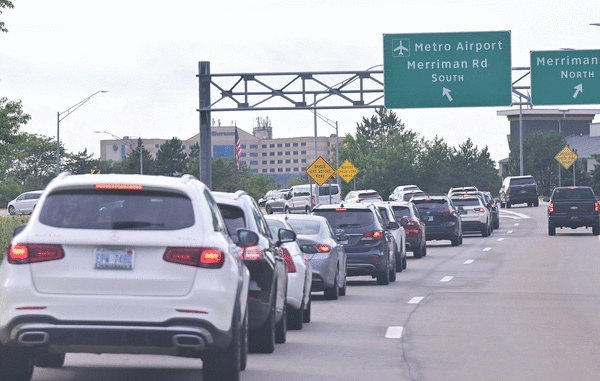
WASHINGTON — Experts warn air quality will worsen because of the Trump administration's repeal of the legal basis for federal climate rules, despite a top federal regulator saying the move "does not change regulations on traditional air pollutants and air toxics."
U.S. Environmental Protection Agency head Lee Zeldin made that statement Thursday in the Oval Office as he and President Donald Trump touted the major deregulatory action. They both suggested the change would boost the U.S. auto industry.
"This EPA is committed to providing clean air for all Americans," Zeldin said. "Powering the great American comeback is based on the singular focus of providing clean air, land and water for all Americans, while harnessing the greatness of the American economy."
It is true that repealing the Obama-era EPA's 2009 "endangerment finding" will leave intact federal rules meant to limit harmful emissions of criteria air pollutants identified more than 50 years ago in the Clean Air Act. Those pollutants include noxious gases like sulfur dioxide, nitrogen dioxide and carbon monoxide that cause asthma, lung issues and neurological damage.
The mass introduction of catalytic converters on new motor vehicles in the 1970s helped drastically curtail emissions of those gases over the next two decades, and the devices will surely remain on gas-powered cars and trucks to ensure they continue meeting federal standards. (Electric vehicles, notably, do not have converters because they have no tailpipe emissions.)
Experts disagreed, however, with Zeldin's suggestion that there would not be "clean air" implications from the move to wipe out a generation of climate-focused regulations.
"Carbon dioxide pollution and other greenhouse gases are correlated with the production of other air pollutants like particulate matter and nitrogen oxides," said Erik Nordman, director of the Institute for Public Utilities at Michigan State University.
"Measures that reduce carbon dioxide and greenhouse gases often reduce those other pollutants. That's a co-benefit of these greenhouse gas regulations. So by removing or lowering standards for greenhouse gases, we would expect those other pollutants that are tightly correlated with greenhouse gases to increase," he said in a phone interview.
Catalytic converters are one example of the link between what Zeldin called "traditional" pollutants and greenhouse gases.
The devices work by causing chemical reactions that transform highly toxic criteria pollutants into less harmful — or in some cases harmless — gases and substances. One byproduct is harmless water vapor. Another primary one is carbon dioxide, a greenhouse gas that causes climate change in the long term but is not instantly poisonous to humans at low ambient levels.
But even as converters have become more effective over time, academic research shows, they still do not block all of the most air-quality-harming pollutants. And because vehicles that use more fuel have higher emissions, the risk for worsened air quality is greater.
Nordman said the Trump administration's endangerment finding repeal "kind of locks in a lower standard, so that will result in cars that are less fuel efficient than they might have been otherwise. That will result in greater pollution than we would have seen otherwise."
The environmental policy expert added that those impacts will play out most over the longer term because "energy and transportation infrastructure that we're building today will be more polluting than it otherwise could be, and we're going to lock in that pollution for decades."
He said other Trump administration actions — like the order to keep a coal plant open in Michigan — will have more immediate impacts on air quality.
Jeff Holmstead, who was an EPA official under former President George W. Bush, said Thursday he expected little near-term impact in air quality from the federal policy change, noting that automakers "have very long planning cycles."
But Tom Luben, a senior research scientist at the University of Michigan School of Public Health and former air pollution researcher at the EPA for almost 20 years, was blunt in condemning the Trump administration's repeal of the endangerment finding.
The action, Luben wrote ahead of the announcement, "would threaten the health of millions of Americans."
"An increase in ground-level ozone concentrations has been linked to respiratory health problems ranging from decreased lung function and asthma exacerbations to increased emergency department visits and hospital admissions," he added, similarly raising air quality concerns.
Luben continued: "Certain parts of the population are especially vulnerable to these effects, including children, older adults, pregnant people, and individuals with pre-existing health conditions."
Beyond air quality, the research scientist also lamented climate-related impacts of the policy change.
"In addition to increased air pollution, the proliferation of extremely hot days, floods, storms, droughts, and fires linked to a changing climate will impact the health of the American people."
In announcing the repeal move, however, Trump dismissed climate-change concerns: "... this has nothing to do with public health. This was all a scam."
©2026 www.detroitnews.com. Visit at detroitnews.com. Distributed by Tribune Content Agency, LLC.








Comments