The struggles of Jack in the Box: A bad investment, the immigration crackdown and a clash for control
Published in Business News
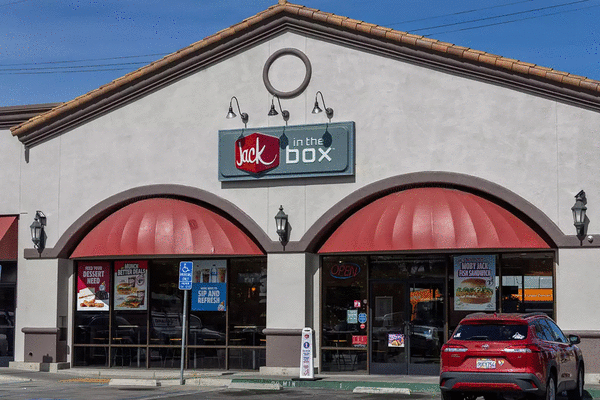
Jack in the Box has lost its spring.
The San Diego-based fast-food chain is losing customers, its shares have nosedived, and some investors think it needs new leadership.
The 75-year-old company is trying to find its footing while everyday consumers pull back on spending. The company reported a more than 6% decline in same-store sales last quarter and has seen shares drop close to 50% over the last year.
It seems stuck in a difficult spot. As it seeks ways to cut costs to boost profitability, customers looking to save seem to find more value in its competitors.
“Fast-food chains have been struggling,” said Julie Littman, a senior reporter at the trade publication Restaurant Dive. “It’s been hard to really pinpoint one thing with Jack in the Box. It’s a mix of economic conditions and some missteps on their part.”
The chain’s woes have sparked a battle with an activist investor seeking to oust the board’s chair.
Biglari Capital, a holding company that owns a 9.9% stake in Jack in the Box, wants to see a change in leadership. Investor Sardar Biglari is leading a campaign to vote Jack in the Box Chair David Goebel off of the board at the end of the month.
In a release this month, Biglari said that Jack in the Box has seen “catastrophic value destruction,” a failed acquisition and excessive executive turnover under Goebel’s leadership.
Jack in the Box has hired three chief executives and eight chief financial officers over the last five years. Shares have fallen around 80% over the same period.
“David Goebel must be held accountable for his bad decisions and poor judgment,” Biglari Capital said in a statement. “Shareholders cannot afford to have David Goebel serve on the board any longer, as he might cause further damage.”
As a result, Jack in the Box is not only scrambling to boost its sales but also trying to prove the company is in good hands. Experts say the chain has faced a range of obstacles and made mistakes that have led to its decline.
One misstep was the acquisition of the struggling Mexican fast-food chain Del Taco in 2022 for $575 million. Jack in the Box sold Del Taco last year for $115 million, a loss of more than $400 million.
Some investors say the acquisition was a mistake because it was made when restaurant valuations were inflated during a boom after the end of the COVID-19 pandemic emergency. Jack in the Box and Del Taco also rely heavily on their locations in California, which raised its minimum wage to $20 an hour in 2023, forcing up labor costs.
Jack in the Box has raised prices at a time when consumers are particularly price-sensitive. As of late last year, the average menu price was 2.4% higher than the previous year. However, the chain has seen success with its $4.99 combo meal and $5 smash burger.
The chain’s downfall hasn’t been sudden. Same-store sales declined more than 7% in both the third and fourth fiscal quarters of 2025 and dropped 4% for the year. The company saw a net loss of $36 million for the year that ended September 2024 and a loss of $80 million for the year that ended in September of last year.
In April, Jack in the Box launched its recovery plan dubbed “Jack on Track” that aims to accelerate cash flow and involves closing up to 200 under-performing stores. The company closed 47 locations during the fourth quarter last year and closed 14 locations in the first quarter of 2026.
It has roughly 2,125 restaurants across 22 states.
“Our results for the quarter were in line with our expectations,” Chief Executive Lance Tucker said Wednesday. “We remain focused on the fundamentals, simplifying the business, and delivering on our ‘Jack on Track’ commitments as we build a stronger foundation for sustainable growth.”
Jack in the Box sales have also been affected by the immigration crackdown led by U.S. Immigration and Customs Enforcement. Many immigrants and Latino Americans have been staying home out of fear of being detained by federal agents.
In an earnings call in August, Tucker acknowledged that “Jack in the Box significantly over-indexes with Hispanic guests, who, especially in our core markets, face uncertainty and have pulled back their spending.”
Jonathan Maze, editor in chief at Restaurant Business Magazine, said the immigration crackdown probably has had an outsized effect on Jack in the Box.
“You now have a sizable portion of the consumer base that is less likely to leave their house,” Maze said. “This is particularly true for Jack in the Box, which has two of its biggest markets in California and Texas.”
According to the Jack on Track plan, the chain will revive its business by selling select real estate holdings and paying down debt. This kind of recovery plan can take more than six months deliver results, Littman said.
Shareholders will vote Feb. 27 ton whether Goebel will remain in his position. This month, Jack in the Box emphasized its confidence in Goebel and urged shareholders to vote for his reelection.
“We believe that we have the right Board and management team in place,” the company said in a Feb. 10 release. “Our Board benefits from Mr. Goebel’s highly specific skill set and hands‑on experience in restaurant operations.”
Biglari wants Goebel gone.
The activist investor has gained the support of proxy advisory firms Glass Lewis and Egan-Jones in his effort to persuade shareholders to vote against Goebel. In response, Jack in the Box issued a release saying that the proxy advisory firm Institutional Shareholder Services recommends Goebel’s reelection.
“We are pleased that ISS recognizes the strength and experience of our Board,” the company said Feb. 17.
A proxy advisory firm gives guidance to shareholders of a company, and an activist investor is a shareholder who tries to exert influence over the company’s leadership and tactics.
“Activist investors want immediate returns, whereas the board wants a little bit more time,” Littman said of Jack in the Box’s recovery plan. “Their stock is down significantly, so there is cause to go after Jack in the Box.”
Littman described Biglari as an “infamous activist investor” who has had several run-ins with Cracker Barrel and is trying to buy El Pollo Loco. Last summer, Jack in the Box issued a so-called poison pill to try to prevent Biglari from purchasing more stock.
Last year, Biglari tried to place himself on the Jack in the Box board but was rejected. The company said Biglari “reacted with extreme anger” when he was not granted a board position.
©2026 Los Angeles Times. Visit at latimes.com. Distributed by Tribune Content Agency, LLC.










Comments