SpaceX launch kicks off busy December on Space Coast
Published in News & Features
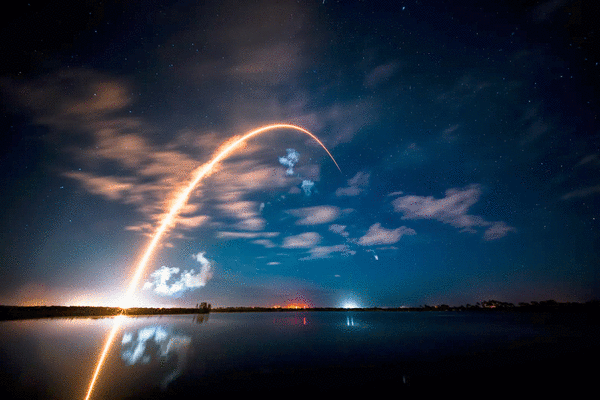
The Space Coast’s record rocket train of 2025 kept rolling with the first launch of December early Monday.
A SpaceX Falcon 9 with 29 of the company’s Starlink satellites lifted off from Kennedy Space Center’s Launch Pad 39-A at 2:44 a.m. marking the first of at least five planned launches on the Space Coast in the next two weeks.
This was the fourth launch of the first-stage booster, which made a recovery landing downrange on the droneship Just Read the Instructions stationed in the Atlantic.
It marked the 102nd launch from either KSC or neighboring Cape Canaveral Space Force Station this year, with SpaceX responsible for all by seven of them. SpaceX, United Launch Alliance and Blue Origin combined to surpass the 2024 record of 93 launches last month with the Space Coast on target to come close to 110 launches before the end of the year.
SpaceX has another launch planned for Tuesday with a Falcon 9 on the Starlink 6-95 mission with 29 Starlink satellites aiming to lift off from Canaveral’s Space Launch Complex 40 during launch window thar runs from 3:16-7:16 p.m. with backup Dec. 3 from 2:50-6:50 p.m. This will be the 25th flight for the first-stage booster, which will aim for a recovery landing on the droneship A Shortfall of Gravitas in the Atlantic.
SpaceX then plans another Starlink launch on Sunday back at KSC with its fleet-leading booster going for a record 32nd trip to space and landing in the Atlantic.
Then on Dec. 9, SpaceX looks to fly a national security mission with a booster return on land that could bring a sonic boom to Central Florida.
A Falcon 9 is set to fly the NROL-77 mission with a classified satellite for the National Reconnaissance Office from Canaveral’s SLC-40 at 2:16 p.m. with backup Dec. 10 at 2:02 p.m.
This will be the fourth launch of the first-stage booster that will aim for a recovery at Canaveral’s Landing Zone 2, which could bring one or more sonic booms to residents of Brevard, Orange, Osceola, Indian River, Seminole, Volusia, Polk, St. Lucie, and Okeechobee counties.
The other launch on the calendar already this month could come from ULA on Dec. 15 with an Atlas V rocket slated to take off from Canaveral’s Space Launch Complex 41 during a window that opens at 3:52 a.m.
The Amazon Leo 4 mission is the new name for what Amazon had been formerly calling Project Kuiper. The Atlas V looks to bring up 27 more satellites for what would be Amazon’s seventh overall operational launch of its internet satellites, and fourth with ULA.
This would increase Amazon’s constellation to 180 of a planned 3,236 total slated to be in orbit by July 2029.
Amazon Leo is seeking to compete with SpaceX’s Starlink, which has already had more than 10,000 satellites launched since SpaceX’s first operational mission in 2019.
The Atlas V mission could be the final launch for ULA in 2025, but the sixth for the year, which also featured the third ever launch of its new Vulcan rocket. The company looks to grow that to closer to 20 missions in 2026.
Blue Origin had two launches in 2025, and had also originally been targeting a third launch of its New Glenn rocket before the end of the year, but now it’s looking to make that flight in early 2026.
SpaceX, meanwhile, could continue its pace of one launch from Florida about every three days, and is expected to queue up Falcon 9 missions through the end of the year.
-----------
©2025 Orlando Sentinel. Visit at orlandosentinel.com. Distributed by Tribune Content Agency, LLC.






Comments