From drug-traffic hub to interdiction leader: The Dominican Republic's turnaround
Published in News & Features
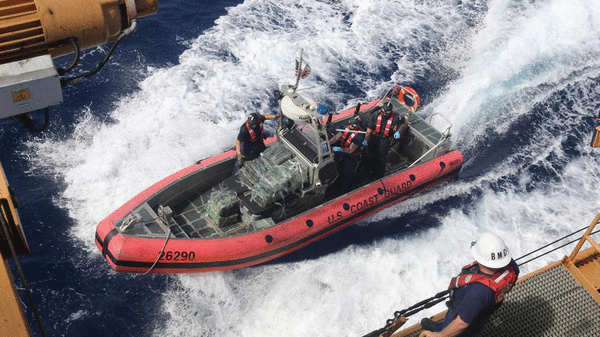
For decades, the Dominican Republic carried a reputation it never wanted but struggled to shed.
Wedged between South America’s drug-producing basin and the consumer markets of the United States and Europe, the country sat squarely in a global narcotics corridor. Geography, for years, was destiny — and destiny was unforgiving. Drug flights landed on clandestine runways. Fast boats cut across the Mona Passage like phantoms. Cocaine was packed deep inside shipping containers leaving Dominican ports. Trafficking networks — protected by political interference and corruption — operated with startling ease.
Thus, the Dominican Republic became a transit nation, a laundering hub and a safe harbor. “A place where cases went to die,” a former U.S. law enforcement officer once said.
Then, seemingly all at once, the trajectory shifted.
Beginning in 2020, the Dominican Republic launched one of the hemisphere’s most ambitious anti-drug reform campaigns. In five years, authorities tripled drug seizures, dismantled networks once considered untouchable, modernized legal and surveillance systems, and rebuilt trust with U.S. and European counterparts. Cooperation once cautious — even suspicious — became fluid and strategic.
“A 180-degree turn,” a former U.S. State Department official told the Miami Herald. “It went from a relationship of mistrust to one of recognition.”
Dominican and American officials interviewed for this story describe the change as a transformation — a nation historically defined by vulnerability repositioning itself as a regional reference point for interdiction, accountability and institutional strength.
The reset
The shift began with a political gamble under the administration of President Luis Abinader, breaking with traditional practices and setting out to purge the government of corruption that had allowed the nation to become a transit hub for cocaine moving out of Colombia and Venezuela.
Dominican officials said the transformation centered on appointing a tough, results-driven rear admiral to lead the country’s anti-drug agency and granting real independence to the Public Prosecutor’s Office, including naming an autonomous attorney general.
This, sources said, was not a reform built for headlines but for results. Independence allowed prosecutors to pursue cases once considered off-limits. Impunity lost its shield. Senior figures long protected by power could finally face scrutiny without whispered warnings or career consequences, a high-ranking Dominican official said.
Veteran prosecutor Jenny Berenice Reynoso quickly became an emblem of the new era. Dormant cases resurfaced. Files once destined for quiet burial turned into indictments. Since 2020, at least 28 senior officials have been removed — not always for proven crimes, but for failing credibility tests. Integrity became the new gatekeeper.
“A cultural reset,” one official called it. “Where loyalty to the institution outweighs loyalty to power.”
Oversight, meanwhile, grew teeth. The General Directorate of Public Procurement — once seen as ceremonial — began canceling financial agreements that failed transparency standards. A system once exploited by traffickers as an entry point for dirty money is now described internally as “a firewall,” equipped with audits, cross-checks and automated alerts.
Reform created something beyond legality. It created trust. And trust opened doors.
Numbers tell story
And the results began to show.
From 2004-20, Dominican authorities seized 77 tons of narcotics. From 2020 to 2025, they seized more than 227,824 kilograms, including 67,373 kilograms captured through joint international operations. The jump was not incremental, it was seismic.
U.S. officials note that the rise reflects not necessarily more drugs in circulation, but a greater ability to detect them. Intelligence deepened. Maritime and aerial oversight expanded. Radar coverage now blankets what were once lawless air corridors.
The country’s National Drug Control Directorate underwent its own overhaul, professionalizing its structure and hiring 758 new agents. With more personnel and better coordination with U.S. law enforcement, long-standing trafficking routes began to collapse. Fast-boat drops faced more interceptions. Clandestine airstrips went silent. Aerial trafficking, once routine, is now almost eradicated.
The efforts targeted what had become one of the most heavily used corridors by Venezuelan and Colombian cartels. Trafficking through the Caribbean has long been fluid, and the Dominican Republic had become one of its pivots. U.S. estimates suggest nearly 90% of drugs entering the central Caribbean pass Dominican waters in some form — by speedboat, container ship,or offshore cargo transfer.
These routes are not fixed, and the networks are modular, one official said. Colombian and Venezuelan traffickers rotate go-betweens rather than build large cartel structures. Local actors handle transport, storage, and bribery.
Operations stay discreet, avoiding the territorial bloodshed seen in Mexico or Colombia.
In such an environment, disputes between narcos are settled quietly, with actors preferring to compensate losses and prioritize continuity over violence. This dynamic, experts say, is partly why the Dominican Republic — despite its trafficking volume — has avoided cartel-style warfare.
New cooperation
For U.S. officials, one of the clearest indicators of Dominican progress is diplomatic.
For years, the Dominican Republic joined anti-drug forums — but rarely led them. Today, it ranks among the top three nations extraditing fugitives to the United States, with more than 200 extraditions since 2020. Operations move faster. Bureaucracy is lighter. Suspicion is fading, a Dominican official said.
Washington, historically cautious, now speaks openly in admiration. A U.S. State Department official said bilateral cooperation is “the strongest it has ever been.” The U.S. has provided equipment, including non-intrusive scanners capable of detecting high-value shipments hidden in yacht hulls — cargo that once left Dominican ports quietly and profitably. Technology matters, she said. But political will matters more.
Much of that will has been driven by Rear Adm. José Manuel Cabrera Ulloa, appointed chief of the drug control directorate in 2021 and widely regarded as a disciplined, transparent reformer. Under his leadership, seizure data became publicly accessible. Irregularities were reported rather than buried, a State Department official said.
“I truly believe that much of the success of recent years is due to him and his leadership within the institution,” the official told the Herald. Under Cabrera’s leadership, the institutional relationship between the two countries has been characterized by integrity and transparency, she said, adding that one of the first things he did when he was appointed to the office in 2020 was to immediately opened the door to cooperation with the DEA and the State Department’s Bureau of International Narcotics and Law Enforcement Affairs.
New challenges
If cocaine and heroin defined the last generation, fentanyl defines the next. The opioid is devastating U.S. cities, driving record overdose deaths and reshaping global supply chains.
As of 2025, Dominican authorities report no confirmed fentanyl trafficking cases, but that absence is both a relief and a warning. The Caribbean remains a natural corridor, and as Mexican cartels see their routes pressured, Washington has urged Dominican officials to prepare not when fentanyl appears — but before.
Santo Domingo responded by creating the Caribbean’s first Synthetic Drugs Unit, strengthening controls of precursor chemicals used to manufacture the drug with digital prescription monitoring, and updating a law to criminalize crypto laundering, dark-net operations, and new psychoactive substances. Cabrera’s units train regularly with DEA and INL teams. Dominican aircraft patrol maritime corridors. Precursors are traced from import to pharmacy shelf.
The country’s anti-drug efforts also led to increased control at the border with Haiti as political conditions there continued to deteriorate. Dominican officials said that marijuana still trickles across land borders, but major flows now move by sea and air. Ports once viewed as soft targets now operate under joint security commissions, and containers are regularly scanned and rigorously logged and tracked.
And yet, vulnerabilities remain and officials suspect that drug proceeds have found their way into the country’s luxury real estate and auto dealerships, both cash-heavy businesses. This situation has led local officials to direct financial intelligence teams to work together with U.S. and European agencies to detect and shut down laundering channels.
In recognition of the nation’s achievements in the drug war, the U.S. State Department took an unprecedented step: it encouraged the Dominican Republic earlier this year to present a candidate to lead the United Nations drug agency. For a country once approached warily, the endorsement signaled confidence not just in seizures, but in governance.
Yet officials in Santo Domingo acknowledge progress remains fragile. Success, they say, can breed complacency. Reforms must outlast the administration that launched them. Prosecutorial independence must withstand political change. Transparency must survive fatigue. And fentanyl still looms offstage.
“The work is never finished,” one of the officials said.
_____
©2025 Miami Herald. Visit miamiherald.com. Distributed by Tribune Content Agency, LLC.




Comments