In U.S. plans for Venezuela, restoration of democracy takes a backseat, at least for now
Published in News & Features
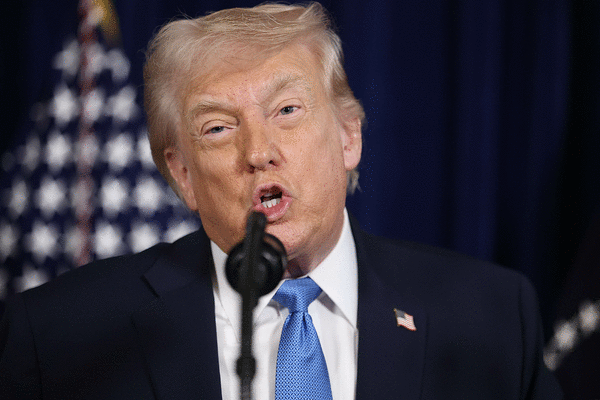
In a press conference Saturday detailing the operation to capture Venezuelan strongman Nicolás Maduro and U.S. plans to “run” the country and rebuild its oil industry, there was one word President Donald Trump never used: Democracy.
Trump’s comments, detailing negotiations with a hardcore regime figure, Delcy Rodríguez, and dismissing opposition leader and Nobel laureate Maria Corina Machado as a “nice woman” who does not have her country’s “respect,” shocked Venezuelans and others who wanted to see a restoration of democracy in the South American nation.
Trump also did not mention the prospects of elections or a role for Edmundo Gonzalez, the opposition candidate widely believed to have won last year’s Venezuelan presidential election, whom the U.S. government officially recognized as president-elect.
The president did mention the U.S. would “run” Venezuela until a “judicious” transition takes place, but provided little clarity on what that would look like.
On Sunday, Secretary of State Marco Rubio, a Miami native and longtime champion of the Venezuelan opposition’s efforts to overthrow Maduro, made it clear that in negotiations with Venezuelan regime figures, U.S. officials are prioritizing stability in the South American country and U.S. national security objectives, at least in the short term.
“We all wish to see a bright future for Venezuela, a transition to democracy. These are things I still care about. We still care about. But what we’re talking about is what happens over the next two, three weeks, two, three months, and how that ties to the national interests of the United States,” he said on NBC’s Meet the Press.
“I would argue that democracy in Venezuela is a U.S. national interest,” said Eric Farnsworth, a former State Department official who is a senior associate with the Americas Program at the Center for Strategic and International Studies. “What gives me optimism is that Rubio actually is now in charge of the effort, and so he gets it. From his days in the Senate, he has been a fierce advocate for democracy in Venezuela, and a friend of Maria Corina.”
Still, the transactional tone of Trump’s remarks and what some see as his dismissing Machado have raised fears in South Florida, the home of the largest Venezuelan community, that the goal of a democratic transition might get lost along the way – if it was ever an administration goal.
“It was incredibly disturbing that President Trump doesn’t apparently plan to help a transition to the democratically elected Edmundo González and María Corina Machado’s opposition party, and seems to have only gone through this process to exploit Venezuela’s oil — which would be incredibly disappointing to the people I represent,” said Democratic U.S. Rep. Debbie Wasserman Schultz of Broward County.
The congresswoman said Venezuelans would feel more confident about the road ahead had Trump suggested the need for another election or talks with Machado. “He didn’t even mention the word democracy in his press conference,” she said.
U.S. priorities
In interviews on morning television news shows, Rubio spoke of Machado and Gonzalez with admiration, but dismissed talks of future elections in Venezuela as “premature” and hinted that it was a problem that both opposition leaders are apparently out of the country.
“María Corina Machado’s fantastic,” he said on NBC’s Meet the Press, “but unfortunately the vast majority of the opposition is no longer present inside of Venezuela.” Machado’s whereabouts are unknown, and she is likely outside the country after receiving the Nobel Peace Prize in Norway in October. González is exiled in Spain.
“Ultimately, Rubio insisted, “we care about elections, we care about democracy. We care about all of that. But the number one thing we care about is the safety, security, well-being and prosperity of the United States.”
Rubio also attempted to clarify that “running” Venezuela did not mean U.S. boots on the ground or an intervention, but “running” U.S. policy to pressure the remaining elements of the Maduro government, who are still in control of the country, to address several administration priorities.
“We want drug trafficking to stop,” he said on CBS’s Face the Nation. “We want no more gang members to come our way. We don’t want to see the Iranian and, by the way, Cuban presence.... We want the oil industry in that country not to go to the benefit of pirates and adversaries of the United States, but for the benefit of the people.”
He also seemed to walk back other comments from President Trump suggesting the U.S. was going to take control of Venezuela’s oil facilities.
“Ultimately, this is not about securing the oilfields,” Rubio told ABC’s This Week. “This is about ensuring that no sanctioned oil can come in and out until they make changes to the governance of that entire industry.”
Rubio said the administration would continue to use the significant military presence off the coast of Venezuela as leverage to get U.S. priorities addressed, and expected “more compliance and cooperation than we were previously receiving.”
“Let’s be realistic here,” he told NBC. “What we are focused on right now is all the problems we had when Maduro was there. We are going to give people an opportunity to address those challenges and those problems.”
Many of those problems were the result of a corrupt regime that remains largely intact. But by choosing to work with Rodriguez, political analysts say, the administration is taking a more pragmatic approach to avoid the kind of power vacuum and lack of security that had haunted past attempts at regime change in other nations.
Perilous path ahead
Trying to stabilize Venezuela without the opposition’s direct participation, however, will backfire, experts warn.
“Any attempt to stabilize Venezuela while sidelining the 2024 [presidential] mandate would immediately face three problems: domestic rejection, international fragmentation and internal regime sabotage,” Benigno Alarcón Deza, an analyst and former director of the Center of Government and Political Studies at Universidad Católica Andrés Bello in Caracas, wrote in Americas Quarterly. “Whatever her administrative role, Rodriguez cannot serve as the foundation of a political transition because she inherits the regime’s original sin: the absence of democratic legitimacy.”
There is also a chance that Rodriguez, a cunning politician who has presented herself as a technocrat who has revived the Venezuelan oil industry, would not play along or that her grip on power does not hold. For starters, Maduro’s inner circle is intact, and that includes powerful figures like Interior Minister Diosdado Cabello and Defense Minister Vladimir Padrino Lopez, both indicted in the U.S., along with Maduro, on charges of drug trafficking.
“The question is going to be, how long does Delcy function in this capacity?” said Farnsworth. “ “You still have Padrino Lopez, certainly Diosdado Cabello, they haven’t left. Don’t forget, Diosdado has a $25 million bounty on his head. So you could also see another operation like this against him. I’m not saying it’s going to happen, but all these guys now have to be thinking they could be next.”
But negotiations with figures close to Maduro — and Trump’s views on Machado — are a hard pill to swallow for many Venezuelan exiles and could create political headaches for the administration in South Florida, where the local Republican congressional delegation has vocally opposed negotiations with the Maduro regime in the past.
U.S. Rep. María Elvira Salazar of Miami told the Miami Herald she did not believe the administration should be working with Rodríguez, who is under U.S. sanctions.
“Delcy has been sanctioned by the United States and she said that Maduro is the legitimate president of the country,” Salazar told the Herald. “We cannot work with her.”
Tensions flared during a press conference on Saturday evening in Doral, home to a large Venezuelan community. Visibly angry at the suggestion by a reporter that he had not supported Machado, U.S. Rep. Mario Díaz-Balart replied: “When have we ever not supported her? Do not put words in my mouth. I am convinced there is going to be a transition and…whether there are new elections or there is a decision to take the old elections, the next democratically elected president of Venezuela is going to be Maria Corina Machado.”
Salazar also said she was confident the Venezuelan opposition would eventually rise to power.
“Marco, he said it today, that this is just a transition we’re talking about the next two weeks, the next few months,” she said. “We need to leave the country stabilized for the opposition and for the civil society to take over. We’re doing them a favor. We’re doing them a favor by cleaning up the house.”
“The good thing,” she added, “is that we have a Miami boy leading this charge.”
©2026 Miami Herald. Visit at miamiherald.com. Distributed by Tribune Content Agency, LLC.


Comments