Michigan's top court considers banning immigration arrests at courthouses
Published in News & Features
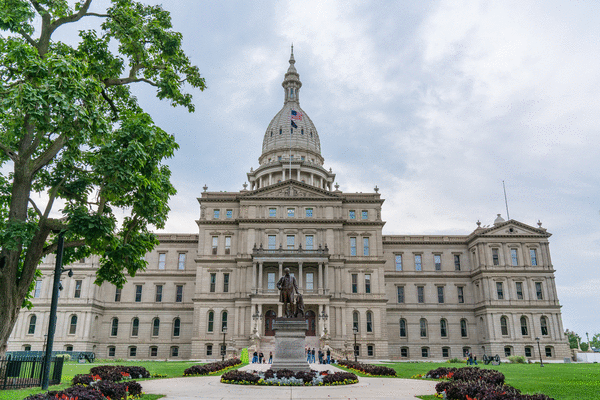
DETROIT — After Ramiro Sanders said he was thrown to the ground and handcuffed by U.S. Immigration and Customs Enforcement agents outside the 35th District Court in Plymouth in April, he and his spouse want to ensure courthouses and surrounding areas are safe for immigrants there on court business.
Sanders, who was released by ICE agents when they realized he was a U.S. citizen, and his wife, Laura Sanders, are two of the more than 2,000 people who have submitted written comments in favor of a Michigan Supreme Court proposal to prohibit warrantless civil arrests, such as immigration arrests, of a person while attending a court proceeding or having legal business in the courthouse.
“People are being good citizens when they follow up and go to court. We ask them to participate in due process, and they do,” Laura Sanders said. “For courts to then be places of entrapment for ICE and immigration makes people afraid to follow through and go to court and be good citizens.”
The Sanderses were in court accompanying a 26-year-old friend who was handling a traffic ticket. Ramiro said their friend was arrested by ICE after he left the courthouse and quickly deported to Mexico. Laura said they believe ICE agents racially profiled Ramiro and assumed he was their friend when the agents tackled and handcuffed him.
The Supreme Court justices are scheduled to hear public comment Wednesday to determine if they want to adopt the amendment. If they amend the court rules to ban civil arrests, ICE would not be able to arrest immigrants — here illegally or legally — who are going to court hearings or conducting legal business in the courthouse unless they have a valid warrant.
The amendment would apply to all state courts, which include circuit and district courts; the state Court of Claims; the state Court of Appeals; and the Michigan Supreme Court, but not federal courts.
Approximately 2,500 people have submitted written comments on the proposed change, the majority of which appear to favor the Supreme Court's approval of the amendment. The six Democratic-nominated justices approved publishing the proposal, while Republican-nominated Justice Brian Zahra opposed advancing the proposal for public comment.
Commenters like Jason Hicks said people attending court proceedings or conducting legal business in the courthouse "are not criminals, but people trying to follow proper rules and laws. It (has) been horrific that the state has permitted federal agents to terrorize individuals and families while simply trying to obey the law."
While there were few public written comments opposing the proposal, some criticized what they saw as a conflict that would be created between state and federal law if this proposal were approved.
"The proposed rule change appears to be an act of foolishness motivated by a political desire to proclaim that the State of Michigan is opposed to the federal government's current immigration policy," Lincoln G. Herweyer wrote. "But given that its purpose appears to be to either encourage state court judges and court staff to engage in unlawful behavior or to at least give those who obstruct federal agents in carrying out their lawful duties with a scienter-based defense to federal criminal charges, the proposed change evinces the exact opposite of a policy in keeping with the rule of law."
Another commenter, Connie Paulson, wrote that if someone has come to the U.S. illegally, they should have no rights anywhere, including in a courthouse.
"Leave and enter legally if you want to become a citizen," Paulson wrote.
Immigrants scared to go to courthouse
The initial request for the Supreme Court to review this issue was sent by the American Civil Liberties Union of Michigan and the Michigan Immigrant Rights Center, prompted by the January 2025 rescission of a former Department of Homeland Security policy that prohibited ICE from conducting immigration arrests in or near courthouses except under extraordinary circumstances. That change made people afraid to appear in court, said Susan Reed, a managing attorney with the Michigan Immigrant Rights Center.
"We’re really hearing from all non-citizens, even naturalized non-citizens, a lot of fear and concern around the intensity of the immigration enforcement environment," Reed said. "We want people to be able to go to court safely and take care of their business there."
Syeda Davidson, senior staff attorney at ACLU Michigan, said everyone in the U.S. — citizen or not — has the right to access state courts. Courts handle a wide variety of issues, from criminal proceedings to divorces, personal protection orders, traffic tickets, landlord-tenant disputes and civil lawsuits.
"Our justice system is at risk of being inaccessible to immigrant comms because they're being scapegoated and torn from communities in multiple horrifying ways, including at courthouses," Davidson said.
Bob Gillett, an attorney on the Michigan State Planning Body, which coordinates the delivery of legal services to low-income people, said court visitors also may be victims or witnesses in criminal cases. This issue is not about being "for criminals or against criminals," he said, but about allowing courts to continue functioning properly.
"It looks like a protection for individuals, but it's really a protection for the integrity of the court system," Gillett said.
Politicians support proposal
State Sens. Jeremy Moss, D-Southfield, Mary Cavanagh, D-Redford Township, and Stephanie Chang, D-Detroit, submitted a joint letter urging the Supreme Court to adopt the rule change, as did State Rep. Noah Arbit, D-West Bloomfield, U.S. Rep. Rashida Tlaib, D-Detroit, and Rep. Tonya Myers-Phillips, D-Detroit.
Cavanagh, Moss and Chang introduced a bill in August in the Democratic-controlled Senate that would restrict immigration enforcement actions in "sensitive locations," such as education institutions, places of worship, hospitals, courthouses, the sites of funerals, weddings or public religious ceremonies or at organizations assisting children, pregnant women, victims of crime or abuse or people with significant mental or physical disabilities. The bill was referred to a committee.
"This rule update would align Michigan with other states to ensure that individuals conducting legal business at courthouses — regardless of their citizenship status — are able to do so without the concern that they will be subsequently arrested for a matter unrelated to their business at the courthouse," the senators wrote.
Michigan Attorney General Dana Nessel also wrote a letter in favor of the rule change, noting that "the impact of the proposed amendment on ICE's operations will be minimal, and any impact is far outweighed by the need to protect and preserve the people's fundamental right to participation and accountability in the fair administration of justice."
_____
©2026 www.detroitnews.com. Visit at detroitnews.com. Distributed by Tribune Content Agency, LLC.






Comments