Delayed Cal Fire report shows state knew fireworks enforcement issues before Esparto deaths
Published in News & Features
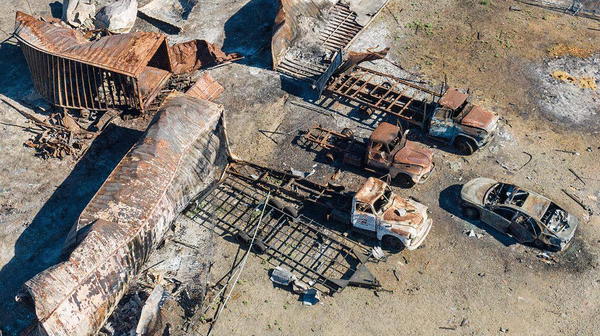
SACRAMENTO, Calif. — The year before California’s deadliest fireworks explosion in decades, the state agency tasked with regulating and investigating fireworks and explosions prepared to tell lawmakers about its enforcement problems — of which it had many.
Officials with the Office of the State Fire Marshal, a division of Cal Fire, drafted a report that explained how a lack of investigators limited the agency’s effectiveness in preventing large-scale incidents, that the cost of destroying growing stockpiles of seized illegal fireworks had outpaced its budget, and that local law enforcement across the state were unprepared to seize, store and report illegal fireworks.
The report was due last January, months before a backyard fireworks compound caught fire and sparked a series of explosions in Esparto that killed seven workers, rattling the rural Yolo County community.
But January came and went. It wasn’t until October — three months after the Esparto blasts and more than nine months past its deadline — that Cal Fire sent the report to lawmakers. Containing outdated figures and making no mention of the Esparto incident, the Cal Fire workload analysis shows the agency was fully aware of its regulatory shortcomings in the year leading up to the disaster.
“This should not have happened,” state Sen. Christopher Cabaldon, D-West Sacramento, said of the Esparto blasts. “And the cascade of government failures to protect people was extremely evident here.”
Authorities in California have struggled to police fireworks for years. Now, Cabaldon has introduced legislation to tighten regulations to prevent another tragedy. The bill aims at closing some of the regulatory gaps exposed by the fireworks operation in Esparto, which was operating in plain view, and with the apparent approval of local law enforcement and fire officials.
“Families in my district continue to grieve and to seek answers for how such a thing could happen,” Cabaldon said. “Esparto wasn’t isolated.”
The fireworks operation, run by the company Devastating Pyrotechnics, included several storage magazines and a warehouse on property owned by a Yolo County sheriff’s lieutenant. County building officials and the local fire chief knew about the fireworks facility but did not issue permits or conduct formal safety inspections. Families of the seven victims — workers who were preparing for a string of Fourth of July shows — have filed a civil suit seeking more than $35 million from Cal Fire, the Esparto Fire Protection District and Yolo County.
No criminal charges have yet been filed in connection to the incident. Cal Fire’s investigation into the cause of the fire remains ongoing. When it concludes, Cal Fire will submit its findings to the Yolo County District Attorney’s Office.
“We thought that concluding this report and investigation would be faster than it has been, because every time we think we are there…we get a new tip,” State Fire Marshal Daniel Berlant said in a November interview. “And it takes us in different directions. And so it becomes all these tentacles.”
A missed deadline
The Cal Fire report shows concerns about inadequate resources to enforce fireworks laws went unaddressed for years prior to the Esparto blasts. The report noted that a shortage of state fire marshal investigators limited the state agency’s capacity to investigate large-scale fireworks seizures and explosions. It also highlighted the need for more funding to destroy illegal fireworks and to train the state’s nearly 1,400 local public safety agencies handling and policing fireworks on the ground.
When Cal Fire finally delivered the report to lawmakers in October, the agency asked for funding to create five new investigative positions and to develop illegal fireworks training for local agencies.
In a statement to The Sacramento Bee, Cal Fire confirmed that it did not receive an extension on its Jan. 1, 2025 deadline to submit the report. Though the report was ultimately delivered in October, it makes no mention of Esparto or any other 2025 data.
“It takes time to gather the needed program history, data and facts, confer with subject matter experts, and make final recommendations with thoroughness and quality the legislature expects,” Cal Fire spokesperson Ed Fletcher said in a statement.
Cal Fire officials knew they were not going to make the statutory deadline for that report as early as February 2024, according to meeting minutes from the agency’s General Fireworks Advisory Committee.
“We are unable to meet the timelines laid out within the bill,” Chief Greg Andersen, who works in the Office of the State Fire Marshal, told the committee. The agency “will move forward with what we can but are limited by budget constraints.”
It is not clear whether meeting the deadline for the report would have resulted in resources or training that could have prevented the Esparto tragedy. But the agency has acknowledged the incident underscored the need to expand its investigations and close loopholes.
“At the end of the day, the families deserve answers,” Berlant said. “But we are the regulator of fireworks, and so we have to continue to close the loopholes to ensure that fireworks can be used or brought in the state legally.”
Cabaldon said in an interview he was aware of a required Cal Fire report but had not seen it, and did not know it had been filed more than nine months late, after his new bill was introduced in September. He was unsure if other lawmakers had seen the report, or why it would have been late or outdated.
The report was mandated by a previous set of fireworks regulations, passed in 2023 and spurred by a series of 2021 incidents, including a stockpile of illegal fireworks that exploded in a Southern California home, killing two, and an explosion that injured 17 people and leveled part of a South LA neighborhood.
The changes doubled maximum penalties for fireworks-related crimes and required Cal Fire to produce the workforce analysis report related to dealing with illegal fireworks and develop training in the proper management of seized fireworks for local fire and police personnel.
The dearth of investigators identified in the report factored into the agency’s ability to fully investigate potential leads, including those that pointed to Devastating Pyrotechnics before the tragedy.
Missed connections to Esparto
Cal Fire received tips and pieces of evidence, dating back to 2023, connecting illegal fireworks storage in at least two facilities in Southern California and the Bay Area to the company based at the Esparto compound. The full extent of the agency’s investigation into Devastating Pyrotechnics remains unclear, but it failed to prevent the July 1 explosions and deaths in Esparto.
A search warrant for the raid shows that Cal Fire was told that Devastating Pyrotechnics and its owner were responsible for the illegal fireworks operation before entering the Southern California warehouse, in Commerce, where officials seized a large cache of fireworks just weeks before the Esparto incident. The agency knew of the company’s state licenses, tied to the address of the Esparto compound, and did not search the property in the roughly six weeks between the warehouse seizure and the Esparto explosions.
“We are striving to provide you with as much information and documents as possible, as quickly as we can, while maintaining the integrity of this investigation,” Berlant said in a statement to The Bee last week, responding to the new information in the search warrant.
“It’s been our commitment to be as transparent as possible, without adversely impacting the investigation and any potential prosecution arising from it,” he added.
Berlant had previously told The Bee that the agency’s delay in investigating the links between Devastating Pyrotechnics and the Commerce warehouse was due in part to the agency’s limited resources, and the numerous tips that emerged from the raid.
But the Commerce seizure was not the first warning sign pointing at Devastating Pyrotechnics that Cal Fire did not thoroughly investigate.
In June 2023, a storage facility packed with illegal fireworks exploded in San Jose. The explosion and fire were investigated by the San Jose Police Department, which reported the fireworks to Cal Fire for disposal. An agency investigator was informed that the fireworks originated with Devastating Pyrotechnics in an email days after the San Jose explosion, according to records obtained by The Bee, but the agency did not vet the tip, which could have led to more scrutiny of the company’s Esparto operation years ago.
Lawmakers in recent committee hearings expressed support for the new fireworks-related bill introduced in response to Esparto. Several raised additional concerns related to fireworks enforcement, highlighting enforcement and investigation gaps between local jurisdictions.
“There’s all sorts of things that can happen, the dangers around fireworks,” state Sen. María Elena Durazo, D-Los Angeles, said in a hearing. “We had a situation in LA where there was a massive explosion in a very dense residential area, not that this would fix that particular problem, but the danger behind it is what everybody is looking out for.”
Closing loopholes after Esparto
In response to the deadly Esparto explosion, Senate Bill 828 aims to plug some of the gaps between local, state and federal fireworks regulations. Cabaldon, who authored the bill, expects its scope to broaden to address more of the inconsistencies exposed by the explosion in his district.
“This explosion revealed so many gaps, loopholes, failures to enforce, conflicts of interest — many of which are still being investigated,” Cabaldon told senators at a hearing last week. “One critical issue became clear immediately, and that is that our systems don’t talk to each other.”
The bill would make these systems more closely aligned. Absent new legislation, the likelihood of a local fire department in the Los Angeles area — where more than 300,000 pounds of illegal fireworks were seized from a warehouse with ties to the Esparto fireworks company — sharing data with one in rural Yolo County is “essentially zero,” Cabaldon told lawmakers.
It would also allow cross-validation of permits and licenses between local and state jurisdictions, while restricting people convicted of crimes from obtaining fireworks licenses – a loophole that apparently allowed Devastating Pyrotechnics owner Kenneth Chee to hold state licenses while barred from a federal license.
Under the revisions, Cal Fire would require proof of local permits for wholesale and storage fireworks licenses, addressing a loophole that allowed the Esparto facility to hold fireworks for years without having local permits.
Berlant said that the failure to cross-verify permits “is an immediately glaring loophole in regulations,” made apparent by suspected local conflicts of interest that have complicated the Esparto investigation.
If the bill passes, applicants will have to send Cal Fire their local permits and licenseholders would also be required to notify local authorities when they bring a shipment of fireworks into a jurisdiction.
“When dangerous materials are stored in our communities, everyone responsible for public safety should know about it,” Cabaldon said. “That’s not bureaucratic, it’s basic protection for lives, and in this case, our systems failed the people of my district.”
Although lawmakers are responsible for changes to state fireworks law, Cal Fire officials — who would not comment on pending legislation — have said the agency can make improvements on its own.
One of those changes is keeping a closer eye on what fireworks companies bring into California. Importers are supposed to notify Cal Fire when a shipment arrives, but a Bee investigation found that the companies linked to the Esparto property shirked that requirement for years.
Berlant said that Cal Fire will begin collecting importation records on file with federal agencies, which are publicly available, and cross-reference them with reports submitted to the agency.
Cal Fire also announced in August the formation of a new fireworks task force comprised of fire and police officials at the state and local levels. The task force is expected to share its findings later this month.
Lawmakers and the state fire agency hope new training will help local authorities better understand their role in the regulatory landscape.
“They are finalizing recommendations that will be public to help us in closing those loopholes,” Berlant said. ”We know now, based on what we learned from people doing the wrong thing, that we need to change the order in what I would call closing this loophole, and checks and balances.”
The tragedy that erupted from the fireworks compound more than six months ago in Esparto continues to expose gaps and loopholes in a fireworks industry that lawmakers and authorities believed to have been heavily regulated for safety.
“Esparto is driving changes that should have happened a long time ago and that may have prevented that tragedy,” Cabaldon said in an interview. “But I think the local residents (say), ‘Let us be the tragedy that drives the change that should have happened a long time ago to finally come into reality.’”
____
©2026 The Sacramento Bee. Visit at sacbee.com. Distributed by Tribune Content Agency, LLC.






Comments