Shot-spotter for space debris: New technique could locate dangerous material from old spacecraft
Published in News & Features
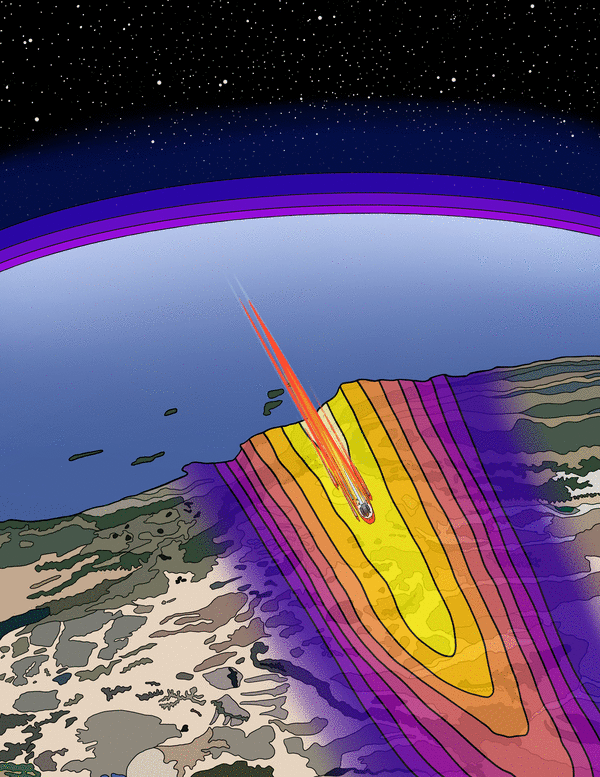
Networks created to measure quakes deep underground could also track old, potentially dangerous satellites burning up in the atmosphere, Johns Hopkins University researchers demonstrated.
“We’d like to get to the point where we can verify where something entered the atmosphere and whether any fragments reached the ground,” Hopkins researcher Ben Fernando told The Baltimore Sun. “These fragments are often quite small once they reach the ground.”
Fernando and other researchers used seismograph records to track the remnant of a Chinese Shenzhou-15 orbital module as it broke up over Southern California in April of 2024. The 1.7-ton spacecraft had been falling toward Earth for some time while passing over major population centers on six continents.
The seismic sensors recorded the shockwaves or sonic booms of the reentering debris, providing a clear track of its path. The team’s analysis provided critical information about the speed, trajectory, descent angle and fragmentation pattern of the debris, and their calculations matched the fiery breakup recorded by multiple eyewitness videos at the time.
They published their work in the journal Science on January 22.
The research is important, Fernando said, because although NASA designs its spacecraft to be deorbited in a controlled fashion, many companies and space agencies do not. Many spacecraft may deorbit with dangerous materials or toxic chemicals on board, including rocket fuel.
The risks posed by debris fragments reaching the ground continue to grow as Earth’s orbit becomes more crowded, they wrote. The number of satellites reentering the atmosphere has increased exponentially over the past five years. Radar systems cannot adequately track these fragments because, as they evaporate and literally burn through the atmosphere, they create a stream of plasma that interferes with radio signals.
“There’s a lot of reentries where we don’t know exactly where they happened,” Fernando said.
The Shenzhou-15 module fell from the sky 5,000 miles from where it was predicted to deorbit over the North Atlantic Ocean.
NASA estimates that close to 10,000 tons of old spacecraft, parts, satellites and other debris currently orbit Earth at speeds above three miles per second. It all has to come down sometime, somewhere.
Detecting satellites, or even meteorites, with existing seismic technology would not require any additional resources, Fernando said, just good software. Networks of seismometers exist throughout the world, with hundreds in Southern California alone. They have been known to pick up aircraft sonic booms and even whalesongs just offshore.
NASA scientists estimate that another 49 tons of meteorites fall to Earth every day, with almost all of them vaporizing in the immense friction of the atmosphere. Between 10 and 15 of those meteorites make it to the Earth’s surface.
In their current study, Fernando’s team teased out the sonic booms from historic seismic data using manual calculations. Fernando hopes to design software to passively monitor for similar signatures to pinpoint unexpected reentries and meteorites. The track these signatures provide could help locate hazardous materials and help meteorite hunters narrow their search.
_____
©2026 Baltimore Sun. Visit baltimoresun.com. Distributed by Tribune Content Agency, LLC.





Comments