After latest Minneapolis shooting: Exhaustion, resilience and deepening fear
Published in News & Features
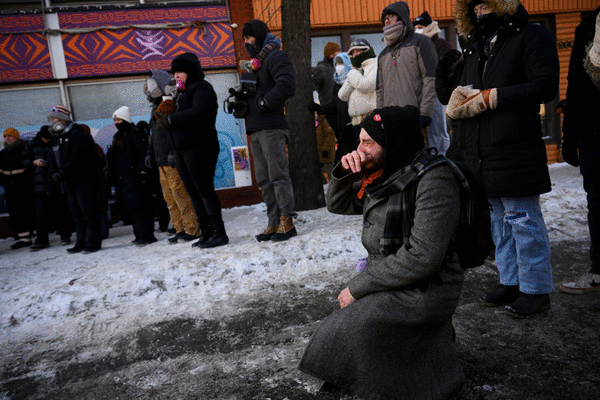
Thousands of protesters marched through the streets of Minneapolis on Jan. 23, in a peaceful, often buoyant show of resistance against the federal surge in immigration enforcement across the state.
Less than a day later, a violent confrontation sent the city reeling once again: Federal agents tackled and then shot and killed Alex Pretti, a 37-year-old ICU nurse from Minneapolis who had been filming them.
The Department of Homeland Security said Pretti had a gun and that the agent fired in self-defense. Details of that account aren’t supported by videos taken by others at the scene.
In the weeks since the Jan. 7 fatal shooting of Renee Good, Minneapolis has become a city on edge. Then, after the second fatal shooting by a federal agent in less than three weeks, the city’s anxiety, rage and deep sadness all seemed to spill forth. The incident upended any sense that the tensions building since federal agents arrived in Minnesota would lessen any time soon, leaving people wondering what’s next.
Fears about safety and concern for neighbors spread quickly, as businesses closed and events were canceled.
The location of the shooting, on Nicollet Avenue in the Whittier neighborhood, made it especially hard. The avenue is known as Eat Street, an immigrant-heavy urban corridor of global eateries and bars. The community around it is tight-knit.
“It’s not even about trying to protect certain people or anyone specific. It’s just the safety of all of us,” said Erica Christ, owner of the Black Forest Inn near the scene of the shooting. Her family opened the German restaurant in 1965.
“Immigrants saved Nicollet Avenue,” she said.
The feeling of unease, in Minneapolis and statewide, transcended political lines.
GOP State Sen. Zach Duckworth of Lakeville sees Minnesotans of all stripes upset and begging for calm.
Most Minnesotans occupy some sort of middle ground not reflected in the current political moment, he said: That immigrants who are violent criminals ought to be apprehended, but that things have gone too far.
“Today is a culmination of frustration being felt by all Minnesotans,” Duckworth said before putting on his Minnesota National Guard uniform on Jan. 24 to go serve. “People see what’s playing out on TV, the violence and the tactics, and they aren’t comfortable with it. A lot of reasonable folks out there are calling for a happy medium — if they continue to carry out operations in this state, to do it as safely as possible.”
Much of the city had shut down Jan. 23 in an economic boycott to protest ICE.
The promise of a calm Jan. 24 disappeared shortly after 9 a.m. Shots rang out along Minneapolis’ Eat Street, and graphic videos quickly spread on social media.
Protests gained steam, both near the site of the killing and at the federal building near the Minneapolis-St. Paul International Airport, where both immigrants and protesters have been detained. Near the scene of the killing, federal agents tossed flash-bang grenades and used a chemical irritant.
Events around the Twin Cities were abruptly canceled.
The NBA postponed Saturday’s nationally televised matchup between the Timberwolves and the Golden State Warriors. TwinsFest at Target Field ended early.
Art institutions shuttered all over the city: the Minneapolis Institute of Art, the Guthrie Theater, the Children’s Theater. Minneapolis College of Art and Design, not far from the scene of the shooting, issued an all-campus shelter-in-place.
A Linden Hills bookstore closed early, but not before announcing it would donate 50% of its profits to Unidos MN, a nonprofit that supports immigrants, among other causes. Small businesses and nearby restaurants, already struggling from the ICE surge, closed.
“This is so overwhelming and so sad,” said Tammy Wong, who has owned nearby Rainbow Chinese on Eat Street for decades. “This is our extended family. There are so many people texting me, customers and friends, seeing if we need anything. It’s so beautiful, everyone wants to help each other out.”
Within minutes of the killing, people imprinted their politics onto the rapidly unfolding situation.
The Department of Homeland Security quickly termed the killing “defensive shots” and released a photograph of the handgun the man, Pretti, had on him. (He had a legal permit for the gun.)
State and city Democratic leaders demanded the federal government end the surge. President Donald Trump accused Gov. Tim Walz and Mayor Jacob Frey of “inciting insurrection.”
In Long Prairie, two hours northwest of Minneapolis, GOP State Rep. Mike Wiener was at breakfast with family when he saw the news. He bemoaned politicians increasing the temperature after the killing.
“Who is going to be the adult in the room and say, Just stop’?” Wiener said. “This only pits neighbor against neighbor. Yes, protest is your First Amendment right. But there are times when is it the best thing to do?”
But DFL State Sen. Scott Dibble of Minneapolis sees those protests as righteous and necessary — and, he believes, only growing in Minnesota and nationally after Pretti’s killing.
“There’s a strong sense, a broad swath of the American people are waking up to the reality of a federal government that’s turning on its own people,” he said.
Pastor Andrew Baumgartner said his stomach dropped when he heard the news. He extended a community meal at the church so congregants could process the day.
“People are looking to be around people,” said Baumgartner, of Grace Lutheran Church in northeast Minneapolis. “We’re all thinking about it.”
All around, though, was that sense of deepening fear.
“Just being home is scary. Walking in the street is scary,” said Shizuka Durgins, president of the Cha-Ami Japanese Cultural Center, which moved classes online a few weeks ago because some students and instructors were afraid to leave their homes in south Minneapolis.
“Thousands of ICE agents coming into our city — why?” said Rabbi Marcia Zimmerman of Temple Israel, a mile from the shooting. “People don’t want go out of their homes. People are afraid. People are getting picked up. It seems to me we are making our city more violent since ICE has arrived.”
Back at the scene of the shooting, the smell of sage, candles and spray paint wafted through the air. Protesters chanted “Alex Pretti!” and banged trash can lids.
When Jack Guimont saw video of the shooting, he started shaking.
“This is the future of us,” he said, his voice trembling. “This is where I’m from. I’m from Anoka. I work in Minnetonka. I went to school in Winona. I grew up here.”
As he spoke, he held an American flag. His friend, Eli Baker, draped a Minnesota flag over his shoulders.
_____
(Kim Hyatt, Kyeland Jackson, Alicia Eler, and Chris Hine of the Minnesota Star Tribune contributed to this story.)
_____
©2026 The Minnesota Star Tribune. Visit startribune.com. Distributed by Tribune Content Agency, LLC




Comments