Maryland Gov. Moore: 'I will not sit quiet' on redistricting as House deliberates proposed map
Published in News & Features
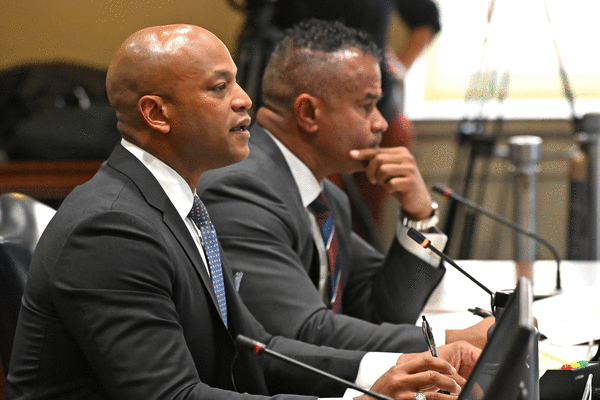
BALTIMORE — The Maryland House Rules and Executive Nominations Committee heard testimonies Tuesday afternoon on a proposal to redraw the state’s congressional district lines mid-decade. The move could significantly alter Maryland’s political map and deepen an open rift between Democratic leaders in Annapolis.
The committee considered legislation, sponsored by Charles County Del. C.T. Wilson, to implement new congressional boundaries recommended by Gov. Wes Moore’s Redistricting Advisory Committee last week. The proposed map would substantially reshape the 1st and 3rd congressional districts and could make reelection more difficult for Rep. Andy Harris, the only Republican in Maryland’s congressional delegation. The committee will also discuss a Republican-led bill to alter the requirements of state and congressional redistricting, called the Fair Districts for Maryland Act.
“We have to choose between districts that look good versus districts that do good,” Wilson, a Democrat, said in his opening remarks during the hearing, pointing to the Trump administration’s policies that he said have increased the cost of living and abridged individuals’ First Amendment rights — arguments Democrats across the country have made in favor of tipping election odds in their favor by redrawing maps.
Testifying before the committee, a defiant Moore said that from day one, he was clear that “Maryland would be a part of [the] conversation” regarding drawing fair maps. “The Commission’s recommendation was shaped by public services. It was shaped by public hearings. It was shaped by public feedback, and that is how our democracy is supposed to work,” Moore said.
The governor cast redistricting as a critical pushback to Trump’s own redistricting effort and to the president’s policies, adding that the president aims to quiet minority voices.
“Make no mistake, what the president of the United States is doing right now is political redlining, and it’s not lost to me that I’m the only Black governor in this country, only the third elected Black governor in the history of this nation,” Moore said. “So now I will not sit quiet, and the audacity of those who are telling me to do so shows that they have no understanding of the journey of so many who came before us,”
Republicans in both chambers have criticized the proposal, arguing that while they consider Maryland’s current congressional map unfair, they believe the new plan was designed to weaken Harris and reduce Republican representation at the national level.
Following Wilson and Moore’s testimonies, House Minority Leader Jason Buckel told both legislators that the redrawn maps were “clearly drawn with purely partisan purposes.” Highlighting a timeline of redistricting changes in Maryland, House Minority Whip Jesse Pippy and Republican Del. Teresa Reilly questioned whether the goal of this bill is to make it 8 Democrats to 0 Republicans — a question they said Wilson repeatedly evaded. Reilly represents Cecil and Harford counties.
The committee could vote on the measures immediately after the hearing, potentially sending it to the House floor and setting up a clash with Senate President Bill Ferguson, who has repeatedly said he will not budge on his opposition to midcycle redistricting.
“I don’t think much has changed since our initial analysis,” Ferguson, a Baltimore City Democrat, told reporters Tuesday ahead of the hearing. “We’re well past the window of opportunity of doing anything even were that the case.”
Ferguson cited looming election deadlines and warned that any legal challenge to a new map would likely extend beyond the point at which district boundaries must be finalized. “The attorney general says it’s going to take at least three to four months to litigate any case,” he said. “We’re at the end of January.”
Under the bill, voters would be asked in 2026 to approve the new congressional boundaries through a statewide referendum. If voters reject the plan, the state would continue using the congressional map adopted in 2022 until the next Census. Ferguson said even that approach could create legal uncertainty and disrupt election administration.
“This wouldn’t even be in effect for 2026,” he said, noting that a petition drive would delay implementation and could force a special election in early 2027. “There are so many legal challenges and issues here.”
Roughly 500 people plan to testify in response to the governor’s redistricting commission, according to a speaker sign-up sheet provided to The Baltimore Sun by Ferguson’s office ahead of the hearing. 396 people — more than 76% of signees — are against the proposal, compared with about 120 people, or roughly 23%, who signed up in support.
The hearing also comes amid mounting pressure from national Democrats, who have urged blue states to redraw congressional lines in response to Republican-led efforts in states like Texas, Ohio and North Carolina.
Ferguson, however, dismissed the suggestion that the Senate’s position is being driven by outside pressure, telling The Sun he has not had recent conversations with national Democratic leaders. “They sort of know where I stand and where I think the Maryland Senate stands,” he said.
Moore has echoed that message, saying he “does not take instructions” from national Democrats and dismissing suggestions that he could be swayed by outside pressure. Still, he privately met last week in Washington with U.S. House Minority Leader Hakeem Jeffries, the highest-ranking Democrat in Congress. Details of their discussion remain unclear.
Harris, whose Eastern Shore-based district would be redrawn to include Democratic-leaning suburbs in Anne Arundel and Howard counties, said he will not attend Tuesday’s hearing.
“This is a sham hearing with a pre-determined outcome,” Harris told The Sun in an email on Tuesday.
Even if the House advances the bill, its fate in the Senate is uncertain. Despite echoing a message of unity, Ferguson declined to say whether the measure would receive a vote if it clears the lower chamber. “We’ll see what happens in the House,” he said. “We have a lot of important issues to take up first.”
----------
Jeff Barker contributed to this report.
----------
©2026 The Baltimore Sun. Visit at baltimoresun.com. Distributed by Tribune Content Agency, LLC.






Comments