Ex-Illinois deputy sentenced to 20 years in prison for Sonya Massey second-degree murder conviction
Published in News & Features
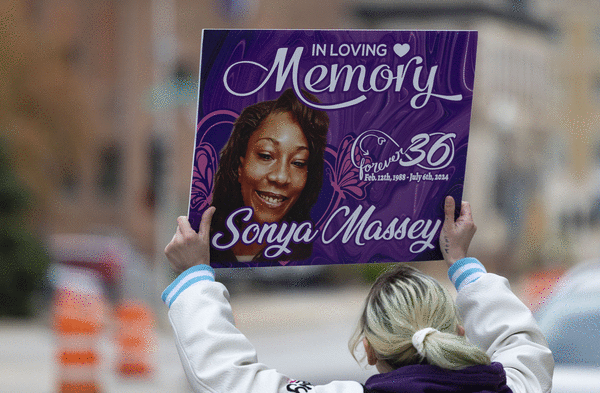
SPRINGFIELD, Ill. — Former Sangamon County Sheriff’s Deputy Sean Grayson was sentenced to 20 years in prison Thursday after his second-degree murder conviction for the 2024 fatal shooting of Sonya Massey, a killing that generated national outrage, protests and calls for changes to police hiring practices.
Sangamon County Judge Ryan Cadagin issued the maximum sentence allowed.
“Thank you, thank you, God,” a woman said softly from the gallery in the Sangamon County courtroom.
The case was defined by graphic police body camera footage shown widely across the nation of Grayson, who is white, fatally shooting Massey, a 36-year-old Black mother of two who at the time was dealing with mental health challenges, while he responded to a call at her home just outside Illinois’ capital city.
The video amplified the harsh treatment Black citizens have sometimes faced at the hands of law enforcement, attracting attention from then-President Joe Biden, who said Massey’s slaying “reminds us that all too often Black Americans face fears for their safety in ways many of the rest of us do not.”
The case also underscored law enforcement’s often-imperfect hiring practices, as Grayson had worked for five other law enforcement agencies before being hired by the Sangamon County sheriff’s office, despite some of his previous employers criticizing his performance as an officer.
The sentencing came down a little more than an hour after the hearing for Grayson began at 9 a.m. before Cadagin at the Sangamon County Courthouse in Springfield’s downtown area.
Before Cadigan imposed the sentence, Donna Massey, Sonya Massey’s mother, delivered a victim impact statement through sobs, saying she’s afraid of contacting the police if she needs help.
At the end of her statement, she looked at Grayson and said, “I rebuke you in the name of Jesus,” the same words Massey said to Grayson moments before he shot and killed her.
Grayson also addressed the court before he was sentenced. He apologized for his actions and, speaking to Cadigan but referring to Massey’s family, said: “I just hope that one day they would be forgiving.”
“I was very unprofessional that night,” Grayson said somberly. In the courtroom, he was shackled and clad in white-and-black-stripped jail garb. “Your honor, I made a lot of mistakes that night…I made terrible decisions that night…I wish there was something I could do to bring her back.”
Mark Wykoff, one of Grayson’s lawyers, tried to argue for a six-year prison sentence, saying in part that Grayson has colon cancer that has spread.
Grayson had initially been charged with first-degree murder. But the jury during his trial was allowed to consider convicting Grayson of second-degree murder, which is a lesser charge that does not carry mandatory prison time, as defendants can be sentenced to four to 20 years in prison, or even receive probation.
Massey was killed at her home after deputies responded to her 911 call about a possible prowler early on July 6, 2024.
Inside her home, as Grayson spoke to Massey, the officer allowed her to move a pot of water heating on the stove, and she set it on a counter. Moments later, Grayson yelled at Massey over the pot and pulled his 9 mm pistol. Massey put her hands in the air, declared “I’m sorry” and ducked for cover before being shot in the face.
Body camera footage from Grayson and his partner, Dawson Farley, was a central focus for Sangamon County prosecutors during Grayson’s trial in October.
Their case also centered on accusations that Grayson, now 31, repeatedly failed to follow law enforcement policies or training, damaging testimony from Farley suggesting Grayson didn’t do enough to help save Massey’s life after shooting her, and Grayson’s own testimony that shooting Massey was a way to “match” the level of her threatening actions.
Grayson’s lawyers tried to argue during the trial that their client killed Massey in self-defense.
In his opening statement to the mostly white jury, which included one Black man, one of Grayson’s lawyers, Daniel Fultz, argued that someone would not reasonably think Grayson made up his mind to kill Massey when the officer went to her home. He also alluded to a point in the body camera footage when “she makes a comment along the lines of ‘don’t hurt me,’ and Grayson responds, ‘why would we hurt you?’”
From there, Fultz argued, the encounter quickly escalated into a situation in which Grayson needed to protect himself and his partner from the danger posed by the boiling water.
The trial occurred at the Peoria County Courthouse, some 75 miles from Massey’s home, amid concerns from Grayson’s defense team that he wouldn’t be able to get a fair trial in Sangamon County due to the extensive media coverage of the killing in the Springfield area. Demonstrations also occurred outside the courthouse during the trial.
After Massey’s death, Grayson got fired, the Sangamon County sheriff at the time of the shooting, Jack Campbell, resigned, and attorneys Ben Crump and Antonio Romanucci helped Massey’s family secure a $10 million settlement from Sangamon County.
Gov. JB Pritzker approved a measure requiring local and state law enforcement agencies in Illinois to be more transparent about former officers’ work histories when they seek employment with another police force in the state.
A local commission was also established in Massey’s name for community leaders to examine certain issues, including societal inequalities in minority neighborhoods, in the Springfield area.
Late last year, the Massey Commission issued a report to make a series of recommendations that included structural changes in the hiring practices, training and accountability mechanisms at the Sangamon County Sheriff’s Office and other law enforcement agencies within Springfield. It also emphasized anti-bias training.
Among other things in the report, the commission also called for a county-wide mental health board and “integrated crisis response protocols” for residents experiencing mental health episodes.
____
©2026 Chicago Tribune. Visit at chicagotribune.com. Distributed by Tribune Content Agency, LLC.



Comments