Panel tosses ex-UCLA doctor's sex abuse conviction; lawyers weren't told of juror's 'limited English'
Published in News & Features
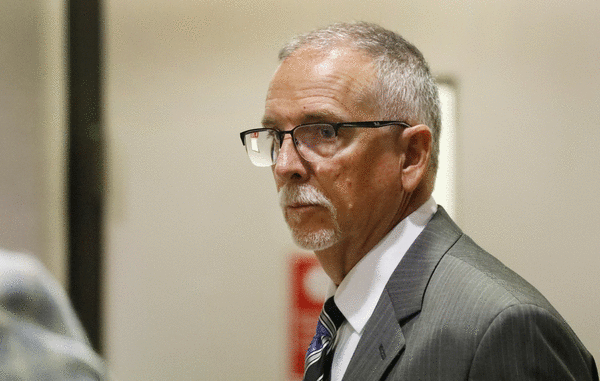
LOS ANGELES — An appeals court on Monday overturned a conviction for an ex-UCLA gynecologist serving 11 years in prison on charges of sexually abusing patients after determining that the trial judge failed to inform his lawyers that some of the jurors raised questions about the English proficiency of one of the panel members.
A three-justice panel of the California 2nd District Court of Appeal ordered that the once-renowned cancer expert, James Heaps, 69, be sent back for a retrial on the charges involving the two patients he was convicted of abusing.
In October 2022, after a complex two-month jury trial, Heaps was convicted of three counts of sexual battery by fraud and two counts of sexual penetration involving the two patients. Jurors acquitted him of abusing two other patients and deadlocked on charges involving four more patients. In April 2023, a judge sentenced him to 11 years in prison.
The University of California system paid nearly $700 million to settle lawsuits brought by hundreds of Heaps' accusers.
John Manly, who represented more than 200 former patients in a lawsuit that resulted in the settlement with UCLA, said the reversal of Heaps' conviction is "an indictment of California's criminal justice system which allows criminals to threaten public safety and prey upon the most vulnerable.''
"These brave survivors suffered through a four-year ordeal of prosecution and trial resulting in an 11-year prison sentence for this monster," he said. "Now they are being told that they must start over. ... Our criminal justice system needs reforms that put victims first.''
During the jury deliberations, Los Angeles County Superior Court Judge Michael Carter, who presided over the trial, sent a judicial assistant, Luis Corrales, into the jury room to speak to the jury about a note sent by the foreperson describing the jurors' "collective concern" that Juror No. 15 "did not speak English sufficiently to deliberate and had already made up his mind," the appeals panel wrote.
Juror No. 15 had been an alternate on the jury, but on Oct. 18 he replaced Juror No. 8. Only an hour later, the jury sent the note, signed by the foreperson. The note stated, "We have observed that the language barrier with Juror (No.) 15 is preventing us from properly deliberating. Juror (No.) 15 was not able to understand calls to vote guilty or not guilty, and expressed to us that his limited English interfered with his understanding of the testimony."
The judicial assistant spoke to the jury in English and, at the request of Juror No. 15, in Spanish. "At no time did the trial judge inquire of the jury or inform trial counsel of the note's existence," the appeals panel said, adding that the conversations with the judicial assistant were not transcribed.
Heaps' defense lawyer was not informed of the note or of the communications, and the trial proceeded to a verdict.
Leonard Levine, Heaps' trial lawyer, in a declaration to the appeals panel, said that had he been informed of the note, he would have sought to determine whether Juror No. 15 was "qualified to serve" and investigated the juror's limited English and the jury's view that Juror No. 15's mind "is already made up."
The Court of Appeal found "the trial court's handling of the note deprived defendant of his constitutional right to counsel at a critical stage of his trial."
"The failure to notify counsel about the jury's note and the judicial assistant's ex parte communications with the jury during deliberations amounted to a violation of the defendant's Sixth Amendment right to counsel," the panel found. The three-judge panel noted that it did not assess the juror's English ability; rather, that was the shared opinion of the juror's fellow jurors.
The appellate court found that the prosecution failed to meet its burden to demonstrate, beyond a reasonable doubt, that the constitutional error was harmless. As a result, the panel reversed the conviction and remanded it for a new trial.
"We recognize the burden on the trial court and, regrettably, on the witnesses, in requiring retrial of a case involving multiple victims and delving into the conduct of intimate medical examinations. The importance of the constitutional right to counsel at critical junctures in a criminal trial gives us no other choice," acting Presiding Justice Helen I. Bendix wrote on behalf of the panel, with Associate Justices Gregory J. Weingart and Michelle C. Kim concurring.
The ruling overturns Heaps' convictions for sexual battery by fraud, a crime jurors found involved separate acts of violence or threats of violence, two counts of sexual penetration of an unconscious person by fraudulent representation and two counts of sexual battery by fraud. He is currently at California's Correctional Training Facility in Soledad.
_____
©2026 Los Angeles Times. Visit latimes.com. Distributed by Tribune Content Agency, LLC.






Comments