US ski resorts turn to drones to make it snow amid dire drought
Published in News & Features
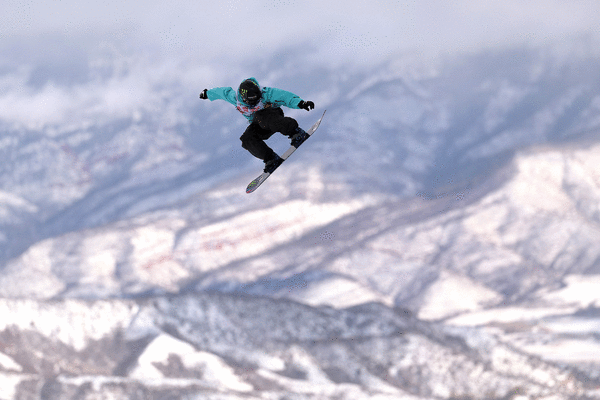
Despite a barren start to Colorado’s ski season, Winter Park Resort opened on Halloween and served up holiday powder.
The ski area’s secret is a contraption a few miles upwind of the chairlifts that looks like a meat smoker strapped to the top of a ladder. When weather conditions are just right, a Winter Park contractor fires up the machine, burning a fine dust of silver iodide into the sky — a process known as cloud seeding. Ideally, the particles disappear into a cloud that is cold enough and wet enough to produce snow, but may need a nudge. The silver iodide becomes the nuclei for water droplets, like iron filings to a magnet. Those droplets freeze and fall from the sky as snowflakes, freshening up the slopes of the resort as it tries to lure the Gore-Tex-clad masses between Denver and larger, showier ski destinations further west.
Doug Laraby, who has helped run Winter Park for nearly four decades, says the resort leaned heavily on its cloud seeding equipment over the Christmas holiday, sprinkling the skies as fresh powder fell days before the critical New Years weekend. At the moment, Winter Park has more snow than Breckenridge, Keystone and a host of bigger resorts nearby.
“For us,” Laraby explains, “that was a million-dollar storm.”
Resorts are increasingly seeking solutions to freshen up the brown slopes spanning the American West this winter, even as the East Coast grapples with back-to-back storms. Last month, Vail Resorts Inc. — which owns nearly 50 resorts across the U.S. and Canada — said it would miss revenue projections due to subpar snowfall this season. The dramatic lack of precipitation in the Rockies “limited our ability to open terrain” and, in turn, crimped spending by both locals and destination guests, Chief Executive Officer Rob Katz said in a statement.
In a battle to improve — or at least maintain — snowpack in the face of rising temperatures and drought, Winter Park, operated by Vail rival Alterra Mountain Co., is one of a growing number of groups in the American West doubling down on cloud seeding, from state governments and ski hills to utilities and watershed management agencies.
Desperate for water — ideally snow — they’re banking on the strategy to buoy the $6 billion U.S. ski industry, while keeping rivers and reservoirs at healthy levels come spring. Despite the promise, though, companies are still trying to amass data showing the technology can actually deliver appreciable amounts of powder. And scientists studying cloud seeding have cast doubt on just how effective it is.
Katja Friedrich, an atmospheric science professor at the University of Colorado, concedes that cloud seeding works in a lab. “But out there,” she says, gesturing to cirrus clouds sweeping over the Front Range outside of her office, “it’s a totally different business.”
Storms are volatile, complex and unforgiving places to gather data. “The application is so far ahead of what the science actually shows,” Friedrich explains. “Usually, it’s the other way around.”
The idea of cloud seeding dates back to the 19th century, and it got an unexpected boost thanks to research at General Electric in the wake of World War II. DRI, a nonprofit research institute in Nevada, started cloud seeding in the 1960s. Putting particles in clouds to create precipitation gained traction in recent years as waves of drought hit the U.S., tallying $14 billion in damages in 2023 alone.
DRI now runs cloud-seeding operations all over the West, including the program at Winter Park. In 2023, the Winter Park generators burned for the equivalent of five straight days, planting an estimated 24 inches of powder on the slopes that wouldn’t have been there otherwise, according to DRI. That equates to 13% of what would have fallen naturally.
“The main driver [for our clients] is water resources,” says Frank McDonough, a DRI research scientist. But, he notes, “we can help the entire mountain economy.”
Private companies are also playing a growing role, most notably Rainmaker Technology Corp., a startup that is now the lead cloud seeding contractor for Utah, which has built one of the most aggressive programs in the American West. From a warehouse in Salt Lake City, founder Augustus Doricko, a 25-year-old with a resplendent mullet that belies his Connecticut childhood, manages a crew of 120, mostly young people working to make it snow on mountains they might otherwise be climbing or skiing.
When the weather looks right, Rainmaker crews pile into 12 pickups, each loaded with two drones, and convoy up the canyons of the Wasatch Mountains. They send half of the drones whirring into the soup of clouds and spray silver iodide for about an hour. When the machines come down to recharge, the team launches the second wave. The cycle is repeated until the clouds move on or get too warm.
Doricko says his company is creating a fresh supply of water with no ecological impact; silver iodide is inorganic and even if ingested, won’t dissolve in the human body.
This year, the state of Utah will pay Rainmaker $7.5 million, part of a cloud seeding blitz that began three years ago. With the Great Salt Lake at historic low levels, Utah lawmakers approved a tenfold increase in funding, committing at least $5 million a year to operations and another $12 million to upgrade and expand a fleet of almost 200 cloud seeding machines on the ground.
Rainmaker is charged with generating enough snow to help partially refill the lake. The company also has a contract with Snowbird Resort, located to the east of Salt Lake City, and much of its seeding will happen near Powder Mountain and Snowbasin resorts, located further north, although neither ski area is a client.
“Anything we can do to increase water levels is going to be well worth the funding,” says Jonathan Jennings, a meteorologist with the Utah Department of Natural Resources.
The list of stakeholders clamoring for more water in the American West is long, ranging from ski resorts to wildfire fighters, reservoir managers to farmers.
“Every state in the West is either cloud seeding or thinking of cloud seeding,” says Friedrich, the University of Colorado researcher.
It’s also popular, in part, because it’s cheap. Jennings estimates that it costs about $30 to produce 325,000 gallons of water, or what experts call an acre-foot of water. Recycling or desalinating a similar amount would cost somewhere around $1,000. Snowmaking, meanwhile, is more expensive and uses more water than it produces.
When Doricko visits potential customers, be they utilities, ski resorts or state agencies, his sales script is simple: “It's the only way you can bring new water supply to the Rocky Mountain West.”
More often than not these days, the pitch lands. Idaho has also hired Rainmaker this winter, eager to fill its reservoirs and keep farmers happy. All told, the company has about 100 drones flying across Western skies.
In Colorado, where arid conditions have exacerbated wildfires, officials are curious about the capabilities of Rainmaker’s drones while waiting to see this winter’s snow tallies from Utah. In the meantime, they’re working to replace decades-old, ground-based seeding machines with ones that can be switched on remotely. Without the need of a human to light the burner, the new units can be tucked into more remote places and at higher elevations that are colder for longer, improving the odds for snow.
“We feel comfortable saying we can get an additional eight to 12% of precipitation per storm,” says Andrew Rickert, a weather modification program manager with the Colorado Water Conservation Board. “And if we have a great winter in Colorado, there are 30 to 35 storms we can seed.”
Friedrich isn’t so sure about that estimate, despite being regarded as a bit of a rockstar in the cloud seeding field. In 2017, her research team zig-zagged a plane rigged with seed flares through a cloud in Wyoming that wasn’t producing snow. Sure enough, snow fell in the same pattern as the flight, results that fueled much of the recent seeding boom.
However, Friedrich points out, there wasn’t that much snow. And she notes that much remains unknown, like how wind affects the amount of silver iodide that gets into a cloud, and whether the particles trigger much precipitation beyond what would occur naturally.
“I understand why people are buying it, because they're so desperate,” she says. “But if you ask me, there's no scientific proof” that it produces a meaningful amount of water. Friedrich is working on a new study to try to figure out how effective ground-based cloud seeding can be and the best operating conditions.
Cloud seeding has also faced pushback from conspiracy theorists who say it works too well. Despite no evidence, Rainmaker was inaccurately implicated in last summer’s deadly Texas floods, and bills to ban weather modification have been filed in dozens of statehouses across the U.S., including those of Colorado and Utah. Former Georgia Representative Marjorie Taylor Greene also introduced a federal cloud-seeding ban in Congress in the wake of last July’s floods.
Doricko, at Rainmaker, has been working to convince lawmakers that cloud seeding does no harm and, on the other front, win over skeptical scientists like Freidrich. Rainmaker spent much of the spring and summer building its own radar system and deploying a layer of on-the-ground weather stations to measure results. It’s also working with independent researchers to provided peer-reviewed validation. As Friedrich did years ago, Rainmaker tries to spray silver-iodide in zig-zag patterns, so its results are more visible on radar — a so-called “seeding signature.”
Doricko acknowledges the challenge of teasing out the exact influence of manmade cloud seeding — which he jokingly refers to as “magic beans” — from natural precipitation. “Our fundamental research on now at Rainmaker is all about what kitchen sink of sensors can we throw at this problem to actually validate” our work, he says.
Vail abandoned its cloud seeding program in 2020, shifting its resources to invest heavily in machines that use water to spray artificial snow. The newest snow guns monitor weather in real time and can be programmed remotely.
“This technology means that Vail can make the most of every moment that conditions allow for snowmaking,” says spokeswoman Michelle Dallal. Still, the resort is feeling the pinch of an abnormally dry winter.
State officials are trying to get Vail back on board. Cloud seeding, they argue, can be cheaper than snowmaking, both in terms of cost and carbon, and it adds water to the ecosystem, rather than taking a share of it away. The state is also trying to get other ski areas to buy in: This year, Colorado positioned a ground system to seed clouds on the slopes of Aspen, in hopes that the resort will help fund future programs.
Meanwhile, Winter Park has emerged as one of the state’s biggest cloud seeding cheerleaders. Laraby says only 10% of the mountain is covered by snowmaking gear, and there are no plans to install more. And yet, when the storms rolled through the state Dec. 28, Winter Park says its cloud-seeding efforts conjured 12 inches of snow, triple what fell on Vail.
“If you ask me, it enhances the efficiency of these storms,” Laraby says. “I think it’s awesome.”
©2026 Bloomberg News. Visit at bloomberg.com. Distributed by Tribune Content Agency, LLC.






Comments