Trump heralds billions in aid, troop commitments for Gaza
Published in News & Features
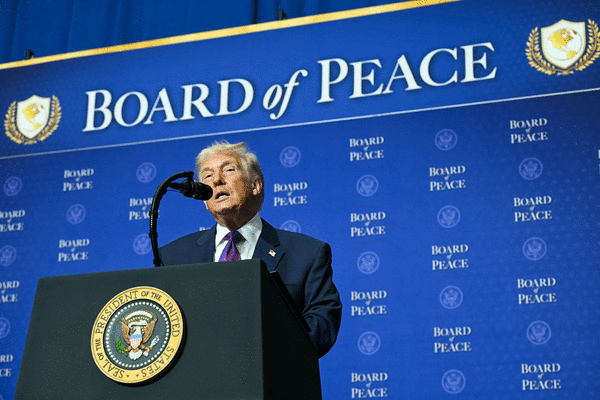
WASHINGTON — President Donald Trump said his Board of Peace received roughly $17 billion in pledges toward humanitarian and reconstruction efforts in Gaza, and that more than half a dozen countries promised personnel to a stabilization force in the war-torn territory.
The announcements made Thursday during the group’s first meeting in Washington came as major questions remained over how to wrest control of the territory from Hamas. The U.S. would contribute $10 billion, Trump said, while a collection of other member states promised $7 billion.
“We’re providing a model for how responsible sovereign nations can cooperate to take responsibility for confronting problems in their own regions,” Trump said. “With the commitments announced today, the Board of Peace is proving that it does not just convene countries. It devises and implements and real solutions happen.”
The board is an attempt by Trump to burnish his self-styled reputation as a peacemaker. He ran for office on a promise to keep the U.S. military out of overseas conflicts and has repeatedly claimed to have ended at least eight wars, though several were smaller in scale. Other claims involved conflicts where he had little role or that ended long ago. The gathering came as U.S. forces are amassing in the Persian Gulf for a potential strike on Iran, and weeks after he ordered a brazen military raid to capture Nicolas Maduro in Venezuela.
On Thursday, Trump provided little detail about how his planned stabilization force would wrest control of Gaza from Hamas, the militant group that has run the territory for decades with an iron fist, or how the money would be spent. Trump predicted that Hamas, designated a terrorist group by the U.S. and European Union, would “give up their weapons” and threatened it would be “harshly met” if its leaders refused.
The U.S. president said that Indonesia, Morocco, Albania, Kosovo and Kazakhstan would provide troops and police to the force in Gaza, and that Egypt and Jordan would offer personnel and training for a “trustworthy Palestinian police force.”
Saudi Arabia, the United Arab Emirates, Qatar, Kazakhstan, Azerbaijan, Morocco, Bahrain, Uzbekistan and Kuwait are among those who have promised “more than $7 billion toward the relief package,” Trump said. The U.S. president also said Norway would host a future event for the board and that Japan plans to hold a fundraiser for Gaza relief.
The board was originally proposed as part of a 20-point peace plan for Gaza, conceived with overseeing its postwar stabilization and reconstruction. The U.S. president has promised to remake Gaza even as such an effort faces numerous obstacles, including uncertainty over whether Hamas will give up its arms and the scope and cost of clearing and rebuilding a territory shattered by conflict.
“Maybe we’re going to make a deal where you’re you’re going to be finding out over the next, probably 10 days,” Trump added. At the same time he downplayed ongoing clashes between Israel and Hamas in Gaza.
“The war in Gaza is over. It’s over. There are little flames,” Trump said.
The Board of Peace, more broadly, has drawn reservations from some allies, worried about its makeup and a mission that appears to stretch well beyond Gaza.
Trump has suggested the Board of Peace could take on other global conflicts, raising worries in some foreign capitals that it could evolve into a rival to the United Nations, particularly over crises that are traditionally handled by the U.N. Security Council. Trump has long assailed the U.N. as ineffective.
Trump on Thursday hailed his Middle East envoy, Steve Witkoff, and son—in-law Jared Kushner for their work in addressing numerous global flashpoints, including ongoing talks with Iran over its nuclear program. Trump said he was also making Kushner “an envoy of peace,” without explaining how the title would change his role.
“Iran is a hotspot right now, and they’re meeting and they have a good relationship with the representatives,” Trump said about the ongoing negotiations. “Good talks are being had. It’s proven to be over the years, not easy to make a meaningful deal with Iran. We have to make a meaningful deal, otherwise bad things happen.”
Trump formally launched the Board of Peace during his visit to Davos, Switzerland for the World Economic Forum last month, alongside political allies such as Argentine President Javier Milei and Hungarian Prime Minister Viktor Orban. Key allies from the Group of Seven and EU, however, kept their distance, cautious about embracing a new structure whose authority, legal basis and relationship to existing institutions remain murky.
Questions remain unresolved, including how the board’s decisions will be enforced, how it will coordinate with the U.N. and regional organizations and whether enough democratic U.S. allies will participate to give it legitimacy.
Trump on Thursday said the Board of Peace is “going to almost be looking over the United Nations and making sure it runs properly.”
Trump has said countries seeking permanent membership on the board would be required to contribute $1 billion. He’s also said Russian President Vladimir Putin has been invited to participate, straining relations with allies over Putin’s invasion of Ukraine.
--------
—With assistance from Hadriana Lowenkron and Skylar Woodhouse.
©2026 Bloomberg L.P. Visit bloomberg.com. Distributed by Tribune Content Agency, LLC.





Comments