Analysis: Trump told MAGA supporters that 'we won' in Iran. They were silent
Published in News & Features
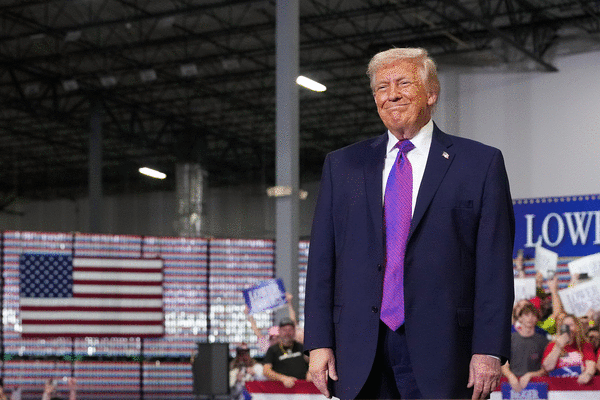
WASHINGTON — The silence from the Kentucky crowd, many wearing “Make America Great Again” gear, was deafening.
The friendly audience in the commonwealth’s 4th District already had booed loudly at President Donald Trump’s mention of “Barack Hussein Obama,” with emphasis on the 44th president’s middle name. It would later howl as the showman in chief verbally eviscerated Rep. Thomas Massie, the area’s Republican congressman who has dared to defy him, including on releasing the Jeffrey Epstein files.
But when the unexpected wartime commander in chief declared that “we’ve won” his surprise war with Iran that he announced in the middle of the night on Feb. 28, no one cheered. In fact, there were no sounds at all inside the Verst Logistics Order Fulfillment Center in Hebron.
There wasn’t even tepid applause.
The crowd had been in a cheering mood just seconds earlier, first when the MAGA movement’s founder touted a $1.5 billion uranium enrichment facility four-hours-and-change south in Paducah, Kentucky, nor when he, in true showman mode, dropped the official name of the Iran mission, saying “Operation Epic Fury” dramatically and with a raised voice.
But he then conjured George W. Bush’s Navy ship deck “Mission Accomplished” moment just 12 days into the Iran war — and with the Islamic Republic government still intact. “Is that a great name? Well, it’s only good if you win. You know, you can only do, and we’ve won. Let me tell you, we’ve won,” he said. “You know, you never like to say too early you won. We won. We won the, in the first hour, it was over. We won.”
But no matter how many times Trump made the questionable claim, there was only silence.
Such surreal scenes and comments this week were a reason why some Democratic senators said Team Trump went to war with no in-depth planning — including on the key question of how they would secure Tehran’s stores of enriched uranium. The perhaps-too-early victory declaration was one of many questionable statements about the Iran operation uttered this week by Trump and his inner circle that created their own collective kind of fog of war.
While the scene in Kentucky, a commonwealth that Trump won three times, was audible, other examples were visual.
After Air Force One ferried him back to a rainy Joint Base Andrews outside Washington, D.C., on Wednesday evening, Trump described the Strait of Hormuz as “in great shape.”
“We’ve knocked out all of their boats. They have some missiles, but not very many. I think we’re in very good, we’re in very good shape,” he said over the loud noise of the specially modified Boeing 747-200B aircraft.
But images and videos had at that point already surfaced of oil tankers ablaze in the key oil and cargo shipment waterway after being targeted by the Iranian military.
‘When do we stop?’
After his supporters in the Bluegrass State sat on their hands at his talk of a “win” in Persia, Trump a few hours later was back to speaking about victory in Iran as a yet-to-occur objective.
“The main thing is we have to win this then, win it quickly, but win it, and there are many people, (I was) just watching some of the news,” said Trump, a noted cable news junkie. “Most people say it’s already been won. It’s just a question of when, when do we stop?”
But several Senate Democrats, after being briefed again by senior administration officials involved in the war, this week said they detected very little of the kind of planning that might lead to a credible presidential declaration of victory this soon.
“Not even close,” New Jersey Sen. Andy Kim, a former senior civilian adviser to commanders in Afghanistan, told CQ Roll Call on Wednesday when asked whether he was satisfied with administration officials’ descriptions of their planning. And that included the question of any plan for what to do about Iran’s remaining enriched uranium.
“I haven’t heard anything remotely like that. And honestly, sometimes when they talk to us, they don’t even mention the nuclear capabilities as a top goal. Sometimes it’s on the list,” he said in a brief interview. “There’s no consistency whatsoever. And as a result, I find this all the more concerning, especially when they haven’t ruled out boots on the ground.”
A senior administration official who briefed reporters on March 3 said there likely would be a need to gain “physical control” of areas inside Iran to seize up to 10,000 kilograms of remaining nuclear materials — the kind of work that could require U.S. ground forces.
“He could, one day, just say, ‘I’ve authorized service members on the ground in Iran,” Kim said of the president.
Sen. Tim Kaine, a member of the Armed Services and Foreign Relations committees, said in a separate interview that he has yet to hear a plan from administration officials about plans for difficult tasks like securing Iran’s sensitive nuclear materials.
“You couldn’t do it from the air,” said the Virginia Democrat, who, like other senators, was briefed by U.S. officials on Tuesday. “They didn’t really describe a plan. ... I fear what might happen next.”
‘Take them as they come’
The White House had not responded to a list of questions, submitted multiple times, about the administration’s planning for such scenarios and whether those were even discussed before Trump gave the green light to attack.
Connecticut Democratic Sen. Christopher S. Murphy said in an X thread after Tuesday’s classified briefing that the perceived lack of planning stretched to what the administration would do when the bombardment stopped and Iran began enriching anew, as well as how it would reopen the Strait of Hormuz.
In his public statements this week, Trump himself appeared stumped about such complex matters.
On Wednesday evening, he flashed the in-the-moment nature of his wartime command — even musing about decimating much of a country he would hours later described as defeated.
“You have a lot of things happening, and all we can do is take them as they come. … We don’t want to let it regrow, and ideally would like to see somebody in there that knows what they’re doing,” he said of Iran’s long-term leadership. “We can hit sections of Karan and other places that, if you do it, it’ll be almost impossible for them to rebuild their country, and we don’t want that.
“But we can hit electric, we can take apart their electric capacity within one hour, and it would take them 25 years to rebuild it,” Trump said. “So, ideally, we’re not gonna be doing that.”
Mulling U.S. military strikes to set back a major enemy for more than two decades is a far cry from the candidate who once railed against “stupid” wars.
Hence, perhaps, Hebron’s silence.
©2026 CQ-Roll Call, Inc., All Rights Reserved. Visit cqrollcall.com. Distributed by Tribune Content Agency, LLC.





Comments