California hospitals laying off thousands as funding cuts trickle down
Published in News & Features
Over the past year, hospitals have felt the pain of thousands of layoffs — some even pushed into dire financial straits — as they have been stripped of billions of dollars in federal and state funding for health care.
Hospital executives are hinting of a second wave of layoffs as some downsize their operations while the federal government continues to close the funding spigot for health care programs in phases over the next several years. The cuts have squeezed patient rolls of undocumented immigrants and restricted health care services for the poor.
The executives say the catalyst for the cuts is coming from passage of the One Big Beautiful Bill Act, or HR 1, signed into law last summer by President Donald Trump. Many hospital executives privately say they are hesitant to pass judgment on the cuts and are taking a wait-and-see approach.
The law is making sweeping cuts of nearly $1 trillion from Medicaid over the next decade, the largest funding reduction in the program’s 60-year history. Medi-Cal — California’s Medicaid program — provides free or low-cost coverage to low-income residents, including families, children, seniors and people with disabilities.
As states such as California brace for steep cuts, the more than 400 hospitals statewide have already laid off more than 3,400 health care workers as of mid-March, with as many as 1,600 coming from Santa Barbara to Orange County and the Inland Empire area, according to a tally of layoffs provided by the state’s Employment Development Department and data collected by Paul Young, senior vice president of public policy and reimbursement with the California Hospital Association of Southern California.
“What I see happening in health care is a shifting of the workforce, meaning that a lot of the positions that you see eliminated are much, much less those on the clinical side with most in the administrative areas,” said Annette Walker, president of City of Hope Orange County. “We’re trying to minimize any impact that might touch the patient.”
Last September, Duarte-based City of Hope, one of the largest cancer care networks in the United States, announced it would lay off roughly 200 workers — or 1.3% of the nonprofit’s total workforce of 15,000 people — in an alignment with “strategic priorities.” The cuts hit the cancer care provider’s business support and operations teams across all levels, including management.
No staff reductions occurred at City of Hope Orange County, which recently opened a comprehensive cancer care center and hired 600 workers.
“Like almost all jobs we recruited, those are clinical people, nurses, people who are going to work in the hospital and help support the clinical function, as opposed to people like me, who has an administrative job,” she said. “Nobody’s healed because of what I do. I facilitate systems for those people. So when you look at the layoffs across the industry, you’re going to see most of them are not going to be in the clinical areas. “
Fiscal cliff
Some analysts see more cuts coming as HR 1 is rolled out in coming years.
“The impact of cuts hasn’t really hit us yet, since certain hospitals are basically preplanning for more pending cuts from the legislation (HR 1) that impacts Medi-Cal more greatly in 2027,” said Young, who estimates that 48% of hospitals in California are already operating in the red and face a fiscal cliff due in part to labor shortages during the pandemic.
The UC Berkeley Labor Center estimates the Medi-Cal cuts could lead to a loss of 72,000 to 145,000 health care jobs throughout California, representing 3% to 5% of the state’s 2.65 million health care positions. These job losses include positions in hospitals, clinics and home care.
“HR 1 is going to have serious consequences for our health care system,” said Kristof Stremikis, director of market analysis and insight with the California Health Care Foundation, an Oakland-based nonprofit that works to improve the health care system for poor people. “At the end of the day, this is about $30 billion in federal cuts to our health care system in California every year, once we’re sort of fully phased in by 2028. Within the next couple of years, we’re staring down about a 20% to 25% reduction in federal funding.”
Stremikis said that the full impact of the federal cuts — from a low of $25 billion estimated by the Rand Corp. to a high of $30 billion by the state’s Health and Human Services Agency — won’t fully hit the system for another year or two.
“When you’re talking about a reduction of this size, that’s going to have very serious consequences for any organization that takes care of medical enrollees,” Stremikis said. “They’re going to be needing to make very difficult decisions, operational decisions, about what services they offer and the size of their workforce. It’s just math. These are pretty significant federal financial cuts, and California is in no position to make that up with state revenue.”
Revenue losses
There are several buckets of potential revenue losses, but one of the largest may be the one involving undocumented immigrants.
For instance, Young said, the state froze new enrollment in Medi-Cal of undocumented California adults, effective Jan. 1. Young cited a new requirement of HR 1 that says the “unsatisfactory immigration status” population — or undocumented workers — will need to recertify for benefits with the state every six months, beginning in 2027.
That process has effectively scared many people away from filling out paperwork to recertify with Medi-Cal due to fears of being outed by the federal government, which is cracking down on undocumented immigrants by apprehending and deporting them.
The state’s Medi-Cal program covers more than 15 million lower-income residents, including 1.6 million undocumented immigrants. The estimates are far from precise, but 289,000 Medi-Cal members may lose coverage by June , rising to 400,000 by 2029-2030, according to the Department of Health Care Services, the state’s health care agency that administers Medi-Cal for more than a third of Californians.
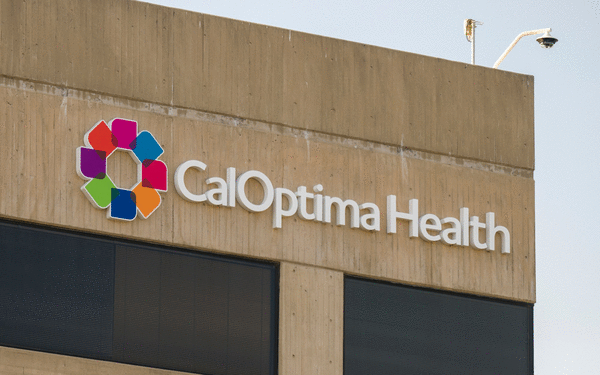
Keeping a close eye on the undocumented immigrant population, which Medi-Cal began doing in 2024, is challenging as funding shrinks and expenses continue to rise for such organizations as Orange-based CalOptima Health, a county-organized health system that manages programs funded by the state and federal governments, and L.A. Care Health Plan, the nation’s largest publicly operated health plan.
While CalOptima has kept steady at 1,645 full-time workers over the past three years, the organization has hired conservatively and not filled some positions in order to keep pace with a shrinking membership base, said Michael Hunn, chief executive officer of CalOptima, in an interview.
“At this time, even with all of the changes in funding, we are not looking to do any staff layoffs or reductions in force,” Hunn said.
CalOptima has about 819,000 members, down 8% from 886,000 in July 2025 when HR 1 became law, and when the organization began to see a sharp decline. Hunn said roughly 134,000 of CalOptima’s members are classified as undocumented immigrants. Over the past year, an estimated 20,000 undocumented members became ineligible to enroll with CalOptima, according to Hunn.
“It’s hard for us to determine exactly what’s going to happen,” Hunn said. “We are are going to be watching this trend very carefully as some of the new rules go into effect in January.”
More cuts coming?
The story is different at L.A. Care Health Plan, which earlier this month laid off 225 workers, or 3% of its workforce of 7,500. More cuts may be coming.
The health organization, which is the largest health plan in Los Angeles County serving about more than 1 of every 4 people in the county, 25.5% of the county’s 9.8 million people.
In a statement issued to the Southern California News Group, Martha Santana-Chin, chief executive officer of the plan, said the layoffs were driven by federal and state Medi-Cal budget cuts and an “organizational restructuring.” She declined to elaborate.
“This restructuring is intended to strengthen critical capabilities and position us for the future,” Santana-Chin said. “By the end of 2028, we project losing up to 650,000 members — this is almost a 30% drop in enrollment,” wrote Santana-Chin, noting that it currently has 2.5 million members.
“Unfortunately, these cuts will not only impact those covered by Medi-Cal,” she added. “They also will impact individuals who purchase coverage through our state’s marketplace, Covered California, those who have private insurance, and those who have employer provided health plans. When individuals lose health coverage, they stop using preventive care and end up in emergency rooms, incurring higher costs that they can’t afford to pay. “
Covered California is the state’s official health insurance marketplace under the Affordable Care Act, also known as Obamacare.
Ripple effects
The ripple effects of the funding cuts have hit every part of the state.
In rural areas, Palo Verde Hospital in Blythe filed for bankruptcy in September — laying off nearly 100 — Oroville Hospital and its parent, OroHealth, filed for bankruptcy in December, and Southern Inyo Hospital in Lone Pine sought emergency funds to keep it going.
In the Bay area, a plan to lay off 183 workers at Alameda Health System was delayed while the Alameda County Board of Supervisors formed a working group to close a $91.7 million deficit and save the hospital, and Lucile Salter Packard Children’s Hospital in Palo Alto announced plans to lay off 87 in December.
In August, Roseville-based Adventist Health underwent a restructuring to address a $244 million operating loss and cut 296 jobs.
Cuts in Los Angeles–area hospitals and health organizations also aren’t immune — the region accounts for most of California’s layoffs to date.
Last October, Children’s Hospital of Los Angeles laid off 439, Kaiser Permanente laid off 216 workers across Southern California, including some in Corona, while the University of Southern California cut 259 jobs to tackle a rising operating deficit of more than $230 million.
About 151 of those job cuts occurred on the USC Health Sciences Campus, including several at the Keck School of Medicine, which includes a teaching hospital, specialized cancer hospital, community hospitals and outpatient clinics throughout Southern California, and the USC Norris Comprehensive Cancer Center.
Planned Parenthood of Orange and San Bernardino Counties, which was forced to close its primary care practice Melody Health in October, laid off 81 staff members.
The organization said it was making “cuts as a direct result of the Trump administration unjustly defunding Planned Parenthood,” and blocking it from receiving federal Medicaid funds.
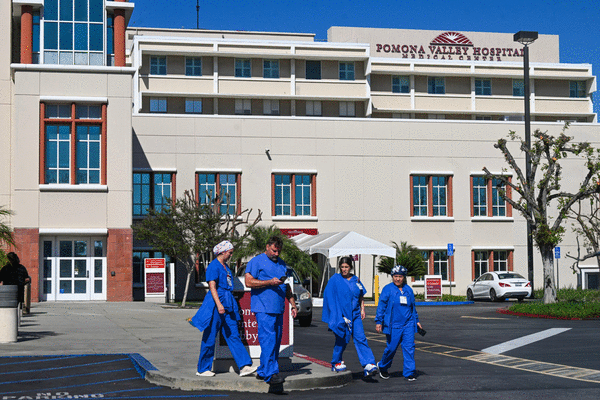
In January, the Pomona Valley Hospital Medical Center said it planned to lay off 265 workers across the hospital system beginning in March due to a budget shortfall of more than $40 million.
The hospital expects to see even more cuts, estimated to be more than $20 million, with drops in insurance coverage for Covered California recipients and other reimbursements over the next couple of years.
On Tuesday, March 17, Mark Ghaly, former state secretary of the Health and Human Services Agency from 2019 to 2024, led a working group of health care executives and government leaders in a discussion at UC Riverside on how to get on top of Medi-Cal changes as funding dwindles.
The group, called the Future of Medi-Cal Commission, hopes to present a set of recommendations to reform Medi-Cal funding in the state to the next governor after November, and any other lawmaker interested in their wish list, Ghaly said.
“I do think it is going to be in a kind of state of flux for a period of time across the state,” Ghaly said to the Southern California News Group. “There’s no question that there are going to be some new funding challenges to systems across the state, for vendors and employers. I think meeting those challenges is going to be increasingly tough for big systems to do, so they have to look at other tools to get cost structures in line. If there wasn’t so much concern about its future funding, we may not be having this conversation at all.”
________
©2026 MediaNews Group, Inc. Visit ocregister.com. Distributed by Tribune Content Agency, LLC.






Comments