Trump delays promised attacks on Iran, claiming negotiations to end war. Iran denies talks
Published in News & Features
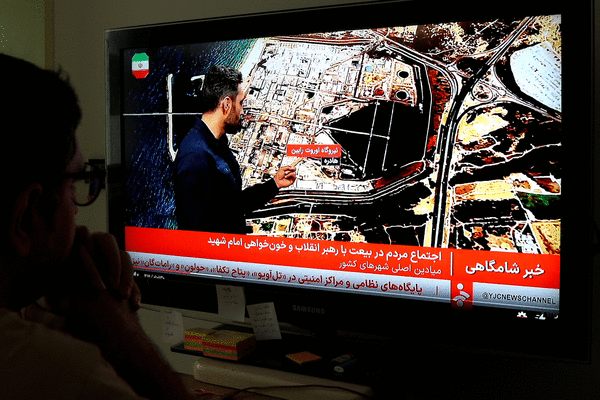
President Donald Trump and Iranian officials gave conflicting statements Monday about a possible deal to end the war — with Trump extending a deadline he’d set for bombing Iranian power plants and claiming negotiations were underway, while Iran denied having any dialogue with Trump officials.
“We are in the throes of a real possibility of making a deal,” Trump told reporters Monday. “If I were a betting man, I’d bet for it — but again, I’m not guaranteeing anything.”
Trump’s remarks followed an early-morning social media post in which he said the U.S. was postponing its planned strikes on Iranian power plants and energy infrastructure for five days based on “very good and productive conversations regarding a complete and total resolution of our hostilities in the Middle East.”
On Saturday, the president warned that the U.S. would “obliterate” Iran’s power plants unless it opened the Strait of Hormuz within 48 hours.
Oil prices, high in early trading Monday as the conflict continued to disrupt oil tanker traffic through the crucial strait, plunged after Trump’s announcement — a shift he alluded to in his later remarks.
“The price of oil will drop like a rock as soon as a deal is done. I guess it already is today,” he said.
Iranian officials, meanwhile, suggested Trump was lying about negotiations with top officials in order to reduce oil prices and in response to Iran’s own threats of retaliation if he orders attacks on its energy infrastructure.
“No negotiations have been held with the U.S., and fake news is used to manipulate the financial and oil markets and escape the quagmire in which the US and Israel are trapped,” Mohammad Bagher Qalibaf, Iran’s parliament speaker, wrote on X.
An earlier Iranian foreign ministry statement quoted by the semi-official Mehr News Agency acknowledged what it called regional initiatives to reduce tensions, but denied negotiations with the Trump administration and framed Trump’s message as an attempt to reassure jittery markets and “buy time” for military operations.
Other Iranian outlets took a more triumphalist view of Trump’s post, including Tasnim News, which featured the headline “Trump backs down!”
Omani Foreign Minister Badr Albusaidi, who mediated negotiations between Tehran and Washington before the war, said Oman was “working intensively to put in place safe passage arrangements” for Hormuz.
“Whatever your view of Iran, this war is not of their making,” Albusaidi wrote in a post on X. “This is already causing widespread economic problems, and I fear they promise to get much worse if the war continues.”
Now in its fourth week, the war has killed more than 2,000 people and badly shaken the global economy, with strikes targeting oil and gas facilities and other civilian infrastructure across the region.
Confusion after deadline lifted
Trump had said over the weekend that the U.S. would “obliterate” Iran’s power plants starting late Monday — threatening electricity to much of the nation’s civilian population, desalination plants that provide it with drinking water and sensitive nuclear facilities — if Iran did not halt its threats in the Strait of Hormuz and allow the resumption of traffic there.
The Islamic Revolutionary Guard Corps said it would retaliate by hitting power plants in areas that provide power to American bases and “the economic, industrial and energy infrastructures in which Americans have shares.” Qalibaf, the parliament speaker, said vital energy and water infrastructure in Persian Gulf nations could become legitimate targets.
Trump’s remarks extending the deadline eased some of that tension, but it remained unclear Monday what exactly was occurring in terms of negotiations between the two countries and their intermediaries.
Turkey has been an intermediary between Tehran and Washington in the past, and Iranian Foreign Minister Abbas Araghchi said he spoke by phone with his Turkish counterpart, Hakan Fidan. President Abdel-Fattah el-Sissi of Egypt also said Monday that his country had delivered “clear messages” to Iran about de-escalating the conflict.
But such intermediary efforts are not what Trump claimed was occurring.
Trump said that his Middle East special envoy Steve Witkoff and Trump’s son-in-law Jared Kushner had been directly involved in talks with Iranian counterparts late Sunday, which he said were continuing Monday.
Trump said negotiations have been difficult because the U.S. has killed many Iranian leaders, including the former Supreme Leader Ayatollah Ali Khamenei, but that his envoys were speaking with a “a top person” whom Trump believes is “the most respected” leader in the country.
However, he said that person was not Supreme Leader Ayatollah Mojtaba Khamenei, who was named as his father’s successor. Trump said the U.S. hasn’t heard from the younger Khamenei, who has issued public statements of resistance to the U.S., and isn’t sure he is alive.
Asked why Iran was denying talks if they were indeed occurring, Trump said, “They’re going to have to get themselves better public relations people.” But he also said that confusion on the Iranian side may stem from the fact that the leadership’s telecommunications networks have been “blown to pieces.”
“We have had very, very strong talks. We’ll see where they lead. We have major points of agreement — I would say almost all points of agreement,” Trump said.
He said the two sides had reached 15 points of agreement, including that Iran will not have or develop nuclear weapons in the future. He also said the U.S., as part of any deal, would take any enriched uranium that Iran has left after the U.S. bombed its nuclear sites last year.
If the talks do not lead to progress, Trump added, “we’ll just keep bombing our little hearts out.”
Ongoing fears
Trump’s pause on bombing energy infrastructure was welcomed globally, even as fears remained about the war’s ongoing disruption to the flow of oil through the strait.
“Any attacks on infrastructure are causing chaos in the region and really escalating this war even further,” European Union foreign policy chief Kaja Kallas said at a news conference in Nigeria.
Already, 40 energy assets in nine countries have been “severely or very severely damaged,” Fatih Birol, the head of the International Energy Agency, told Australia’s National Press Club on Monday. “No country will be immune to the effects of this crisis if it continues to go in this direction.”
Trump’s talk of winding down the war has also come amid a build-up of U.S. forces in the region, with the Pentagon sending three California-based warships and roughly 2,500 Marines to the Middle East, outlets reported Friday. It was the second significant deployment in a week — and one sharply criticized by Democrats.
“More than 2,000 Marines from Camp Pendleton are now headed to the Middle East as the Iran war shows no signs of slowing. Alarm bells should be ringing across America, with the prospect of boots on the ground,” Sen. Adam Schiff, D-Calif., said Friday. “Every day raises the risks of a new forever war.”
Trump declined to address the deployment or his intentions for the Marines out of California when asked about them Monday.
“Do you really believe I’d give you an answer? Crazy question,” he said. “We don’t talk about strategy.”
_____
(Rector reported from Colorado and Bulos from Beirut.)
©2026 Los Angeles Times. Visit at latimes.com. Distributed by Tribune Content Agency, LLC.





Comments