China's $17 billion crop pledge falters ahead of Trump-Xi summit
Published in News & Features
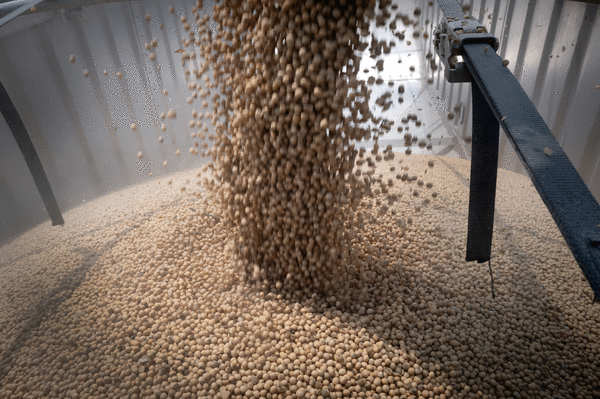
China looks unlikely to fulfill a pledge to buy billions of dollars in U.S. farm products in 2026 as the leaders of the two nations prepare for their third meeting this year.
President Donald Trump and his Chinese counterpart Xi Jinping are set to have talks this week at the Asia-Pacific Economic Cooperation summit in Shenzhen. The two sides agreed in September to lower tariffs on a slew of farm products. But nearly two months later, those cuts are still pending — and Trump’s bargaining position is expected to be weakened by Republicans’ midterm setbacks and Nvidia Corp.’s scandal.
Those issues, plus the war in Iran, are likely to take precedence at this week’s talks. Even as China closes in on a target to buy 25 million tons in U.S. soybeans this year, the industry is pessimistic that a separate commitment to purchase an additional $17 billion in American farm products will be met.
“I wish it would happen, but I think it’s pretty low,” AgResource Co. analyst Ben Buckner said of the chances. “I would not be counting on China to buy corn or wheat from the U.S. in the next 30 days.”
The $17 billion pledge could get an extended timeline. But the lack of progress so far has been a disappointment for American farmers who, after being stuck in a yearslong slump, have lost some faith in U.S.-China trade and had looked to the agreement as a way to regain stability in the market.
While a failure to meet the target isn’t expected to derail wider trade relations, it could make it difficult for weak grain prices to recover. The Bloomberg Grains Spot Subindex is hovering near the lowest level since July, while input costs have soared with the Iran conflict, driving up fuel and fertilizer prices for farmers. With a record soybean harvest and bumper corn crop, a rebound increasingly hinges on demand.
A strengthening U.S. dollar combined with a weaker Brazilian real and Russian ruble are also making American goods more expensive versus rivals.
“We will be the seller of last resort,” said Mike Zuzolo, analyst at Global Commodity Analytics and Consulting in Kansas.
China dominates global soybean imports and remains a large grain buyer, although a slowing economy has trimmed its purchases from peaks seen just a few years earlier. Weak prices for hogs — the main industry driving feed imports — leaves little incentive for the country to buy higher-priced supplies from the U.S.
Instead, China has been diversifying purchases across other markets, recently turning to France and Argentina for wheat and corn and Brazil for distillers dried grains and sorghum. Even as state-owned importers make steady purchases of U.S. soybeans, tariffs are deterring private traders from joining the fray — a move that could accelerate purchases and widen demand to other crops.
“China has already demonstrated through soybean purchases by state importers that it is willing to pay above-market prices for U.S. agricultural products when broader trade considerations are at play,” said Vladimir Zinkovski, head of Asia-Pacific crops research at S&P Global Energy. “Private importers, however, are unlikely to contribute significantly toward the $17 billion target while current tariffs make U.S. products commercially uncompetitive.”
Beijing never formally confirmed the $17 billion deal announced by the White House in May, and it’s unclear exactly what it includes. The U.S. said the dollar target is prorated for 2026, without specifying for how much or when the clock started.
AgResource estimates China has purchased all but about 4 million tons of a separate pledge to buy 25 million tons of U.S. soybeans. But buying of other agricultural goods has been minimal. Through September, China’s purchases of U.S. corn and wheat stood at a fraction of those seen prior to 2025, U.S. Department of Agriculture data shows. No American corn or wheat are on the books for China in the 2026-27 season.
Successive record domestic corn harvests in China, alongside ample supplies of sorghum and barley, are limiting the commercial incentive for imports of the grain, Zinkovski said.
The National Corn Growers Association said China’s tepid interest in U.S. farm products outside of soybeans is tempering expectations for demand from the country under the $17 billion pledge.
“While we would be hopeful to see corn included in China’s target, due to the uncertainty around the terms, I do not think the market is pricing in an expectation for large corn purchases as of now,” Gretchen Kuck, an economist with the association, said in an email.
Beef offers another example of the gap between improved market access and actual trade. China renewed permits for hundreds of American beef plants in May, but shipments have barely recovered as surging U.S. prices and tepid Chinese demand curbed purchases.
Still, while reaching the $17 billion goal appears difficult and unlikely, any momentum on tariffs or non-soybean purchases would be beneficial, said Darin Friedrichs, co-founder of research firm Sitonia Consulting Co.
“Until now, there hasn’t been much movement outside of soybeans,” he said. “If there are reciprocal tariff reductions and increase in purchases of U.S. grains, that would be positive for the U.S.-China relationship, even if it is below the goal.”
During the first meeting of a new trade council on Friday, the two nations discussed a $30 billion for $30 billion reciprocal tariff-reduction arrangement and agricultural trade — moves that could lead to the final implementation of the duties cut and boost Chinese purchases of other U.S. farm products.
China’s commerce ministry has signaled an openness to boosting U.S. agricultural purchases provided the two sides implement a deal to reduce reciprocal tariffs.
“The fact that they’re publicly saying ‘drop that tariff and we’ll do something’ is a good sign,” said Randy Place, senior grains analyst at the Hightower Report.
(With assistance from Ilena Peng.)
©2026 Bloomberg L.P. Visit bloomberg.com. Distributed by Tribune Content Agency, LLC.





Comments