Once arrested, now honored -- California bids farewell to activist Dolores Huerta
Published in News & Features
SACRAMENTO, Calif. — For much of her career as a labor activist, Dolores Huerta did not have the state on her side.
Conducting marches and sit-ins, Huerta was arrested more than 25 times, including in 1988 when a San Francisco police officer broke four ribs and ruptured the spleen of the then 58-year-old with his baton. It would not be her last arrest.
But on Monday morning, when she made her final march on the California Capitol, the state marched with her. Proceeded by a squadron of low-rider cars and a Native American dance troupe, Huerta, who died Oct. 28 at the age of 96, was conveyed up the Capitol Mall in a white hearse with two flags on the hood bearing her signature slogan, “Si, se puede.”
Behind the hearse marched Gov.-elect Xavier Becerra, Senate President Monique Limon and Speaker of the Assembly Robert Rivas, three of the state’s most powerful officials and each Latino leaders who say their personal political journeys were influenced by Huerta.
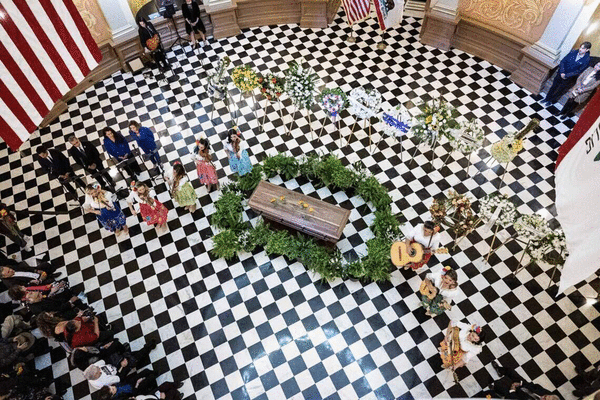
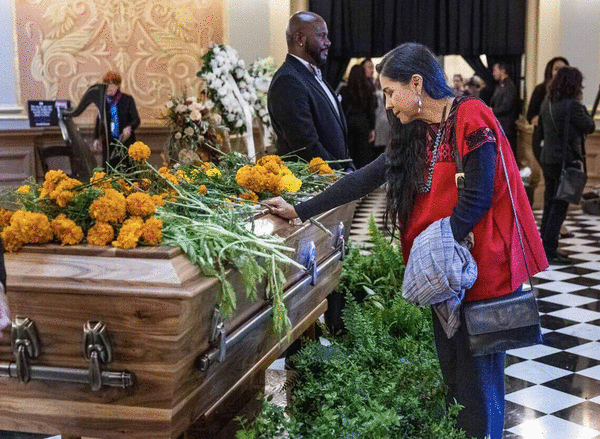
The iconic Central Valley activist became the first woman, and the first person who did not hold an elected office, to lie in honor at the state Capitol.
Her son, Emilio Huerta, told The Sacramento Bee that when his mother was in the thick of her days turning the United Farm Workers union into a powerful national movement — something Emilio, too, participated in after dropping out of high school at age 16 — he never would have imagined her being honored in this fashion.
“We lived a life where we were criticized for our work and what we were doing,” he said, “but she never stopped organizing.”
Hailed as a trailblazer
As they had on the day of her death, a chorus of women leaders cited Huerta as a trailblazer who had forced her way into rooms and conversations where at the time few women had a presence. “They once accused her of being ‘too aggressive, too loud, too radical’” Puneet Maharaj, director of the California Nurses Association, said during a California SEIU-hosted ceremony at Crocker Park ahead of the procession.
“Dolores’ words of ‘Si se puede’ are deeply personal for women, especially women of color,” Maharaj said. “Dolores has been teaching every woman in the labor movement that our voice is powerful and must be heard.”
Huerta died just seven months after The New York Times published extensively documented allegations of sexual assault and rape against women and girls, including one as young as 12, by her co-founder of the United Farm Workers, Cesar Chavez. During the course of their reporting, Huerta told the Times reporters Chavez had raped her in the 1960s, and that she had kept it to herself to protect the farmworker movement.
That revelation for many merely strengthened Huerta’s legacy as an advocate for gender and labor equity, as women who had worked alongside her expressed both horror and sympathy at the secret she had carried.
Chavez and Huerta had long both been hailed as intertwined icons who together had turned the United Farm Workers into a nationally successful movement that uplifted not just farmworkers but the country’s immigrant communities as a whole. Banners with the Chicano Eagle, the UFW’s symbol, were in abundance on Monday, as were signs bearing “huelga,” the Spanish word for strike.
“We were each just one of the community of people who saw something that needed to be done,” said Ron Lopstain, who belonged to and marched with the UFW in the 1970s and 80s, as he watched the procession unfold. “Like her and Cesar did. Something had to be done, so we went out and did it.”
Lopstein wore a UFW vest with pins commemorating different phases of the farmworker movement. Throughout their efforts, including historic strikes against grape growers, he considered Huerta a friend, he said. He recalled her pulling him into one march to walk between her and the civil rights activist Jesse Jackson. He was not surprised to see her now honored in the statehouse, he said, given the recognition she accumulated over her lifetime.
“She’s world known,” he said. “She was like a Ghandi kind of figure.”
Her footsteps
Despite the dark revelations ahead of her death, the ceremony also crystallized that Huerta died in a state where the politics has shifted in many ways in her image. Labor unions, the leaders of several of which spoke ahead of the procession to the statehouse, are today among the most powerful players in the building. Both Limon and Rivas have described themselves as indebted to her.
“There would be no Speaker Rivas without Dolores Huerta,” Rivas wrote on the day of her death.
And in Becerra, the state now has its first elected Latino governor. Speaking in both English and Spanish, Becerra remembered Huerta as a constant presence not just in the state’s social justice movements, but also in his own life.
To a young Becerra, Huerta was just “Tia Lola,” he said. He found her full name appropriate once he learned it, he said, as Dolores is the Spanish word for hurts, pains or griefs. Huerta was someone who took on the injuries of entire communities, Becerra said.
“To our communities who always suffered injustices, who worked day in and day out and when it was pay day received nothing,” Becerra said, “she said ‘let me accept this pain.’”
Gov. Gavin Newsom ordered state flags to be flown at half-mast on Monday but was not in California for the ceremony, which came at the tail end of a diplomatic trip to Europe. Newsom announced after her death that the California Labor and Workforce Development Agency building would be renamed after Huerta, though she had told The San Francisco Standard she didn’t want buildings to be named in her honor.
On the edges of the crowd in Crocker Park and along the route of the procession, people whose personal histories were wrapped in the UFW movement shared their own moments and memories, often through tears, of a crusader whose work had a concrete impact on their lives.
Kevin Cristobal posed for a photograph in front of the hearse before it departed Crocker Park, draped in a black flag bearing the call for a strike and the Chicano eagle. He’d traveled from Gilroy, where much of his large family of Mexican and Philippine immigrants have worked as apricot pickers over generations.
“It was important I got up here to represent my family,” he said through tears.
As procession slowly pulled away from the park, Charlene Tapia-Delgado raised her fist and shouted “vive los mujeres” —“long live women.” She was cheered, she said, by the backgrounds of the state leaders who had gathered to honor Huerta.
“This is who we are now,” she said, “this is going to be the new normal.”
Huerta’s wooden coffin was carried to the statehouse steps by eight pallbearers, family members wearing black pants and crisp white guayabera shirts. Inside the building, only a small group of family and dignitaries attended a private ceremony before the public was allowed to pay their final respects under the Capitol dome.
As the casket was carried through the doors of the building out of sight, the crowd outside launched into a few final protest chants. “Dolores vive,” they shouted.
____
©2026 The Sacramento Bee. Visit at sacbee.com. Distributed by Tribune Content Agency, LLC.



Comments