Commentary: How Spotify's video podcasts hijacked talk TV's playbook
Published in Entertainment News
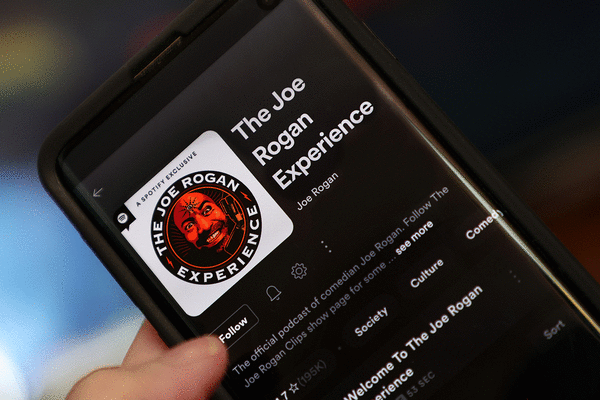
Spotify Technology SA’s list of its top podcasts of the year didn’t offer much in the way of surprises — Joe Rogan, for example, is number one yet again, for the fifth year in a row. But one stat is noteworthy: Nearly half of those shows, 24 of the 50, also have a video version streaming on the platform. And Spotify video consumption has more than doubled year-over-year, thanks largely to podcasts.
It’s a striking explosion in popularity for what was once seen as an audio-only medium, and a telling one as well.
The surge suggests that audiences miss the cultural ubiquity once held by traditional talk shows and are seeking a version of it in today’s online media ecosystem. But they clearly want that style of programming in a different form: stripped-down, minimally produced and intentionally rough around the edges.
To be clear, talk shows — of either the Oprah-style daytime variety or the late-night talkers modeled on "The Tonight Show" — haven’t lost their audience entirely. There is still an appetite for the entertainment and analysis they provide through showcasing new talent, interviewing celebrities and political figures or simply engaging in of-the-moment conversations.
But people are increasingly turning away, and the falling viewership — coupled with the high costs of name-brand talent and slick television production — has greatly decreased the once-mighty profitability of both daytime and late-night shows.
The result is a gap that video podcasts are poised to fill, thanks in part to two broader cultural forces.
One has to do with our current era of rampant misinformation — political propaganda or “fake news” (depending on the eye of the beholder). In this environment, cynical viewers may see talk shows as a component of the much derided (if somewhat nebulous) mainstream media, and therefore seek out sources, platforms and personalities that they more clearly perceive as authentic.
Video allows for the appearance of authenticity. Savvy producers and editors can cut and piece together a smooth-sounding audio podcast. But with video, what you see is (typically) what you get — and if not, these shows have already established a visual style that broadly indicates how unfiltered they are meant to seem.
Much of that perception comes down to aesthetics. Talk show hosts are essentially entertainers, dressed for the part, perfectly coiffed and made up for the camera, reading their prepared remarks and questions from their crisp little cards.
Podcast hosts, on the other hand, tend to present themselves closer to the guy or girl next door, eschewing suits and other designer duds for hoodies, ball caps and jeans.
More important than such visual elements are the personas that the most popular podcasters adopt. They take pains to remind audiences that they are neither entertainers nor journalists. They’re simply curious inquirers, just asking questions, while the more bombastic among them position themselves as rabble-rousing truth-tellers. As opposed to the TV hosts sitting behind their desks or on their couches in well-lit studios in front of hooting audiences, these regular Joes and Janes are just hanging out on their laptops at home, not attempting to hide their microphones, bundles of cords or messy desks.
The messaging of such seemingly amateurish visual touches is clear: Podcasters are not involved in anything as gauche as show business. They’re just out here trying to make sense of the world — like you and me.
It’s not unlike what we saw during COVID lockdowns, which are the second force behind the rise of video podcasts. During that time, the professionalism associated with the personalities we look to for information and insight was shattered.
Much of what aired on network and cable television in those early months featured previously studio-bound anchors doing their shows via Zoom. This new normal extended to the faces of talk shows — often to their advantage. Seth Meyers, for example, did some of his best work to date from his attic, where his relaxed affability came through more clearly without the formalities of studio production. As production values collapsed, many viewers were themselves doing their own jobs remotely too, further blurring the line between show business and real life.
Once lockdown lifted and broadcasters went back to their studios, they had already created a precedent that was easy for audio podcasters (whose numbers also boomed during that time) to adopt.
As video podcasts enjoy the limelight, and companies such as Netflix Inc. treat them as a formidable investment, there’s perhaps a lesson here for our flailing terrestrial media. Old habits are hard to break, but broadcasters could dispose of the scripted simulations of conversation and attempt something more freewheeling and conversational. The alternative is to keep losing ground to hosts who aren’t afraid to appear unpolished.
———
This column reflects the personal views of the author and does not necessarily reflect the opinion of the editorial board or Bloomberg LP and its owners.
Jason Bailey is a film critic and historian. He is the author, most recently, of "Gandolfini: Jim, Tony, and the Life of a Legend."
©2025 Bloomberg L.P. Visit bloomberg.com/opinion. Distributed by Tribune Content Agency, LLC.









Comments