Q&A: Why UK band Shame donated the fee from Minnesota tour stop to charity
Published in Entertainment News
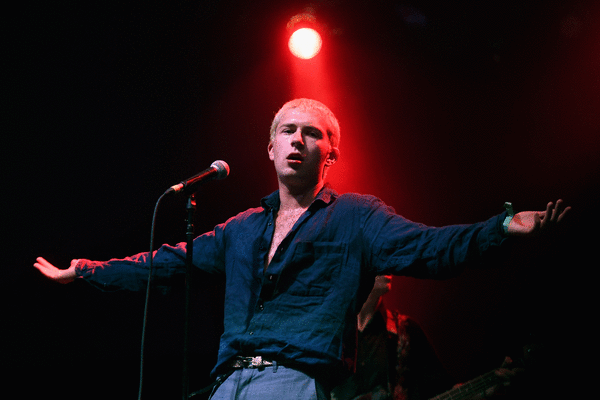
ANAHEIM, Calif. — When the English post-punk band Shame went into the studio to make its new album “Cutthroat,” the idea was to play faster and louder, singer Charlie Steen says.
“I think when we toured our last album, ‘Food for Worms,’ we were kind of having to borrow from ‘Songs of Praise,’ our first album, to kind of pick up the tempo in the set to help the flow,” Steen says on a recent video call from the road before a show in Oklahoma City.
“We were just like, ‘Well, we should probably just write some faster songs,” he says.
“There’s definitely also an influence from touring with Viagra Boys, where we would sort of watch them play in America and just be like, ‘God, it’s just so fun, the energy in the room, and just sort of energy that’s coming from the songs as well as with them and the looseness of it.”
So that’s what Shame asked American producer John Congleton, whose credits include albums by St. Vincent, Angel Olsen, Regina Spektor and the Mountain Goats, to help them do.
“We met him in London in Brixton in a pub, the summer before we recorded in December [2024],” Steen says. “We got to chat with him, and we’d send him over demos.
“He had some keywords like sort of ‘primal’ and ‘dangerous’ and stuff like that,” he says. “So it was really exciting. And when we worked with him in the studio, it was just really good, old-fashioned work, you know?”
Many of the songs were worked out live, Steen says, and recorded without a lot of takes.
“We kind of were aware of the direction we wanted to go,” he says. “I think a good word might be ‘excessive.’” [He laughs]. It felt like a general theme throughout the album.
“I mean, we took [the title track] ‘Cutthroat’ and just went all the way in that direction with that song,” Steen says, laughing. “I remember the first time our A&R heard it, he went quite pale.”
In an interview edited for length and clarity, Steen discussed the inspirations for songs on the new record, why Bob Dylan and Little Richard are punk rock to him and more.
Q: “Cutthroat” is a terrific song. Why’d your A&R guy go pale when he heard it?
A: Well, John [Congleton] played it at volume 100 in the studio, which if you’ve ever been in the studio and heard the full sound of those speakers, it’s pretty crazy. And it’s not really like anything we’ve done before as well. It’s pretty out there. And songs like “Lampião,” just going full in that direction, excessive in that.
But it also worked the other way, where songs like “Quiet Life” references the Gun Club and the Cramps. Almost a rockabilly style and quite simple.
Even with a song like “Spartak,” I remember John being like to [drummer Charlie] Forbes and Josh [Finerty on bass] in the room, “Play it like you just started a band,” and it’s sort of just super straight.
So in every way it’s like, ‘OK, if we’re going to make it sort of simple, let’s go all that way, and if we want to make it as out there as possible, let’s go all that way,’ you know? So it was really nice, and every song became quite succinct, direct and straight to the point.
Q: As far as the lyrical content, there are several songs that reference cowards, and others addressing insecurities, or you’re speaking to people who don’t like your protagonist in the song. What’s the common thread on this record?
A: For the first time ever, I was writing a large majority of the lyrics in the studio to try and make it more concise. An overall theme was trying to talk about paradoxes. Like you mentioned, “Cowards Around,” where it mentions politicians, members of parliament, and you might think it’s going in that direction. Then it’s also just of people who like me and people who don’t use garnishing [on plates of food].
I think the main thing is before we were doing this album I wasn’t that super interested in, like, the good and the evil. It’s more about what happens when you have someone like Lampião [a song inspired by a real-life early 1900s Brazilian bandit leader of that name], where you have loads of people who say he is evil and loads of people who say he is good. And why is that?
Q: You mentioned Lampião – I’m not sure I’m saying that right –
A: – Ah, I’m probably not saying it right.
Q: – and I was thinking about how I’d never heard of him yet millions of Brazilians know his history, have watched TV series about him. How did you learn about him?
A: Because my girlfriend’s Brazilian. Her dad’s English, but her parents both live there, and she grew up there in São Paulo. A few Christmases ago, I was staying with her family, and they were the ones who basically explained his history to me.
That song that I sing at the beginning [of “Lampião,” in Portuguese] was written by a person called Volta Sêca, who was 9 years old when he joined Lampião’s gang of bandits. He has two songs, “Acorda Maria Bonita,” which I sing, and “Mulher Rendeira,” which everyone still grows up knowing.
I found it fascinating that hundreds of millions of people might know about him in one area of the world, and I’m just finding about that history.
Q: Tell me about the “Cutthroat” music video, which has the band at the bottom of a Wall of Death carnival attraction as a motorcycle speeds around the structure’s drum-like walls.
A: I’m green-screened in [as a motorcycle rider on the wall], but the rest of the band, it was a real motorcycle driver, and the band were actually playing while he was riding around. Which is pretty [bleeping] crazy to watch.
I mean, it was pretty mad that we were even able to do that video. It was very touch and go. I was chatting with [Ja] Humby, the director, and calling up Wall of Death people at the 11th hour because someone pulled out. Yeah, it was mental.
Q: I want to ask you about your vocal style, a kind of spoken-sung style, and who inspired you.
A: I think when I was a kid, the main person, the main sort of Oppenheimer atomic bomb moment, was hearing Bob Dylan. It was that idea of, “Oh, you don’t have to be able to sing to be like who I would consider to be maybe the greatest singer. Then, when we started the band, it was probably getting into the Fall, you know, Mark E. Smith. And being, “Oh, OK, there’s other ways to do this.”
Bob Dylan, I mean, he’s obviously in his own league, but it’s not exactly post-punk. Then, with bands like the Fall, I always like stories. Another one, when I was really young, I heard “In Every Dream Home a Heartache” by Roxy Music, which is spoken, and that just blew my mind.
All those people I’ve mentioned, they’re sort of talking of quite diverse subjects, you know, and as a kid, you’re like, “Wow, you can sort of explore things that might interest you.” They aren’t just talking about heartbreak or love or whatever. So yeah, I think that’s the drive behind it.
Q: That’s great –
A: – But also, we come from a background of just gigging relentlessly in DIY venues, and I think that context will explain a lot about the style, probably, because a lot of those shows you can’t hear yourself properly, so you might be shouting and it might be more chaotic.
Q: Your live shows are known for the high energy the band delivers. Is that also from all that DIY gigging and trying to catch the crowd’s attention?
A: Yeah, it came from a sort of attitude of, first and all, you have to grow a backbone pretty quickly. Because most people who you’re playing to, a large majority of people you’re playing to in the beginning, don’t like your music and they don’t like you. So you have to develop tough, thick skin pretty quickly.
I mean, I don’t think you could be in this industry without it, because you have to sort of believe in what you’re doing and know yourself to an extent to be able to do it. To sort of fight back.
Q: And when you all go on stage, what are you hoping to achieve?
A: I just did an interview where I was l like, you know when you’re playing blackjack, and you know you’ve got a lucky hand? You know you’re on a streak, and you can’t really describe that feeling because it’s just luck? That’s the best feeling, when you feel like, “OK, this is it. It feels like it’s out of your hands.”
Q: How has this American tour been so far?
A: It’s been [bleeping] cold. It’s been the coldest tour we’ve ever, ever, ever done. It was really brutal. It’s been really fun. The show’s been really good, but it’s a weird [bleeping] time to be in America. With ICE and everything else that’s going on, it’s pretty devastating. So it’s a big mixture of things. We know certain bands are not coming here anymore, and it’s pretty crazy.
Q: Did you go through Minneapolis, play a show there?
A: Yeah, we played in St. Paul. We donated all of our fee to Unidos MN, which is a grassroots charity there. That’s definitely the show I think of most.
Q: I know Shame is part of a scene that includes Fontaines D.C., Viagra Boys, Idles and bands like that. What’s the common thread there?
A: I think to an extent we’re just writing the music that we want to write, you know? I mean, yeah, that sort of label of post-punk or whatever, stuff like that. But when I was a kid growing up, I thought James Brown would be punk to me, and Bob Dylan would be punk, and Screaming Jay Hawkins and all of these other people.
Little Richard would probably be the biggest. Nina Simone. They’re like [bleeping] badass [bleepers]. I see it like if you watch those James Brown clips, it’s like, OK, it might be a different style of music. It’s way better funk. But the performance is pretty brazen and pretty daring.
When we started out, there’d be the Stooges and the Fall and all these other bands. But the link is that they were doing what they wanted to do, and hopefully that’s the link still.
©2026 MediaNews Group, Inc. Visit ocregister.com. Distributed by Tribune Content Agency, LLC.










Comments