Amid polarized climate, more Michigan colleges focus on 'civil' discourse
Published in Lifestyles
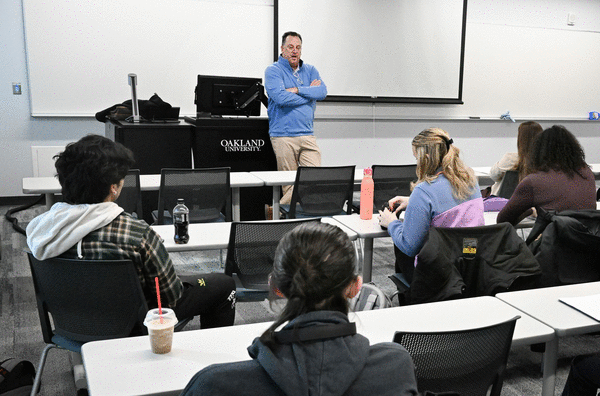
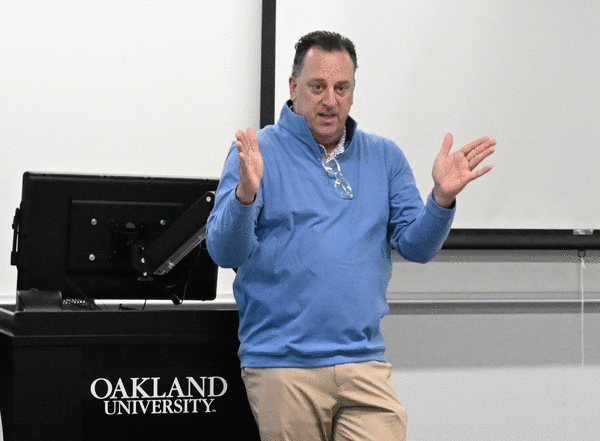
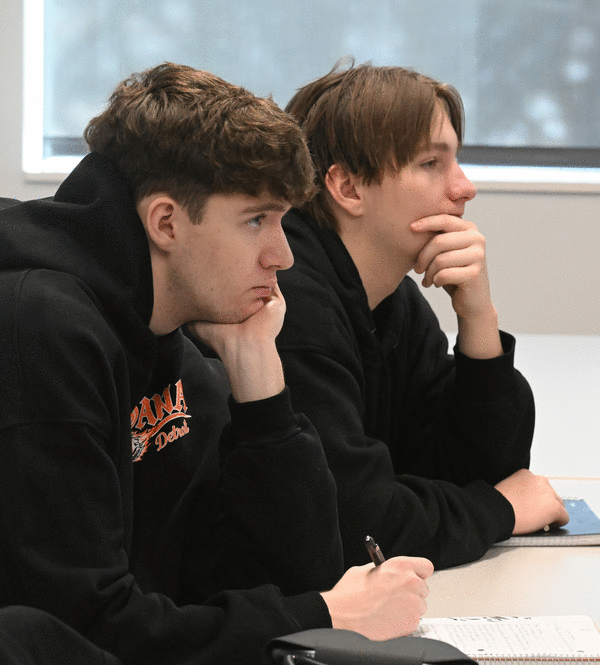
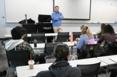

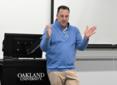

ROCHESTER, Mich. — It's a Tuesday morning at Oakland University in Rochester, and political science professor Dave Dulio is discussing the First Amendment with his Civil Discourse class.
As he paces in front of about two dozen undergraduate students who come from a range of backgrounds and ideologies, Dulio gives a brief history of how the amendment got into the U.S. Constitution, then asks what the amendment protects. The students respond: religion, expression, press, assembly.
Once that's established, Dulio tells his students why they're discussing the amendment at all.
"I don't think you can have civil discourse without a healthy dose of free speech," said Dulio, who is also the director of the university's Center for Civic Engagement. "It is our ability to say what we want without fear of government intervention."
The class is new to Oakland University, debuting earlier this semester in a push to teach civic "literacy" to students at a time when respectful dialogue about opposing views seems nearly impossible in some circles, especially on college campuses.
But some Michigan universities are taking steps to encourage civil dialogue or discourse among their students and on their campuses.
The University of Michigan plans to open an entire Center for American Dialogue this fall with classes, events and community partnerships on all three of its campuses. The center will not just promote productive dialogue across a "spectrum" of ideologies but also promote research and evaluation on solutions, according to the university.
Grand Valley State University also has a Center for Civil Discourse, which opened more than a decade ago.
Dulio said he decided to start OU's class after realizing that "Americans can’t talk to each other anymore."
"So one of the things that we want to do... is have Oakland University be known as a convener of conversations," said Dulio, who has taught in the university's political science department since 2012. "But when we have them, we want to have them in the right way."
The class meets the moment in U.S. politics, said Josh DuBach, a sophomore in Dulio's class. In a setting like the one at OU, "you’re sort of at an obligation to be respectful, and to know there’s a limit to what you can and cannot say," he said.
"So it makes for more productive conversation when you’re able to hear other people," DuBach said.
Beyond higher education, Dulio is partnering with groups throughout the state to promote more civil conversations.
"It doesn't have to be as nasty as it is," said Dulio, who once worked as a congressional fellow in the office of U.S. Rep. J.C. Watts, R-Oklahoma.
Oakland's partnership lands four governors' talk
Dulio's work promoting civility in Michigan preceded his Civil Discourse class.
The class was born from the work Dulio has done with Oakland University's Center for Civic Engagement, which he launched about eight years ago. He said "the thread of civility" has run through the center's work.
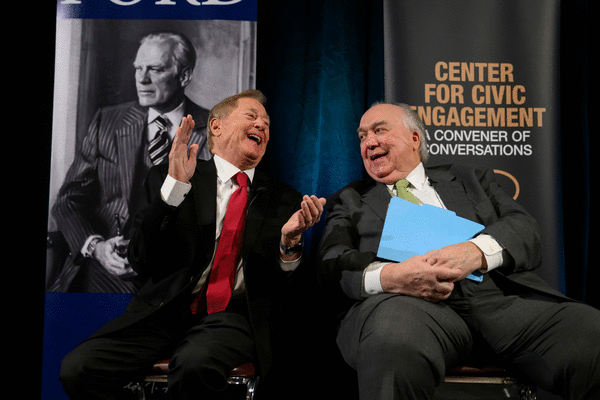
At the beginning of February, Dulio partnered with the Mackinac Center for Public Policy, the Democracy Defense Project, the Gerald R. Ford Presidential Foundation and Michiganders for Civic Resilience to host a panel of Michigan's four living former governors to promote political civility.
"We all realized that we’re all trying to do the same thing. And we all sort of do it in our own little way, but there’s power in numbers," Dulio said.
Through doing events like the governor's forum, Dulio and others are "trying to pull together all those little islands to make a chain."
“There are more and more people, organizations, whatever, that are getting into the civility business, and I think the more the merrier, because I think the more people who are advocating for it or talking about the need for it, the better," said Dulio.
Grand Valley State has led civility movement for over a decade
Grand Valley's Center for Civil Discourse began as a small program in 2013 before it received enough money to become a full-fledged center in 2021. Director Lisa Perhamus said it was founded by Carol Sarosik and Shelley E. Padnos, who traveled to Amsterdam and learned about the life of Anne Frank, a Jewish girl who wrote a diary of her family's two years of hiding from the Nazis before they were discovered and sent to detention camps.
"When they walked out, they just said to each other, ‘This can never happen again, and we need to do something that contributes to making peaceful communities,'" said Perhamus, an interdisciplinary studies professor whose university biography said she "aims to foster mutual understanding through humanizing dialogue rather than divisive debate."
Perhamus said funding for the center grew as demand increased. She said she saw the demand during the mid-2010s and after the murder of George Floyd in Minneapolis at the hands of police officers in 2020.
“I’ve seen a striking uptick since the last election," Perhamus said.
The center's work in the community is growing, she said. In November, the center hosted Michigan Listens, which highlighted diverse perspectives from across the state. The center has done a training in Chelsea and got a request from Traverse City, Perhamus said.
UM gets ready to launch American dialogue center in fall
In Ann Arbor, the University of Michigan's Center for American Dialogue is expected to open this fall. Announced in September by interim President Domenico Grasso, the university plans to put $50 million toward the center. It will have "presence and activities" at the university's Ann Arbor, Dearborn and Flint campuses, said Assistant Vice President for Communications Paul Corliss.
"It may seem ironic and redundant that a university, which is already a marketplace of ideas, would establish a center committed to dialogue. But we have all seen how polarized our country is. When division too often drowns out discourse, Michigan must lead," Grasso said at the UM Congressional Breakfast in February. "We may not always succeed. But we will always strive for mutual respect, humility, and a commitment to consequential outcomes."
The center is emerging two years after the UM Board of Regents unanimously approved a new statement on free speech that re-emphasized the university's commitment to free speech and diversity of thought.
"These principles declare unequivocally that cancel culture is dead at the University of Michigan," UM Regent Mark Bernstein, a Democrat who is a lawyer, said at the time.
At a Board of Regents meeting last fall, Grasso said as an Army officer, he took an oath to support and defend the Constitution. He said he would always protect the First Amendment, even as some have called to fire professors for writing social posts with which they disagree.
Some have also been reckless and harmful with their speech, the interim president said.
"There have been moments in our university’s history when free speech was tested," Grasso said. "At times, we rose to the challenge; at other times, such as during the Red Scare, we failed. We must learn from both."
The Red Scare was a period in the late 1940s through the early 1950s when the perceived threat posed by communists during the Cold War between the Soviet Union and the United States intensified. The loyalty of federal employees was scrutinized, while U.S. Sen. Joseph McCarthy, R-Wisconsin, led an effort by the House Un-American Activities Committee to investigate allegations of communist infiltration into the Hollywood film industry and government.
Class explores when protests cross the line
During the class at OU in mid-February, the discussion between Dulio and his students went in several directions — namely, what kind of speech should be allowed on social media, whether someone should be punished for swearing loudly in public and what are acceptable forms of protest.
On the topic of protest, some students said demonstrators shouldn't interfere with innocent people's lives, while others said it could be argued that aggressive forms of protest are sometimes more effective. Freshman Karinna Trotter argued that assertive forms of protest are sometimes more effective, noting the differences between Civil Rights Era leaders Malcolm X and Martin Luther King Jr.
Dulio's students said having an environment where they can open dialogue is both reassuring and growth-spurring.
Trotter said it was hard for her to maintain friendships amid the 2024 presidential election because "politics have turned into a morality thing." Coincidentally, the class touched on separating politics from people.
"If I can better figure out how to separate politics from a person, then I think I’ll be a better person," Trotter said.
Freshman Contessa Kiessling, who identifies as conservative, said the class has given her confidence to discuss her political views. It's a stereotype that colleges are "very liberal," she said.
"I'm starting to realize other people would be more chill about it," Kiessling said. "They wouldn't get on me about that."
Kiessling also said the concepts from the class can be applied to other areas of study. The concept of private morality, for example, can be applied to studying drug use in her major, which is criminal justice, she said.
Freshman Alex Damino, a self-declared libertarian, said concepts can even be applied to his biology major.
“It’s really important in the field of biology when you have a study and get results, you have to be able to discuss these results with other experts in the field. You have to have civil discourse with others in the field to get your opinion across," Damino said.
OU class identifies social media as culprit for divisiveness
Beyond honing skills, students in Dulio's class gain perspective on where political divisiveness comes from in this day and age. Dulio said they've discussed "the big sort," the concept that like-minded people are only living close to and associating with people who think like them.
But Dulio said in most discussions, there's a common culprit: social media.
“It possibly feels more chaotic now because of how quickly the information can be pushed out," said DuBach, the freshman.
Civil discourse class seeks to instill respect over conversion
While they believe in fostering dialogue, Dulio — who actually uses "The Civility Book," written by Detroit News Editorial Page Editor Nolan Finely and longtime journalist Stephen Henderson, as the main text in his civil discourse class — said it's important to enter into the discussions with the right goal in mind.
Dulio said understanding the other person and refining one's own opinion should be the goal of civil discourse, he said. The goal shouldn't be to try to change the other person's mind, because it will ultimately fail, he said.
“It’s not about policy positions. It’s not about politics. It’s about a healthy respect for somebody else as a person. That’s what it comes down to," Dulio said.
Perhamus said "agree to disagree" should not be the goal of dialogue. Freshman student Trotter agreed.
“It’s very important to hold your own opinion but to be an active listener and an empathetic listener," Trotter said.
Dulio said he'd like his course to "get to a point where we build this out a bit more" and offer a credential to students and members of the public who have done the work.
Ultimately, Dulio said he believes civil discourse is important regardless of the political environment.
“At different points in time — and many would argue we’re at an inflection point now in the United States — maybe it’s harder to do that," he said. "But I would say it’s even more important to do it during those hard times.”
©2026 www.detroitnews.com. Visit at detroitnews.com. Distributed by Tribune Content Agency, LLC.






Comments