Chicago artists warn gentrification is pushing them out of a hub for Mexican mural art. Some are fighting to stay
Published in Lifestyles
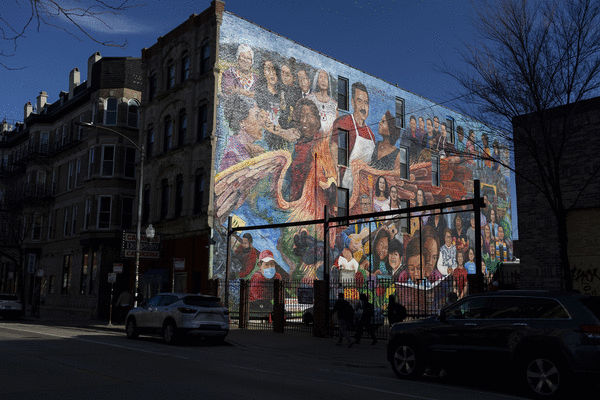
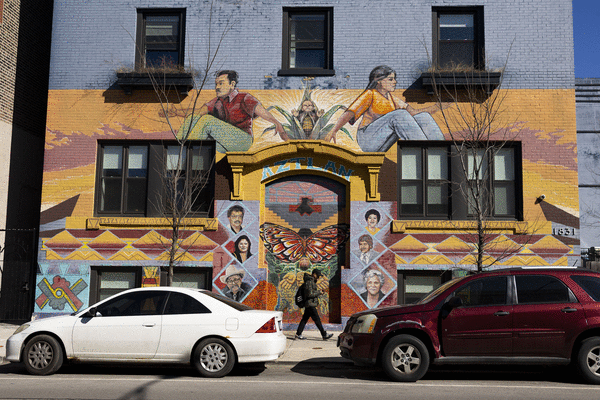


CHICAGO -- Vivid blues, yellows and reds make the brick facades along West 18th Street pop. Paintings of faces, birds and other subjects draw foot traffic into alleyways and eyes onto the side of buildings, which house a mix of mom-and-pop shops, taquerias and chains like Dunkin’.
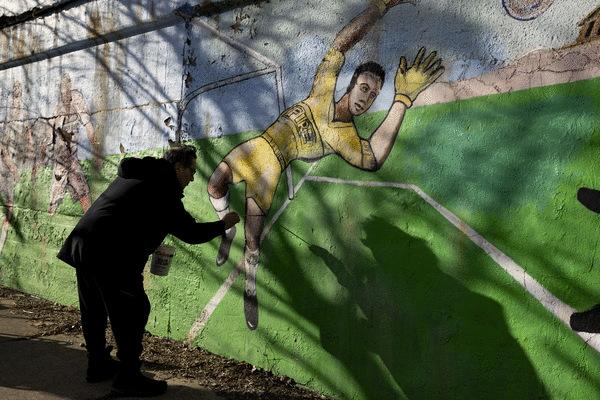
The paintings are evidence of Pilsen’s mural movement, which began in the 1960s and cemented the Lower West Side neighborhood’s future as a hub for Mexican art.
“The movement was not in a museum and a fancy gallery,” said Alejandro Romero, a 77-year-old muralist who has been based out of the neighborhood for over 40 years. “It was in the streets, in the alleys.”
But in recent years, rising property values and taxes on the Lower West Side have brought affordability struggles for artists. Some feel the strain of keeping arts spaces open, and others have been pushed out altogether.
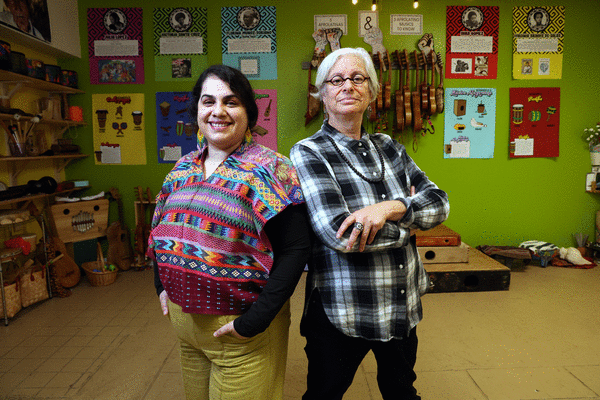
In the past decade, at least 12 Pilsen cultural spaces that frequently hosted art and music events have closed, according to Jackie Rodriguez and Gina Pacheco-Gamboa. The two founded 18th Street Casa de Cultura, where they organize cultural gatherings, concerts and art events.
Robert Valadez, a 63-year-old muralist raised in the community, said he’s seen this pattern of gentrification in cities all over the globe. Artists move into a place, making it hip, Valadez said, and then white-collar workers follow, driving up prices.
“When I was a kid, nobody wanted to live in Pilsen,” Valadez said. “The only white people I ever saw were your teachers and the cops.”
A changing neighborhood
Pilsen became a predominantly Mexican community in the ’60s when the population more than doubled. Families moved into the neighborhood from the Near West Side due to the construction of the University of Illinois at Chicago’s campus. Longtime residents recall the disinvestment they faced, like the fight for garbage collection in the ’80s and blackouts in the ’90s.
From 2000 to 2013, over 10,000 Hispanic residents left Pilsen, one study from UIC found. In that same time frame, the area’s white population grew by 22%.
Valadez said he got priced out of Pilsen years ago. He used to work out of Casa Aztlán, a community center that opened its doors to artists. Valadez didn’t pay rent at the center, he said, and instead did in-kind work.
Hector Duarte, a prolific muralist based out of Pilsen since 1985, also recalled Casa Aztlán’s importance to the neighborhood.
“Young people started gathering there, and without really having training as painters or anything like that, they began painting inside the building, outside of it, on the streets and on other houses,” Duarte said in Spanish.
Casa Aztlán closed in 2013, when a bank auctioned off the property due to unpaid debts. In 2017, the building’s new owner, a real estate developer, painted over the public murals with gray paint. Residents pushed back, and artists, including Duarte and Valadez, repainted the mural on the building’s facade with the owner’s permission later that year.
Today, the shuttered community center is a modern co-living apartment boasting a theater and fitness space. A bedroom in a shared apartment costs $858 a month, and average studios and one-bedrooms rent for over $1,300 and over $1,900, respectively.
Pilsen rents are rapidly trending upward. Average gross rents in the Lower West Side area increased around 68% from 2010 to 2023, according to the Institute for Housing Studies at DePaul University. Chicago’s average gross rent increased only 52% in that time frame.
New residential builds are geared toward young, single people, said Docia Buffington, a project manager at the Pilsen Housing Cooperative, making family housing less prevalent.
Single-family home sale prices in the Lower West Side have increased over 250% since 2000, according to the Institute for Housing Studies. That’s the third-largest price spike in the entire Chicago area.
“This has led to a lot of displacement of families — of Latino families in particular — in Pilsen,” Buffington said.
Residents put up a ‘Fight To Stay’
Some Pilsen artists and residents have formed groups or used art to stake their claim in the community.
The Pilsen Housing Cooperative works to combat resident displacement by providing permanently affordable housing solutions in designated buildings. According to Buffington, the co-op has around 20 units. Recent building purchases will allow it to double its impact, Buffington said. One new building will include affordable art studio spaces.
Susana Avitia, a 49-year-old actor and Aztec dancer, grew up in Pilsen and began her artistic journey at Casa Aztlán. She said she moved out of the area 10 years ago because of rising rents.
“It was so beautiful back in the day,” Avitia said. “It’s still beautiful now, but it’s a little different.”
Avitia returned to Pilsen in December through the co-op. She pays $800 a month for a “perfect” one-bedroom apartment with a patio. Avitia said the home allows her almost 4-year-old son to grow up surrounded by art and expression.
“He can learn to remember who he is and what his background is as he grows and evolves in our culture,” she said.
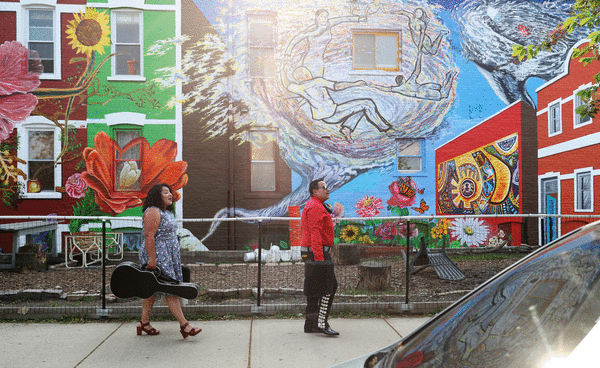
One of Duarte’s 80 murals across Chicago can be seen on a Pilsen Housing Cooperative building at 1910 S. Wolcott Ave. Duarte and artist Gabriel Villa painted two tornadoes: one ripping away cultural elements, like a guitar and a paleta cart, and one carrying a family holding hands.
The mural, called “Fight To Stay,” symbolizes the struggle to remain in Pilsen, Duarte explained. Over the years, he’s seen rising costs of living affect his neighborhood. In 2003, Duarte and other artists launched Pilsen Open Studios, an event that allows the public to visit artists’ workspaces. At its peak, it had nearly 40 spaces participating, Duarte said. Now, he estimates the number has dwindled to 25.
Rising costs affect cultural spaces
“Fight To Stay” also pays homage to Mario Castillo’s “Peace,” a mural at 1935 S. Halsted St. that was later sandblasted away. “Peace” is credited with beginning Pilsen’s mural movement in 1968 and inspiring Hispanic murals nationwide.
Castillo, now 80 and no longer living in Pilsen, said art is important to the neighborhood because it is important to Mexican culture.
“Art reflects the spirit of the artist that created it,” Castillo said. “And when you get all of the artists from one country together, it’s showing the essence of that country.”
As the mural movement grew, more artists, including Alejandro Romero, brought color to Pilsen’s walls.
Decades ago, Romero said he could afford to leave his Pilsen studio for months at a time to do projects abroad. From 1989 to 2001, he even rented a second studio with an elevator and bathroom in Wicker Park’s Flat Iron Arts Building.
Now, Romero said he has to be producing work in his Pilsen studio consistently to afford it.
Romero was, more recently, the curator of La Luz Gallery, which he said displayed Mexican and Hispanic art at the Pilsen Law Center on West 18th Street before closing last year.
“My dream was to create a movement,” he said of his work with the gallery.
Romero said the law center’s leadership told him the gallery had to close because its sales weren’t enough to help pay the building’s rising property taxes.
Rodriguez and Pacheco-Gamboa, who have worked together since the early 2000s, said they met when artistic and cultural events were happening in the neighborhood all the time.
Rodriguez said the area still teems with these activities. But with art space closures, it now takes more effort to get events going, she said.
“We don’t get taught our culture in school,” Rodriguez said. “You look to your neighborhood for that. But if we don’t have cultural spaces that are talking about Mexicano and Latino identity, how are our new generations getting that?”
Pacheco-Gamboa and Rodriguez used to host and participate in events at sites in Pilsen that have since closed, like Colibrí Studio and Gallery, Calles y Sueños and Café Mestizo.
The two said the dwindling number of arts spaces was one motivator to get a physical location in 2021 and form 18th Street Casa de Cultura. It now has two more addresses, also along West 18th Street: a healing center in Colibrí’s old building and an office.
“We don’t want to be the only space,” Pacheco-Gamboa said. “The more, the better. Because that’s how you get what we had before, when you really have a movement.”
Still a thriving arts scene
To Duarte, the arts movement is different but still rooted in Pilsen. He said it helps preserve the neighborhood’s culture and identity and pass that along to younger generations.
“Many young people have two cultures,” Duarte said. “The one here, and the one their parents come from. They can take the best from both to create a better future.”
Those from outside Pilsen continue to recognize its artistic contributions. Pacheco-Gamboa and Rodriguez said they’ve met people at 18th Street Casa de Cultura’s events who traveled from Matteson, Joliet, Elgin and farther.
Pacheco-Gamboa said that despite their distance, those attendees all have connections to the neighborhood they were priced out of.
“People have told us that they would come to our space specifically to bring their kids because then their kids can feel a little bit of what they experienced,” Pacheco-Gamboa said. “And it is sad. … We’re not trying to be a place so that people can come from far away. We want to be the place with the people.”
Artists have also used their craft to speak out against gentrification. Cesáreo Moreno, chief curator and visual arts director for the National Museum of Mexican Art, referenced the “Pilsen is not for sale” art, murals and signs in response to developers buying up properties.
Artists need community support, Moreno said, or they’ll leave. And if artists are talking about gentrification, they’re not the only ones.
“When the artists are working on a topic or idea, and you see more than one artist working on this topic or idea, you can be sure that’s what’s on the lips of the community,” Moreno said.
____
Chicago Tribune’s Laura Rodríguez Presa contributed.
©2026 Chicago Tribune. Visit at chicagotribune.com. Distributed by Tribune Content Agency, LLC.














Comments