Heidi Stevens: As Trump threatens to end a civilization, it's clear we never should've gotten to this point
Published in Lifestyles
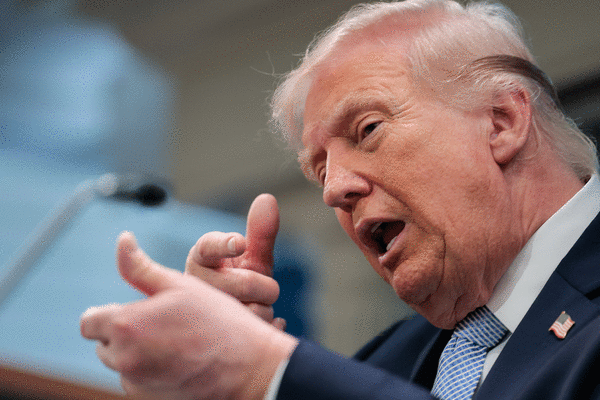
I see the same posts and clips you do, the ones saying the president of the United States has dementia.
They tick off the tell-tale signs. They call for the 25th Amendment to be invoked. They may be right, though diagnosing from a distance never feels helpful or humane to me. Especially for the stigma it leaves on folks truly living with a diagnosed illness.
I see the same updates and breaking news alerts and morning briefings you do, the ones saying the president’s worst instincts were reined in by a last-minute deal. The ones that leave you wondering if things just got a little bit better or a whole lot worse. The ones that provide cold comfort.
I see the same excuses you do, the ones saying he’s a tough talker, deal with it. Or he was just kidding, get over it. Or a staffer posted it, don’t worry about it.
I see it all, day after day, and I always return to the same thought: It never should have gotten to this point.
The president of the United States shouldn’t be delivering apocalyptic threats on a social media platform he created after he was banned from mainstream sites following a violent attack on the U.S. Capitol carried out by his supporters.
The president of the United States shouldn’t use language like “a whole civilization will die tonight, never to be brought back again.” Language that reverberates immediately and strikes terror globally. Language that sends countless people on a gut-wrenching march of dread, wondering whether this will be their final day, wondering whether their loved ones will live or die, wondering how they’ll possibly piece a life back together if they lose a child, lose a parent, lose the love of their life.
The president of the United States shouldn’t conduct foreign policy via a racist, profanity-laden Easter morning post. He shouldn’t stand next to the Easter Bunny at the White House Easter Egg Roll and talk about bombing Iranian power plants while children frolic on the lawn.
He shouldn’t keep United Nations officials and military scholars and members of Congress scrambling to determine whether his words forewarn a war crime in the making or merely moral bankruptcy in full bloom.
None of it befits the office. None of it benefits the country. None of it makes us safer, healthier, smarter, more secure, more innovative, more prosperous, more equal, more joyful.
And none of it should have happened.
Because the writing was on the wall.
This nation — filled as it is with brilliant minds and courageous souls and resourceful problem-solvers and resilient survivors and mission-minded servants — somehow still elected the guy who mocked a reporter’s congenital joint condition and bragged about assaulting women and described fallen veterans as “suckers” and “losers” and paid hush money to an adult film star and revealed, in all these ways and more, a vacancy where a conscience might be.
And then re-elected him.
And now we’re living with the consequences.
And it never should have gotten to this point.
And the only thing more painfully self-evident, more blatantly obvious, more woefully apparent than that, is that it never should again.
Character has to matter. Carefully choosing your words, your battles, your priorities has to matter when you serve the public. When you take an oath to protect your country and uphold democracy and defend the Constitution. When centuries of progress and setbacks and sacrifices and stories and hopes have shaped this place you’re now stewarding. Care has to matter.
Because we’re watching what happens when it doesn’t.
On the day that President Donald Trump threatened to wipe out an entire civilization, poet and playwright Nikita Gill shared on her Instagram page a poem by Mary Oliver called “Of The Empire.” It’s from Oliver’s 2008 book, “Red Bird,” and it goes like this:
“We will be known as a culture that feared death
and adored power, that tried to vanquish insecurity
for the few and cared little for the penury of the
many. We will be known as a culture that taught
and rewarded the amassing of things, that spoke
little if at all about the quality of life for
people (other people), for dogs, for rivers. All
the world, in our eyes, they will say, was a
commodity. And they will say that this structure
was held together politically, which it was, and
they will say also that our politics was no more
than an apparatus to accommodate the feelings of
the heart, and that the heart, in those days,
was small, and hard, and full of meanness.”
And we can also be known as a culture that learned and mourned and grew and vowed to do better. And we better. We can.
©2026 Tribune News Service. Distributed by Tribune Content Agency, LLC.












Comments