Editorial: Hybrids return auto industry to practicality
Published in Automotive News
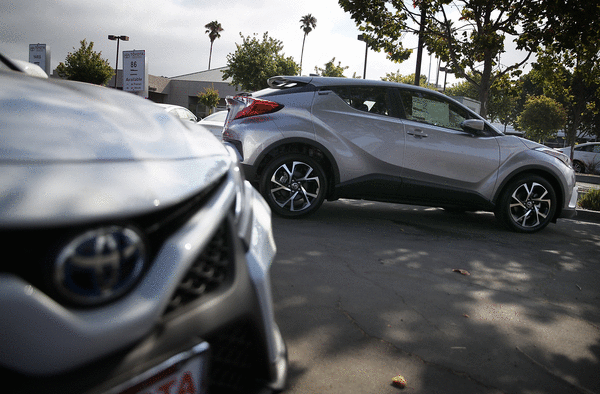
The auto industry is headed back to where it should have stayed in the quest to put a cleaner fleet on the road: hybrids.
Automakers are rapidly backing away from plans to fully electrify their offerings, due to an easing of fuel economy and emissions mandates by the Trump administration and continued resistance from consumers.
But that doesn’t mean they are totally abandoning their green ambitions. Rather, most manufacturers are making the common sense decision to expand the hybrid market. They are putting more hybrid models in showrooms and continuing to perfect the technology to achieve greater fuel efficiency.
That’s what they should have done in the first place. But government regulators bowed to the demand from environmentalists for a 100% switch to zero-emissions vehicles, and on a pace that ignored consumer wariness and the practical challenges to going all electric.
Hybrids were the first step away from traditional ICEs. They enjoyed consumer confidence and did not require a complete remake of the vehicles motorists were used to driving.
And best of all, they didn’t need a new national charging network. Because they have both a gasoline engine and electric motor, they can fuel up, and quickly, at existing gas stations.
Perhaps they made too much sense. But the industry, with Washington’s hand on its back, largely blew past hybrids and committed billions to developing and building EVs.
Practicality is now prevailing. Sales of hybrids were up 20% in the third quarter of 2025, according to the analytics firm PwC, and the surge is expected to continue this year. In Europe, hybrids account for 35% of all vehicle sales.
Most automakers have revamped their strategy to get as many hybrids as possible in showrooms, as soon as possible.
Toyota, which never abandoned hybrids, is selling its popular Sienna and Camry brands only in hybrid versions. Hyundai is doubling its lineup to offer 14 hybrid models. Ford has quadrupled hybrid production as it scales down the building of EVs.
General Motors, which not so long ago was committed to an all-in EV strategy, is reintroducing plug-in hybrids.
It’s all good news for consumers. EVs carry an average sticker price of $59,200, compared to $47,500 for a hybrid. And in the U.S. market, there are currently 87 hybrid models to choose from.
While not as fuel-efficient as an all-electric vehicle, they still reduce fuel costs by roughly 35% compared to standard gas-powered models, while curbing emissions by 20% to 30%.
And you can drive them wherever you want, whenever you want, and as far as you want, without the charging anxiety that haunts EV drivers.
Some motorists prefer EVs, and they aren’t going away. But America has always needed a vehicle for the masses, and hybrids adequately fill that role in today’s transportation mix.
The key difference between hybrids and EVs is that the decision to build them is market driven. Consumers prefer them because of their convenience and greater affordability, and because they still carry a significant environmental benefit.
Automakers should hurry to make hybrids the inevitable future transportation technology before the power pendulum in Washington swings to bring back the zero-emissions crowd.
©2026 www.detroitnews.com. Visit at detroitnews.com. Distributed by Tribune Content Agency, LLC.







Comments