SpaceX lines up 1st Space Coast launch of the year
Published in Science & Technology News
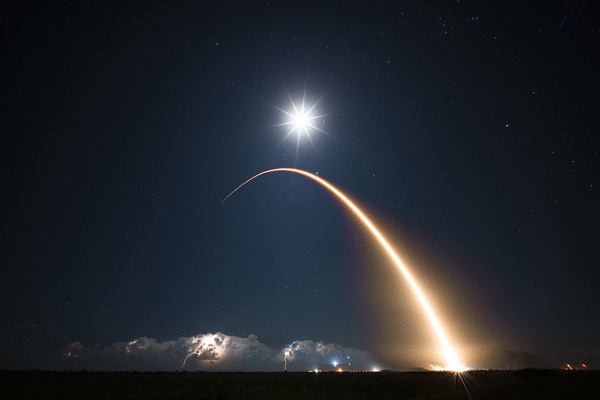
ORLANDO, Fla. — The Space Coast’s first launch of the year could come at midnight Sunday, the first of what could be four launches in the next 10 days, all from SpaceX.
A Falcon 9 is set to lift off on the Starlink 6-88 mission with 29 Starlink satellites from Cape Canaveral Space Force Station’s Space Launch Complex 40 during a launch window that runs from 12:00-3:17 a.m.
This will be the first flight of the first-stage booster, which will aim for a recovery landing downrange on the droneship A Shortfall of Gravitas stationed in the Atlantic.
A cold front moving through Central Florida beginning Saturday night could affect conditions during the window, though. Space Launch Delta 45’s weather squadron forecasts only a 30% chance for good weather at the opening of the window, but that improves to 70% by the end, plus a low to moderate risk of upper level wind shear. A 24-hour delay has a 75% chance for good conditions.
The next three missions by SpaceX are similar, all with payloads of 29 Starlink satellites, all from SLC-40, and all landing downrange on one of its two droneships stationed out of Port Canaveral.
Next up will be the Starlink 6-96 mission targeting Wednesday from 1:55-5:55 p.m. using a booster flying for the 29th time. After that will be the Starlink 6-97 mission on Jan. 10 from 1:34-5:34 p.m. with a booster flying for the 25th time. And then the Starlink 6-98 mission on Jan. 14 using a booster for the 13th time.
SpaceX flew 165 Falcon 9 missions in 2025 from all of its launch sites in Florida and California, and 101 from just Kennedy Space Center and Cape Canaveral combined.
Its first 2026 mission already flew from California, having launched Jan. 2 from Vandenberg Space Force Base when a Falcon 9 sent to orbit the COSMO-SkyMed Second Generation satellite for the Italian Space Agency and Italian Ministry of Defence.
SpaceX, United Launch Alliance and Blue Origin combined to launch 109 missions from Florida, a number the Space Force expects it will come close to in 2026.
Neither ULA nor Blue Origin have announced launch dates for their next missions, but both are expected in the beginning of the year.
ULA announced its next launch will use its new Vulcan rocket on the USSF-87 mission. It would mark Vulcan’s fourth ever flight having flown twice in 2024 and once in 2025. It will also be the rocket’s second national security flight.
ULA launches come from Canaveral’s Space Launch Complex 41, where the company expects to hit about 20 missions in 2026 among its Vulcans and remaining stable of Atlas V rockets.
For USSF-87, Vulcan will be carrying the Geosynchronous Space Situational Awareness Program (GSSAP) spacecraft, one of two NSSF Phase 2 contracts awarded to ULA in 2021 originally targeting a launch by the fourth quarter of fiscal year 2023.
Delays in Vulcan development have led to a backlog of more than 20 national security missions on the rocket.
Vulcan, will also be used for new commercial missions for ULA, though. The company said the flight after USSF-87 will be its first use of the rocket for the Amazon Leo constellation.
ULA has flown four missions so far with operational satellites for Amazon, but all on Atlas V rockets, which can take up 27 at a time. Vulcan can hold 44, and Amazon has dozens more flights lined up with Vulcan as well as Blue Origin’s New Glenn and Arianespace’s Ariane 6 rockets to grow its constellation to more than 3,200 satellites by 2029.
Blue Origin, meanwhile, is preparing still for its third ever launch of its New Glenn rocket from Canaveral’s Launch Complex 36. The NG-3 mission is planned to be for the Blue Moon Mark 1 lunar lander, an uncrewed mission targeting a touchdown on the moon’s South Pole.
The three commercial companies could be joined by new ones by the end of the year with both Relativity Space aiming to launch its new Terran R rocket from Canaveral’s LC-16 and newcomer Stoke Space trying to make the debut launch of its Nova rocket from LC-14.
Plus NASA is back with the Space Launch System rocket for the Artemis II mission targeting launch from KSC’s Launch Pad 39-B no later than April this year. Its first opportunity could come as early as Feb. 6, but the SLS topped by the Orion spacecraft remains at KSC’s Vehicle Assembly Building awaiting a rollout targeting mid-January to the pad where NASA will need to perform more tests before giving the go for launch.
Artemis II is the first crewed mission for Orion and aims to send three NASA astronauts and one Canadian Space Agency astronaut on a trip out to the moon without landing. It’s a test flight to prove the safety of Orion setting up the future Artemis III mission that looks to return humans to the moon’s surface for the first time since Apollo 17 in 1972.
©2026 Orlando Sentinel. Visit orlandosentinel.com. Distributed by Tribune Content Agency, LLC.






Comments