Many in Eastern Kentucky under boil water advisories, without service weeks after winter storm
Published in Weather News
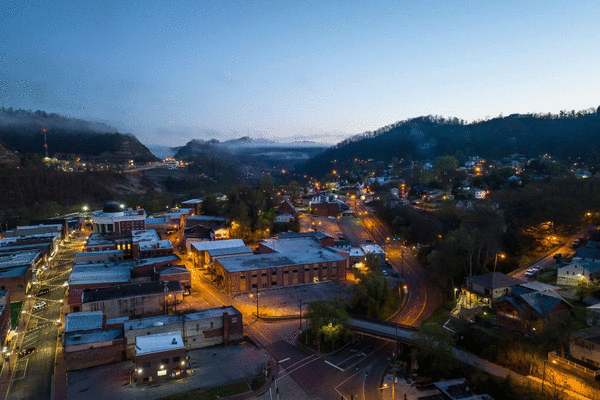
WHITESBURG, Ky. — As most of the commonwealth continues to thaw out after the bitter cold left behind by Winter Storm Fern earlier this month, several Eastern Kentucky water districts are still struggling to restore service to their customers.
Whitesburg residents have been under a boil water advisory for more than three weeks, and service that was turned off in and around Hazard for 10 days only began to come back online Thursday afternoon. Several hundred Perry County customers are still without water, and rolling water advisories continue to plague communities in Knott, Letcher, Harlan and Pike counties.
The drawn-out return to normalcy for water and sewer systems in Kentucky’s mountainous Appalachian highlands underscores a chronic problem the region has efficiently moving water to and from residents across rugged terrain through increasingly aging, worn-out pipes, tanks and pump stations.
The latest problems began in late January when residents started leaving their faucets running to prevent frozen pipes amid the persistent subfreezing slump. Gravity-fed tank water levels in Kentucky’s easternmost counties plummeted, causing pressure disruptions that forced municipal governments to issue boil water advisories and turn off service to check for leaks.
Then the bitter cold started slowing down the water treatment process itself. Many municipal systems in Eastern Kentucky take in surface water from high mountain streams and treat it through a gravity-separation process that takes advantage of the differences in density between liquids and solids. The open-air separation basins slowed — and even froze in some cases — as arctic air hung over the region for more than two weeks.
“It’s harder to treat water when it’s cold,” Whitesburg public works manager Chris Caudill said. “Way harder.”
Out of an abundance of caution, Caudill said, the Whitesburg Water Department instituted a boil water advisory for all its 1,100 customers, causing major disruptions for residents and businesses like restaurants that had to adjust their menus.
Caudill said the city hopes to have completed checks on most of the water distribution network and be able to lift the advisory by early next week, but he said he understands residents’ frustration and asked for their patience.
“I know it’s frustrating,” he said. “Luckily, we’ve been able to keep the water on most of the time.”
Residents in Perry County haven’t been so lucky. Neighborhoods north and northeast of Hazard were without water for more than a week as the utility department fought unusually high demand during the cold snap and have experienced a slew of water main breaks since.
Perry County Sheriff Joe Engle has been documenting his experiencing “surviving” without water on Facebook and organized his neighbors in the Lost Creek area to take their complaints about the department to the Kentucky Attorney General’s Office.
He filed a formal complaint against the Hazard Utilities Department earlier in the week and told the Herald-Leader he believes the department has failed to adequately communicate with residents what they’re doing and why.
“That’s the big problem,” Engle said. “People are fed up with how little communication there has been.”
Hazard Mayor Donald “Happy” Mobelini said the city has posted regular updates on its social media pages and utility workers have engaged directly with disgruntled residents.
“We’re doing what we can,” he said.
Eastern Kentucky is disproportionately represented among the state’s most disadvantaged sewer and water systems.
Natural disasters, population decline and dried-up mineral severance accounts have left many municipalities managing old, coal-camp era water systems.
The natural, topographical barriers water systems have to overcome in order to deliver safe drinking water through narrow river valleys and to and from tiny mountain communities only compounds that problem, Kentucky Area Development District Associate Director of Community and Economic Development Jennifer Mcintosh said.
“The mountainous terrain doubles or triples the cost of replacing anything here compared to Louisville or Lexington,” Mcintosh said. “I don’t think a lot of people understand the dynamics of a water or sewer system in Eastern Kentucky.”
State funding programs geared toward Eastern Kentucky’s unique needs exist, but that doesn’t change the length of time it takes for projects to get funding. The allocation of a grant for infrastructure improvements only marks the beginning of a long process that includes siting, permitting and construction.
Hazard and Whitesburg have two of the oldest water distribution networks in the region, Mcintosh said, which makes them especially susceptible to weather-related disruptions.
©2026 Lexington Herald-Leader. Visit kentucky.com. Distributed by Tribune Content Agency, LLC.






Comments