Anita Chabria: Is RFK Jr. better on women's health than Newsom? We're about to find out
Published in Op Eds
It's a bad look when Robert F. Kennedy Jr. is ahead of you on scientifically sound health policy — women's health, to make matters worse — but that's exactly what happened to Gov. Gavin Newsom last week.
Ouch.
In a Cabinet meeting, Kennedy went on a six-minute-plus grovel to Trump. That's pretty standard for these increasingly weird meetings, but the secretary of Health and Human Services specifically praised the president for ending a "20-year war on women by removing the black box warnings from hormone replacement therapy."
As much as it shocks me to say it, RFK Jr. has a reasonable point.
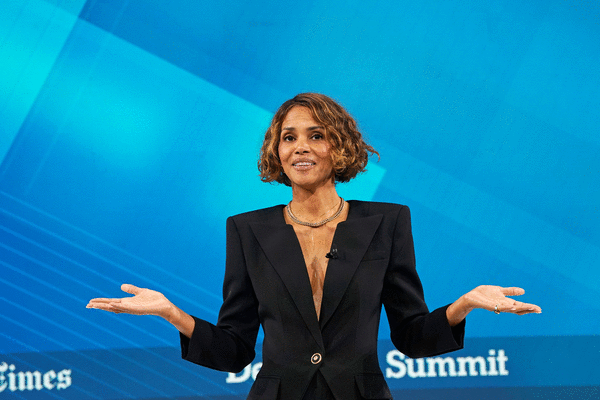
A couple of days later, appearing onstage at the New York Times' DealBook Summit, Oscar-winning actor Halle Berry took an unexpected and harsh shot at Newsom for vetoing a bill on menopause treatment.
"But that's OK," she said of Newsom killing the Menopause Care Equity Act (AB 432), which she had lobbied to pass and which had strong bipartisan support in the Legislature.
"Because he's not going to be governor forever, and with the way he has overlooked women, half the population, by devaluing us in midlife, he probably should not be our next president either," Berry said. "Just saying."
The two events show just how complicated and controversial menopause care has become in the past few years, as women not only talk about it more openly, but demand care that for, well, basically always, has been denied or denigrated as unnecessary.
Looking a bit deeper, this seemingly out-of-the-blue menopause moment gets to the heart of an insurance problem that, male or female, most Americans have an opinion on: How much power should insurance companies have to deny care that a doctor deems reasonable?
To keep it simple, menopause is a phase that all women go through when their fertility ends, meaning 50% of the population deals with it. It has specific and life-altering symptoms — most of which can be treated, but often aren't because many doctors aren't trained in menopause care (or perimenopause, which comes first), and the science is too-often overlooked or misunderstood.
The result is that way too many women stumble through menopause not understanding what is happening to them, or that there are excellent, scientifically backed treatments to help.
A prime example of that is the "black box" warning that has been on many hormone replacement drugs since the turn of the millennium, when one large but flawed study found that such drugs might increase the risk of cancer or other diseases.
A black box warning is the most serious caution the Food and Drug Administration can put on a medication, and its inclusion on hormone replacement theory, or HRT, put a severe chill on its use.
Twenty years of subsequent research not only revealed the flaws in that first analysis, but also showed significant benefits from HRT. It can protect against cognitive decline, decrease heart disease and alleviate symptoms such as hot flashes, among many other benefits.
In early November, the FDA removed those warnings from many HRT drugs. The result will likely be greater access for more women as doctors lose a hesitancy to prescribe them, and women lose fear of using them.
"The misconceptions around the risks have been overblown for decades, fringing on dogma over real science and have led to population-level missed opportunities for life improvements for our aging women of the developed world," wrote Michael Rodgers, chairman of the Santa Clara County Health Advisory Commission, on a public comment about the change.
While Rodgers is right, insurance coverage and doctor know-how remain problems for women seeking care — ones that the Menopause Care Equity Act hoped to address.
The bill would have required private insurance companies to cover FDA-approved menopause treatments and rewarded doctors who took voluntarily continuous education classes on menopause topics. That final version had already been watered down from earlier proposals that would have mandated coverage of even more treatment options (such as non-FDA approved compounded hormones) and made menopause training required for doctors.
But Newsom seemed to take issue with a part of the bill that banned insurance companies from applying "utilization management" to menopause treatments — and here's where we get back to agreeing with RFK Jr.
Utilization management, or UM, is basically when insurance companies get to decide what a patient needs and what they don't — the pre-approvals, the reviews and the denials, which all too often seem to be far more about cost than care.
Now artificial intelligence is getting in on the utilization management business, potentially meaning it's not even a human deciding our treatments. UM is a multibillion-dollar industry that, under the premise of keeping healthcare affordable, too often does so by denying care.
Which is why Assemblymember Rebecca Bauer-Kahan (D-Orinda), the author of the California bill, put in a prohibition against UM.
"The standard is 'medically necessary'" when it comes to insurance coverage, Bauer-Kahan points out.
"When you talk about menopause, that's a really fuzzy term, right? I mean, I will survive in the short term without any treatment," she said. "So what is 'medically necessary' is this very vague thing when it comes to menopausal care."
In his veto message, Newsom said the UM prohibition "would limit the ability of health plans to engage in practices that have been shown to ensure appropriate care while limiting unnecessary costs."
But the truth, and problem, with menopause care is that it is specific to the individual woman. Like birth control pills, a treatment that works for one woman might cause side effects for another. There is often a lot of trial and error to find the right path through menopause, and women need to be able to have the freedom and flexibility to work one-on-one with their doctor. Without interference.
In June, Kennedy called out prior authorization across the healthcare industry as a problem, and announced shortly after that he had received a pledge from many large insurance companies to reform that process by 2026, removing the need for prior authorization from many treatments and procedures and streamlining the process overall.
If that reform comes to pass, it will indeed be terrific — I am hopeful — but also, let's wait and see. Those changes are supposed to begin in January.
Back in California, Newsom has also pledged to do something about menopause coverage in January, when he announces his budget proposal. In his veto message, Newsom said he would go this route — adding it into his budget package — rather than work on a new bill in the regular legislative session. This remains the plan, though no details are yet available.
Apparently, someone forget to mention it to Berry.
The budget has increasingly become a catch-all for legislation the governor wants to get done with less fuss because the budget and its trailer bills always pass at some point, and it can be an easier route for him to control.
Newsom has made it a core part of his policies, and his presidential campaign, to be a backer of women's rights, especially around reproductive care — and equity for women is a cause championed by his wife, First Partner Jennifer Siebel Newsom.
But the governor also has long been hesitant to pass legislation that has costs attached (the menopause bill could raise individual premiums by less than 50 cents a month for most private-pay consumers). With federal cuts, increasing premiums and the generalized hot mess of healthcare, his caution is not unwarranted.
But also, in this case, maybe it is misguided. The only real opposition to the California bill came from insurance companies. Go figure.
Bauer-Kahan said she has been in touch with the governor's office, but remains committed to pursuing a law that limits utilization management.
"I am happy to hear that we are going to hopefully achieve this, but it needs to be achieved in a way that actually meaningfully makes a difference for getting the menopausal care women need," she said.
Newsom's October veto made barely a ripple. Thanks to Berry's punch, his January proposal will be not just noticed, but scrutinized.
If he does eliminate the restrictions on UM, he'll need to answer the broader question that action would raise — how much power should insurance companies have to override the decisions of doctors and patients?
It would be strange days if January saw Kennedy and his chaotic and questionable Department of Health and Human Services offering better healthcare options for women than the state of California.
And stranger still if Newsom puts a price tag on the well-being of women.
©2025 Los Angeles Times. Visit at latimes.com. Distributed by Tribune Content Agency, LLC.































Comments