Commentary: The Supreme Court's 3 terrible reasons for allowing Texas' racially rigged map
Published in Op Eds
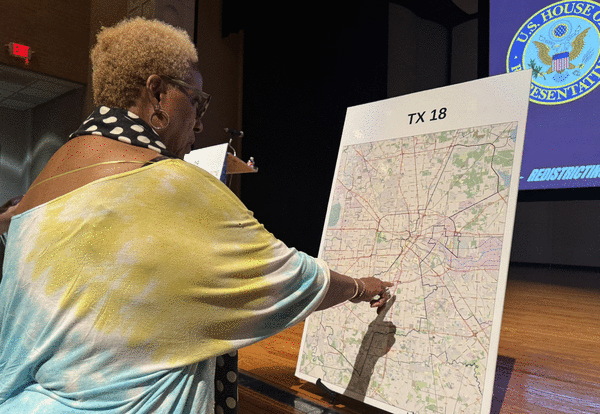
It is hard to imagine a worse decision than the Supreme Court’s ruling on Thursday allowing Texas to use its new congressional maps designed to elect five more Republicans to the House of Representatives. In a 6-3 decision, the six conservative justices have opened the door to states being able to adopt unconstitutional laws on voting — with immunity from judicial review for at least one election.
At the urging of President Trump, Texas’ Republican-controlled state Legislature redrew congressional districts to help Republicans retain control of the U.S. House of Representatives. Gov. Greg Abbott signed this into law on Oct. 25. It was immediately challenged in court.
Pursuant to federal law, this was heard by a three-judge federal court. The judges conducted a nine-day hearing, involving the testimony of nearly two dozen witnesses and the introduction of thousands of exhibits. There is a factual record of more than 3,000 pages. In a 160-page opinion, with the majority opinion written by a judge appointed by Trump, the federal court found that Texas impermissibly used race as a basis for drawing the election districts. The Supreme Court has held for more than 30 years that it violates equal protection for the government to use race as a predominant factor in districting.
But the Supreme Court nonetheless overturned the district court’s decision and will allow Texas to use its new districts. The court gave three reasons.
First, it said that the lower court “failed to honor the presumption of legislative good faith.” But this is belied by the overwhelming evidence recited in the district court opinion that the Texas Legislature achieved its goal of creating more Republican seats by using race to draw congressional districts. No “presumption” was appropriate: The legislators’ motives and methods were explicitly on the record for the lower court to assess.
One of the most basic principles in jurisprudence is that appellate courts are to accept the fact finding by lower courts unless it is clearly erroneous. The Supreme Court disregarded this and gave no deference to the detailed facts found by the federal district court.
Second, the Supreme Court said that the district court erred by not producing “a viable alternative map that met the State’s avowedly partisan goals.” This is an astounding argument: It asserts that the only way the lower court could have declared race-based districting unconstitutional would be for it to devise a different map that would also have created five more Republican-controlled congressional districts. What if there was no way to draw such a map without impermissibly using race? That surely should not be a basis for accepting an unconstitutional government action. As Justice Elena Kagan said in her dissent, “the map’s absence does not make the direct evidence of race-based decisionmaking go away.”
Finally, the court said that the challenge to the new districts came too close to the next election — the midterms of November 2026. The justices’ majority opinion stated: “This Court has repeatedly emphasized that lower federal courts should ordinarily not alter the election rules on the eve of an election.” This is the “ Purcell principle” — from a 2006 Supreme Court order in Purcell vs. Gonzalez — that federal courts cannot strike down laws regarding an election too close to the start of voting. On Thursday, the Supreme Court said that the three-judge court violated this rule by improperly inserting itself “into an active primary campaign, causing much confusion and upsetting the delicate federal-state balance in elections.”
The Supreme Court never has explained the basis for the Purcell principle and did not do so here. Regardless of timing, it makes no sense that a state government should be able to violate the Constitution and be immune from judicial review in conducting an election. But the court’s decision in the Texas case extends the Purcell principle as never before. Even in a case such as this, when there was no possible way to bring an earlier challenge or get an earlier decision, still the Supreme Court says that there cannot be judicial relief for an unconstitutional government action.
Abbott did not sign the bill for the new districts until late October. The plaintiffs sued immediately. The district court acted as expeditiously as possible and issued its ruling on Nov. 18. This did not come on the eve of the election, but almost a year before it; the midterms are on Nov. 3, 2026. And still the Supreme Court said there could not be a legal challenge.
The implications of this are staggering. It means that if a state waits long enough to adopt an unconstitutional restriction on voting or districting, it will be completely immune from challenge until after the next election. Kagan made exactly this point in dissent: “If Purcell prevents such a ruling, it gives every State the opportunity to hold an unlawful election.”
The Supreme Court’s ruling in the Texas case means that there cannot be challenges to the new districts in California under Proposition 50, or for that matter those that were drawn in Missouri or North Carolina. We’ll see next November what it means for control of the House of Representatives. But we can see already that the Supreme Court has abdicated its most important role: enforcing the Constitution.
____
Erwin Chemerinsky is the dean of the UC Berkeley Law School.
©2025 Los Angeles Times. Visit at latimes.com. Distributed by Tribune Content Agency, LLC.















































Comments