Editorial: Trump's brand of socialism has no place in a revival of America's nuclear power industry
Published in Op Eds
This page has long supported the responsible use of nuclear power to generate electricity. Illinois was the birthplace of the first-ever reactor at the University of Chicago, after all, and now has more reactors than any other state.
Today, we’re optimistic that modern nukes using up-to-date technology could pull off a comeback. America needs more juice, not least because President Donald Trump’s administration has attacked wind and solar projects — putting the U.S. out of step with the rest of the world and short-circuiting economic growth.
Westinghouse, a nuclear pioneer, has announced plans to build 10 large reactors in the U.S., with construction to begin by 2030. Each of its AP1000s could supply 750,000-plus homes or, alternately, some of the power-hungry data centers coming online to fuel the artificial intelligence boom.
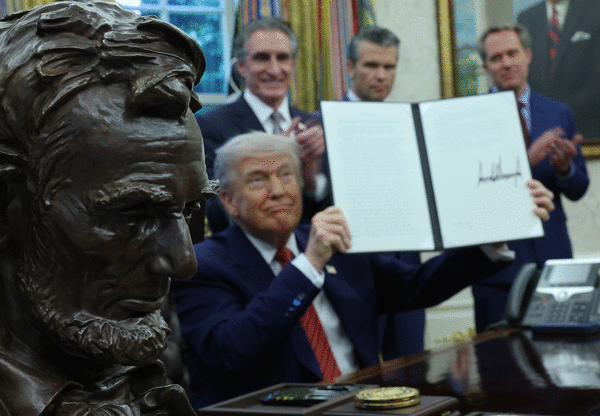
Trump issued executive orders in May that aim to quadruple the use of nuclear power in the U.S. by 2050, including a “wholesale revision” of Nuclear Regulatory Commission regulations. So far, so good, as government red tape is a glaring reason why just a few new reactors have come online since the 1980s.
Unfortunately, Trump’s otherwise welcome support of nuclear power comes with a catch. And it’s a potentially ruinous one.
Instead of staying in its lane by updating regulations and providing incentives to help jump-start the private sector, the administration reportedly is demanding a piece of the action. Its current plan appears to put taxpayers on the hook for tens of billions while giving the government an ownership stake.
So, the U.S. would pick the winning company to carry out its policy and then exert direct control over the company’s management. That is the opposite of letting the free market do its job. Yet turning independent businesses into state-owned enterprises is becoming a pattern under Trump.
Earlier this year, unchecked by a subservient Congress, Trump forced Japan’s Nippon Steel to give the government a so-called golden share in exchange for approving its takeover of U.S. Steel. The move will give politicians veto power over rational economic decisions at a storied player in the American steel industry.
Similarly, chip-maker Intel was forced to make the U.S. its biggest shareholder, and the government also has taken equity stakes in a handful of mining companies that are on the hunt for scarce minerals. Meantime, Nvidia and AMD agreed to hand over 15% of certain sales revenue from China in exchange for permission to sell their cutting-edge computer chips there. In effect, those companies bought federal approval, even though their sales to China could threaten national security.
These deals strike us as un-American.
As Chicago Tribune columnist Steve Chapman wrote earlier this year, America’s brand of capitalism requires companies to provide valuable goods and services at prices customers will pay. “Firms that fail at this relentless obligation go out of business sooner or later, freeing up resources that can be used more productively.”
The recent examples of government interference with private enterprise undermine that basic function of capitalism, resulting in a “noxious form of socialism,” Chapman wrote.
When it comes to nuclear power, the concerns extend beyond political corruption and cronyism to life-and-death. For all the assurances about today’s newfangled reactors being clean, efficient and reliable, nuclear facilities are inherently dangerous. They create the deadliest waste imaginable and can be high-risk targets for terrorists and others looking to do harm.
The lack of a national repository for this toxic waste also has meant that each nuclear station has doubled its own hazardous-waste storage site. That appears it will be the case for perpetuity.
Nukes also are freakishly expensive. They require a fortune for construction. Cost overruns and lengthy delays are the norm. Those risks get magnified when politicians can call the shots about where and how these projects proceed.
The proposed Westinghouse deal is difficult to evaluate because its details remain uncertain. At least some funding is supposedly coming from Japan, because of trade war concessions, which recalls Trump’s phony promise that Mexico would pay for a border wall.
The Canadian firms that jointly run Westinghouse today are said to be under pressure to spin off their subsidiary to facilitate the U.S. government becoming a big shareholder. Under the deal, Westinghouse presumably will be able to draw on taxpayer funds for its reactor projects, bypassing the discipline imposed on those seeking investment funding in the open market.
A conference call with Westinghouse investors last month left unanswered questions, even as executives celebrated the “wonderful alignment” between the company and the U.S. government. You could almost hear cash registers ringing in the background.
Before this nuclear scheme goes farther, Congress needs to start doing its job and put all these squirrelly deals under a microscope. There’s no reason why Comrade Trump’s brand of socialism will work better than any other kind.
_____
©2025 Chicago Tribune. Visit chicagotribune.com. Distributed by Tribune Content Agency, LLC.













































Comments