James Stavridis: Five reasons why the boat strike debate matters for the US
Published in Op Eds
It has been a turbulent couple of weeks in national security, highlighted by continuing strikes on high-speed boats in the Caribbean that are, according to the Trump administration, carrying drugs headed to the U.S. Whether that doctrine of “shoot-to-kill,” carried out without warning or any opportunity for surrender, stands up under congressional and judicial scrutiny over time remains to be seen.
But what has really struck a nerve is the so-called double-tap strike that killed two alleged drug runners while they were clinging to the wreckage of their boat. Very few analysts have seen the video of that second strike, and hopefully it will come out soon so that a wider group of observers can provide a more informed judgment on whether it was justified.
Perhaps predictably, among the congressional leaders who have seen the footage of the second strike, there is sharp disagreement. Democrats say it is deeply troubling and a possible war crime that requires a fulsome investigation. Senior Republicans are adopting a “nothing to see here” view that it was entirely justified because the two survivors were still somehow “in the fight,” despite having no weapons, radios or serviceable craft. It is a Rorschach test in every way.
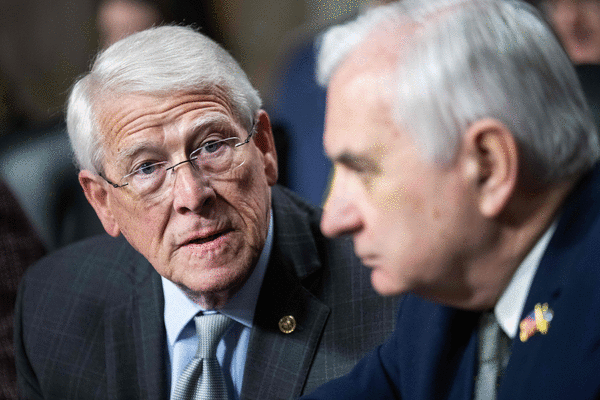
Hopefully, we will see a bipartisan approach from the Senate and House Armed Services Committees, which are the principal oversight bodies for the military. In particular, I look to the leaders of the Senate committee, Roger Wicker (a former Air Force Judge Advocate General and retired lieutenant colonel) and Jack Reed (a West Point graduate and former Army officer), to conduct a full investigation, including the video of the second strike, audio from both strikes, and supporting advice from the commanders and JAGs involved, under oath.
But it is worth backing up to remember why all of this is so important for our nation. It is something I wrestled with throughout my own 37-year career in the Navy, including my time in that theater as head of U.S. Southern Command for three years, overseeing many counter-narcotic operations in which we routinely stopped, searched and apprehended tons of cocaine coming toward the U.S.
Additionally, during my time as Supreme Allied Commander of NATO, I was likewise deeply concerned about issues of collateral damage, the treatment of prisoners (both at Guantanamo Bay and in Afghanistan’s Bagram facility), and the general conduct of war.
First and foremost, the idea of allowing an enemy — no matter how despicable — to surrender is a moral and ethical imperative. We all grow up knowing we don’t continue to strike an opponent when they are knocked down on the ground. In war, this means we don’t machine-gun survivors in the water after their warship is sunk, shoot and kill pilots parachuting from an aircraft we’ve hit with anti-air missiles, or “double tap” an opponent on the ground with a bullet to the chest and another to the head when they are already knocked out by a concussive grenade.
Second, we follow the law. War — although inherently vicious and full of chaos — is governed by an extensive set of laws (both domestic and international); treaties to which our nation is a signatory (e.g., the Geneva Conventions); our own policies on the treatment of enemy combatants; and our standing and promulgated rules of engagement. In other words, there are laws and rules governing war, and when we appear to violate them, we need to investigate and determine whether we did the right thing — or not.
A third and frequently overlooked aspect of why we give quarter is pragmatic: intelligence. By capturing our downed opponents, we can interrogate them (where rules again apply) and glean much-needed and often highly useful intelligence. The drug runners floating in the water in September knew things: locations of logistics centers, routes, fueling stops, the next ship they were going to rendezvous with, the people who paid them and much more. By capturing instead of killing them, we can harvest that intelligence about the whole rotten network, reverse-engineer it, and dismantle it.
Fourth, there is the question of reciprocity. If those were two Navy SEALs floating on the wreckage of their small boat or recovered from their submersible by North Koreans, we would want them to receive humane treatment and be captured, not shot to death when they had no means to resist. While there is never any guarantee that our adversaries will follow our lead, it seems to me that we are in a better position to ensure the safety of our own people if we take the high road and capture instead of kill whenever we can.
Finally, the global optics of all of this matter. When the U.S. has been involved in war crimes — e.g., the My Lai massacre in Vietnam, the Abu Ghraib prisoner abuse scandal, or the Haditha killings in Iraq — the world watched closely. We investigated each of those scenarios and found varying degrees of culpability, with some participants exonerated and others sanctioned. But the point is that we were unafraid to fully investigate and assign accountability, without fear or favor. We need to model the behavior we hope for from a global audience, including our allies, partners and friends.
I hope Congress, notably the Senate and House Armed Services Committees, will fully investigate this incident. If it needs to be done behind closed doors for security and to protect sensitive sources and tactics, so be it. But the reasons for further investigation seem clear: We must be a nation that follows and respects the rule of law — even when it applies to the worst of our enemies and hardened criminals.
_____
This column reflects the personal views of the author and does not necessarily reflect the opinion of the editorial board or Bloomberg LP and its owners.
James Stavridis is a Bloomberg Opinion columnist, a retired U.S. Navy admiral, former supreme allied commander of NATO, and vice chairman of global affairs at the Carlyle Group.
_____
©2025 Bloomberg L.P. Visit bloomberg.com/opinion. Distributed by Tribune Content Agency, LLC.




















































Comments