Marc Champion: Why Russia loves the new US national security strategy
Published in Op Eds
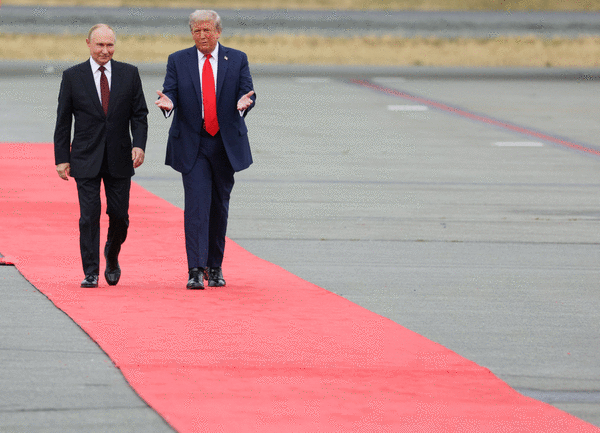
Nothing about the Trump administration’s new National Security Strategy should shock European leaders, still less the enthusiastic welcome that this confirmation of a revolution in U.S. foreign policy has received from Moscow.
It calls, after all, for a rupture in the Transatlantic Alliance that every Kremlin leader — with brief exceptions for Mikhail Gorbachev and Boris Yeltsin — has sought since 1945.
Why that is should be self-evident. Moscow has been fighting wars to expand or protect its westward borders and influence since at least the days of Peter the Great. U.S. interventions to help defeat Russia’s primary 20th century rival for continental dominance — Germany — were helpful to the Kremlin’s goals. America’s decision to stay on as guarantor of a new transatlantic “West” was not.
This much won’t be disputed by the U.S. strategy’s authors. It’s just that, unlike their predecessors, they believe American interests now align with Moscow’s when it comes to the European Union. Better it should be an atomized group of small- and medium-sized nations that can be pushed around and exploited for economic gain, than a $30 trillion-plus economic rival with potential to retaliate, especially on issues such as trade.
A second interest that President Donald Trump and Vladimir Putin share in Europe is perhaps less obvious: Unseating the liberal, pluralist leaderships that continue to run most European states — because they pose a threat to the domestic political narratives that both are dependent on to stay in power. More bluntly: When it comes to the culture wars, Trump and Putin are allies; liberal Europe is the enemy.
The reason Putin was so triggered over Ukraine in 2013, when it sought to sign a trade deal with the EU, was that the Kremlin couldn’t afford to have so similar a neighbor achieve Polish-style prosperity and liberties in the bloc. What might Russians then think about the necessity of their own authoritarian system? Putin had to suppress a Russian pro-democracy movement less than two years before and could ill-afford for Ukraine to rekindle it by providing proof of concept.
Trump, likewise, needs liberal Europe to fail if he’s to persuade future voting majorities of Americans that he offers the only solution to their problems. Hence the extraordinary acknowledgment in Trump’s new security strategy that the U.S. feels it has the right and obligation to interfere in European politics to ensure that MAGA-style leaders come to power there, too.
Like so many ideologues, including Karl Marx, Trump and his co-authors are far better at diagnosing the ills of a troubled system than proposing effective remedies. It took decades for many on the left to realize that just because capitalism had exploitative and disruptive tendencies didn’t mean this must lead inevitably to proletarian revolution and socialist utopia. Similarly, I suspect it may take a while for the penny to drop on what the far right is offering today.
The attempt to close the vast gap that quickly opened between Marxist doctrine and reality led to industrial-scale Soviet gaslighting and repression. You can see echoes today.
To pick just one example, as early as February, Trump’s Vice President JD Vance took to Munich the new administration’s idea that it was here, in “woke” liberal Europe, that democracy and freedom of expression were under threat. Never mind that his own boss had sought to overturn an election he lost in 2020, was imposing personal political control over independent democratic institutions, was trampling over the constitutional separation of powers, and has since gone on to abuse the power of both the National Guard and federal funds to impose his will on cities and universities that disagree with him.
It simply isn’t true that you can restore democracy by bending all institutions to the will of a leader, or improve freedom of expression by suppressing academic independence. Nor can you deliver peace by demolishing international institutions and reverting to an age of great power spheres of influence. We know this from most of human history.
So, the gaslighting is needed to maintain these fictions. The same goes for Trump’s empty claims on bringing peace to wars that either continue or were already over, and in particular his casting of Europe and Ukraine as the villains of Putin’s 2022 invasion.
Viktor Orban has done the same in Hungary. Poland has shown how hard it is to restore the independence of courts and other institutions once lost, even if a political opposition can overcome a tilted playing field to regain power. From the UK to Germany, far right mini-Trumps are waiting in the wings to take power across Europe.
At least some will succeed, because the populist diagnosis of what ails liberal democracies is largely accurate. Europe is indeed weak. Its democracies are struggling to restore dynamism lost to years of disarmament, poor demographics, bloated welfare states and complacency over deindustrialization. Some insurgents from the right, like Italy’s Prime Minister Giorgia Meloni, will prove astute political operators who reject populist policies they know can’t work once in office. Others won’t.
In the meantime, there’s nothing to suggest Europeans will have the courage to voluntarily cut their overdependence on U.S. arms and tech, a move fraught with economic risk from the trade war that inevitably would follow. Easier to go on pretending the U.S. is a briefly errant ally, because to do otherwise would involve alliance shifts and a butter-to-guns policy revolution so dramatic it would put Trump’s new doctrine in the shade.
_____
This column reflects the personal views of the author and does not necessarily reflect the opinion of the editorial board or Bloomberg LP and its owners.
Marc Champion is a Bloomberg Opinion columnist covering Europe, Russia and the Middle East. He was previously Istanbul bureau chief for the Wall Street Journal.
_____
©2025 Bloomberg L.P. Visit bloomberg.com/opinion. Distributed by Tribune Content Agency, LLC.








































Comments