Commentary: Thank goodness for 'A Charlie Brown Christmas'
Published in Op Eds
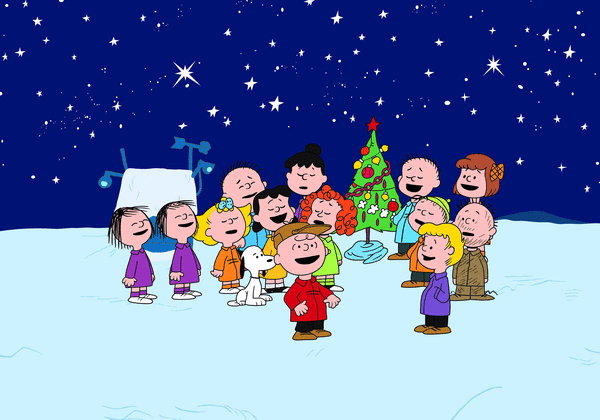
One of the most beloved holiday specials ever made doesn’t start with costumed pageants, joyful carols or snowmen come to life but with a self-aware declaration of seasonal depression.
“I think there must be something wrong with me, Linus,” says Charlie Brown, shuffling through the snow as other kids frolic to a song about the holiday’s happiness and cheer. “Christmas is coming, but I’m not happy. I don’t feel the way I’m supposed to feel.”
Sixty years ago this week, on Dec. 9, 1965, TV audiences were introduced to a downtrodden blockhead and his quest to find joy and understand the true meaning of Christmas — made more difficult when he doesn’t get any Christmas cards, the other children can’t be bothered to listen to his instructions for the Christmas play Lucy appoints him to direct and his own dog enters a commercialized decorating contest to win “money, money, money.”
Charlie Brown is anxious and depressed during the rest of the year, so understandably, it gets heavier during the holidays. (“I know nobody likes me. Why do we need a holiday season to emphasize it?” he laments). The same is true for the rest of us. The collective grief a lot of us feel, whether it’s our anxiety about the future or simply missing a world that once felt a bit kinder, is heightened when everyone else wants to slap a red and green bow on it.
We now have more modern examples of holiday gloom — “Home Alone” or “The Holdovers,” “The Family Stone,” “Last Christmas,” Joni Mitchell’s “River,” and plenty of other reminders that Christmastime can be hard in essays and antidepressant advertisements. But “A Charlie Brown Christmas” is maybe the most uncomplicated, most sincere and most direct. It offers us all the unadorned language we need to say, “You know what, I feel pretty bad this year, and that’s not the way I’m supposed to feel.”
Even the most holiday-inclined have felt this pang at some point. My dad, Joe, who was born in 1968 and grew up with “A Charlie Brown Christmas” just as we all did, with annual airings and Vince Guaraldi’s jazz soundtrack playing on a loop, put it simply to me once. In 2018, on a drive to meet family the night before Thanksgiving, I put the album on, to which my dad remarked that it always gave him a feeling, but one he couldn’t name. My suggestion of “melancholy” didn’t quite fit.
“It always made me think, ‘I’m not going to be a kid much longer,’ even when I was a kid,” he said, laughing a bit from the driver’s seat. That I could understand. I was 21 at the time, and my excitement for the season felt exceptionally far away. Even well before then, Charlie Brown’s Christmas crisis had represented my own complex feelings of hope, loneliness and anxiety, from childhood until now, and also made me more comfortable that those feelings can exist together.
That feeling my dad described now strikes me as a sort of preemptive grief, one we see Charlie Brown feeling in his namesake special during what should be a cheerful time of year, with Snoopy skating and kids writing to Santa and Guaraldi’s ubiquitous jazz score. Charlie Brown is grieving the loss of childhood wonder and his joy of the season — likely earlier than most of us experience it, but he knows he doesn’t feel the anticipation and happiness he’s supposed to feel. He’s just not sure why.
This year, my grief is both collective and personal. On Oct. 15, my dad died suddenly but peacefully. It was not expected. We were close. I miss him constantly. The loss feels abstract some days and others, looking at photos or videos feels like touching a hot stove. I veer between fully leaning into the holidays, grasping for some sense of normalcy and joy, and wishing it would all go away.
Watching “A Charlie Brown Christmas” this year, what stands out for me is that nothing changes for Charlie Brown to “solve” his depression. Neither the other children nor his dog apologizes to him. Who knows if he pulls off directing the Christmas play, since the special ends after just one disastrous rehearsal. Ultimately, it’s not any of the season’s commercial trappings, but instead verses from the Gospel of Luke and a small, drooping tree that help convince our hero it’s possible to find hope during the holiday season, despite the grief. There’s a bigger meaning than what’s happening out in the world and inside Charlie Brown’s own head.
Nothing is going to change for me, either. I will feel the loss of my dad today, tomorrow, on Christmas Day, and every day after that. But I will be OK, even alongside the ache of his absence. Right now, I’m finding my hope in the kindness of family, friends and strangers; the understanding of my husband as he walks alongside me; the joy of talking about my dad with my sister; the comfort of hot coffee in a Snoopy mug; the belief in something bigger and simpler than my grief.
I won’t feel happy all the time this holiday season. Maybe you won’t either, for one reason or many. But maybe, in this moment, with the hope of something else ahead, it’s the way we’re supposed to feel.
____
Abigail Rosenthal is an editor and writer in Austin, Texas, where she is currently the culture editor of Chron.
©2025 Los Angeles Times. Visit at latimes.com. Distributed by Tribune Content Agency, LLC.


















































Comments