Mark Z. Barabak: The US Senate is a mess. He wants to fix it, from the inside
Published in Op Eds
To say the U.S. Senate has grown dysfunctional is like suggesting water is wet or the nighttime sky is dark.
The institution that fancies itself "the world's greatest deliberative body" is supposed to serve as a cooling saucer that tempers the more hotheaded House, applying weight and wisdom as it addresses the Great Issues of Our Time. Instead, it's devolved into an unsightly mess of gridlock and partisan hackery.
Part of that is owing to the filibuster, one of the Senate's most distinctive features, which over roughly the last decade has been abused and misused to a point it's become, in the words of congressional scholar Norman J. Ornstein, a singular "weapon of mass obstruction."
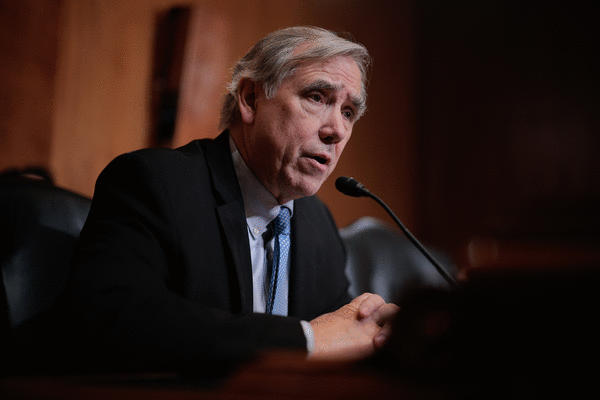
Democrat Jeff Merkley, the junior U.S. senator from Oregon, has spent years on a mostly one-man crusade aimed at reforming the filibuster and restoring a bit of sunlight and self-discipline to the chamber.
In 2022, Merkley and his allies came within two votes of modifying the filibuster for voting rights legislation. He continues scouring for support for a broader overhaul.
"This is essential for people to see what their representatives are debating and then have the opportunity to weigh in," said Merkley, speaking from the Capitol after a vote on the Senate floor.
"Without the public being able to see the obstruction," he said, "they [can't] really respond to it."
What follows is a discussion of congressional process, but before your eyes glaze over, you should understand that process is what determines the way many things are accomplished — or not — in Washington, D.C.
The filibuster, which has changed over time, involves how long senators are allowed to speak on the Senate floor. Unlike the House, which has rules limiting debate, the Senate has no restrictions, unless a vote is taken to specifically end discussion and bring a matter to resolution. More on that in a moment.
In the broadest sense, the filibuster is a way to protect the interests of a minority of senators, as well as their constituents, by allowing a small but determined number of lawmakers — or even a lone member — to prevent a vote by commanding the floor and talking nonstop.
Perhaps the most famous, and certainly the most romanticized, version of a filibuster took place in the film "Mr. Smith Goes to Washington." The fictitious Sen. Jefferson Smith, played by James Stewart, talks to the point of exhausted collapse as a way of garnering national notice and exposing political corruption.
In the Frank Capra classic, the good guy wins. (It's Hollywood, after all.) In real life, the filibuster has often been used for less noble purpose, most notably the decades-long thwarting of civil rights legislation.
A filibuster used to be a rare thing, its power holstered for all but the most important issues. But in recent years that's changed, drastically. The filibuster — or, rather, the threat of a filibuster — has become almost routine.
In part, that's because of how easy it's become to gum up the Senate.
Members no longer need to hold the floor and talk nonstop, testing not just the power of their argument but their physical mettle and bladder control. These days it's enough for a lawmaker to simply state their intention to filibuster. Typically, legislation is then laid aside as the Senate moves on to other business.
That pain-free approach has changed the very nature of the filibuster, Ornstein said, and transformed how the Senate operates, much to its detriment.
The burden is "supposed to be on the minority to really put itself ... on the line to generate a larger debate" — a la the fictive Jefferson Smith — "and hope during the course of it that they can turn opinions around," said Ornstein, an emeritus scholar at the American Enterprise Institute. "What's happened is the burden has shifted to the majority [to break a filibuster], which is a bastardization of what the filibuster is supposed to be about."
It takes 60 votes to end a filibuster, by invoking cloture, to use Senate terminology. That means the passage of legislation now effectively requires a supermajority of the 100-member Senate. (There are workarounds, which, for instance, allowed President Trump's massive tax-and-spending bill to pass on a 51-50 vote, with Vice President JD Vance casting the tie-breaker.)
The filibuster gives outsized power to the minority.
To offer but two examples, there is strong public support for universal background checks for gun buyers and greater transparency in campaign finance. Both issues have majority backing in the Senate. No matter. Legislation to achieve each has repeatedly been filibustered to death.
That's where Merkley would step in.
He would not eliminate the filibuster, a prerogative jealously guarded by members of both parties. (In a rare show of independence, Republican senators rejected President Trump's call to scrap the filibuster to end the recent government shutdown.)
Rather, Merkley would eliminate what's come to be called "the silent filibuster" and force lawmakers to actually take the floor and publicly press their case until they prevail, give up or physically give out. "My reform is based on the premise that the minority should have a voice," he said, "but not a veto."
Forcing senators to stand and deliver would make it more difficult to filibuster, ending its promiscuous overuse, Merkley suggested, and — ideally— engaging the public in a way privately messaging fellow senators — I dissent! — does not.
"Because it's so visible publicly," Merkley said, "the American citizens get to weigh in, and there's consequences. They may frame you as a hero for your obstruction, or a bum, and that has a reflection in the next election."
The power to repair itself rests entirely within the Senate, where lawmakers set their own rules and can change them as they see fit. (Nice work, if you can get it.)
The filibuster has been tweaked before. In 1917, senators adopted the rule allowing cloture if a two-thirds majority voted to end debate. In 1975, the Senate reduced that number to three-fifths of the Senate, or 60 members.
More recently, Democrats changed the rules to prevent filibustering most presidential nominations. Republicans extended that to include Supreme Court nominees.
Reforming the filibuster is hardly a cure-all. The Senate has debased itself by ceding much of its authority and becoming little more than an arm of the Trump White House. Fixing that requires more than a procedural overhaul.
But forcing lawmakers to stand their ground, argue their case and seek to rally voters instead of lifting a pinkie and grinding the Senate to a halt? That's something worth talking about.
____
©2025 Los Angeles Times. Visit at latimes.com. Distributed by Tribune Content Agency, LLC.


















































Comments