Commentary: Prosperity and philanthropy reborn -- The conservative way forward
Published in Op Eds
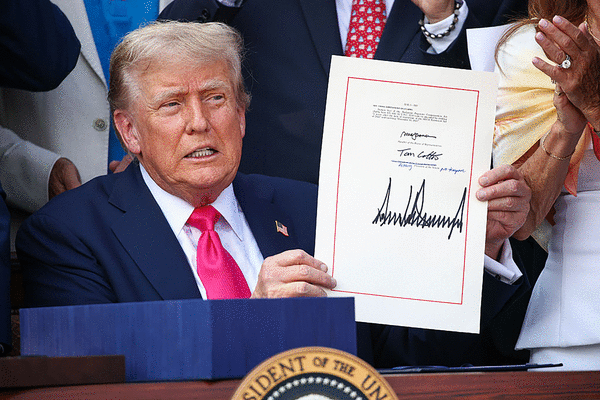
Much has been written about the One Big Beautiful Bill Act (OBBBA) since it was signed into law last summer, but one of its more interesting provisions has been somewhat overlooked: the expansion of charitable contribution benefits for all taxpayers, which allows all Americans to potentially lower their tax bills by giving to qualified organizations.
This provision underscores how free-market capitalism and philanthropy complement one another, reminding us that conservative governance can foster both prosperity and generosity.
Historically, only taxpayers who itemized could take advantage of charitable contributions, which in recent years has included only about 10% of taxpayers on average. Furthermore, these itemizers tend to be the most well-off Americans.
For many Americans who opt for the standard deduction, donations have yielded no tax advantages. The OBBBA changes this dynamic. Taxpayers who take the standard deduction can now claim an "above-the-line" adjustment for charitable contributions up to $1,000 for single filers and $2,000 for married filing jointly. This means that everyday acts of generosity, like giving to a veterans' support organization or funding environmental conservation efforts through a nonprofit can now reduce taxable income and potentially turn a tax bill into a refund.
The OBBBA also added a floor on charitable deductions for (typically high-income) itemizers. Specifically, to qualify for the deduction, an itemizer’s annual giving must be at least 0.5% of their income. For example, an itemizer earning $1 million in income can only deduct charitable giving more than $5,000. Before the OBBBA, high-earners giving modest amounts could claim tax deductions, while charitable deductions were denied to most low-and moderate-earners giving the same amount. The OBBBA reversed that.
These changes represent a critical step towards having equal tax treatment for all charitable giving and ending a decades-long skew towards providing tax advantages on philanthropy only for the wealthiest Americans.
The above-the-line charitable deduction provision is a triumph for conservative principles. As influential economists like Milton Friedman, Adam Smith, and Thomas Sowell have emphasized, free-market capitalism flourishes through voluntary cooperation and exchange, prioritizing individual choice over coercive mandates.
By offering a modest “above-the-line” deduction for charitable contributions, this legislation encourages philanthropy without direct wealth redistribution or new government spending programs, allowing more taxpayers to potentially reduce their tax liabilities through personal and voluntary generosity. Ultimately, it's a policy that avoids taking from one group to benefit another, instead enabling Americans to retain more of their earnings while supporting causes they value.
The term “charity” is often misused. In IRS parlance, there’s no such thing as a “charity.” Instead, IRS Publication 526 defines a “charitable contribution” as a donation to a “qualified organization”—typically a 501(c)(3) nonprofit, such as Goodwill, the Salvation Army, or a local church. These organizations, which include religious, educational, and philanthropic entities, are tax-exempt and mission driven. The OBBBA references "charitable" approximately two dozen times, making it important to clarify that this pertains precisely to contributions to such qualified organizations.
The broader impact on the political, social, and economic power of nonprofits remains uncertain. The changes to the tax treatment of charitable giving may amplify their influence—from religious institutions to community groups- in addressing societal problems and shaping political outcomes. What’s clear, however, is that this modest reform fulfills a core conservative promise: lowering taxes through policies that empower individuals.
Beyond that, we should not underestimate the positive impact this reform may have on our culture. By extending this advantage to all tax filers, it will promote the act of charity. Increasing the focus on the non-profit sector will highlight the value of these non-governmental initiatives and the work of the passionate and talented entrepreneurs that are harnessing charity to improve quality of life. The value of fostering a culture that supports and idealizes this kind of work may pay cultural, as well as financial, dividends long into the future.
At a time when government overreach seems too much, the OBBBA stands out as a beacon of principled reform. It’s a testament to the Trump administration’s focus on helping all Americans, not just the wealthy. The change in the treatment of charitable contributions is a clever provision, standing as a reminder that conservative governance can foster both prosperity and generosity.
____
Richard Stern is Acting Director of the Roe Institute for Economic Policy Studies at the Heritage Foundation and Director of its Grover M. Hermann Center for the Federal Budget. Spencer Skalleberg is a member of Heritage's Young Leaders Program.
_____
©2025 Tribune Content Agency, LLC.

















































Comments