Commentary: US needs immigrants to sustain the health care workforce
Published in Op Eds
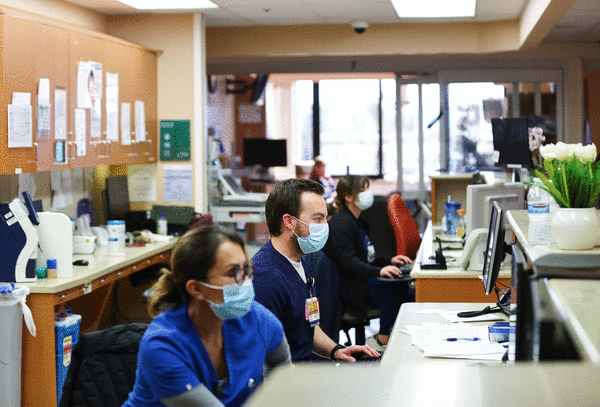
As Americans gather for holiday celebrations, many will quietly give thanks for the health care workers who keep their families and friends well: the ICU nurse who stabilized a grandparent, the doctor who adjusted a tricky prescription, the home health aide who ensures an aging relative can bathe and eat safely.
Will most of us notice how many of these professionals are foreign-born? Will we recognize how immigration policies shaped in Washington today could determine whether our families can get care when we need it in the future?
As an economist who studies how immigration influences economies, including health care systems, I see a consistent picture: Immigrants are a vital part of the health care workforce, especially in roles facing staffing shortages.
Yet current immigration policies — such as increased visa fees, stricter eligibility requirements, and enforcement actions that affect legally present workers living with undocumented family members, in addition to detention of legal residents and U.S. citizens— risk eroding this critical workforce, threatening timely care for millions of Americans. The timing couldn’t be worse.
America’s health care system is entering an unprecedented period of strain. An aging population, coupled with rising rates of chronic conditions, is driving demand for care to new heights.
The workforce isn’t growing fast enough to meet those needs. The U.S. faces a projected shortfall of up to 86,000 physicians by 2036. Hospitals, clinics and elder-care services are expected to add about 2.1 million jobs between 2022 and 2032. Many of those will be front-line caregiving roles: home health, personal care and nursing assistants.
For decades, immigrant health care workers have filled gaps where U.S.-born workers are limited. They serve as doctors in rural clinics, nurses in understaffed hospitals and aides in nursing homes and home care settings.
Nationally, immigrants make up about 18% of the health care workforce, and they’re even more concentrated in critical roles. Roughly 1 in 4 physicians, 1 in 5 registered nurses and 1 in 3 home health aides are foreign-born.
State-level data reveal just how deeply immigrants are embedded in the health care system. Consider California, where immigrants account for 1 in 3 physicians, 36% of registered nurses, and 42% of health aides. People born outside the U.S. constitute 33.2% of the Golden State’s health care workforce, a higher percentage than in any other state. In New York City, they make up a majority of health care workers, representing 57% of the health care workforce.
Even in states with smaller immigrant populations, their role is outsized.
In Minnesota, immigrants account for nearly 1 in 3 nursing assistants in nursing homes and home care agencies, despite making up just 12% of the overall workforce. Iowa, where immigrants are just 6.3% of the population, relies on them for a disproportionate share of rural physicians.
These patterns transcend geography and partisan divides. From urban hospitals to rural clinics, immigrants help keep units staffed and beds open. When policies shrink that workforce — through higher visa fees, tighter eligibility, or more detentions and removals — the effects show up quickly: schedules thin out, services are scaled back, and capacity can drop.
While health care demand soars, the pipeline for new health care workers could struggle to keep pace under current rules. Training more doctors and nurses is essential — but it’s slow. With a decade-long runway for physicians, the fastest ways to prevent today’s shortages from becoming tomorrow’s access crisis are to improve retention and responsibly increase the supply of qualified clinicians who can practice here, including immigrants.
That pipeline also runs through U.S. universities. International students, who often pursue STEM and health-related fields at U.S. universities, are a key part of this pipeline. Yet recent surveys from the Council of Graduate Schools show a sharp decline in new international student enrollment for the 2025-26 academic year, driven partly by visa uncertainties and global talent competition.
If this trend holds, the smaller cohorts arriving today will mean fewer physicians, nurses, biostatisticians and medical researchers in the coming decade — precisely when demand peaks. Experts warn that tighter visa rules, higher application fees and stepped-up enforcement are likely to intensify shortages in the health care workforce.
These policies make it harder to hire foreign-born workers and create uncertainty for those already here. In turn, that complicates efforts to staff hospitals, clinics and long-term care facilities at a moment when the system can least afford additional strain.
Patients don’t feel staffing gaps as statistics — they feel them physically.
A specialist appointment delayed by months can mean worsening pain and worse outcomes. Older adults without home care aides face higher risks of falls, malnutrition and medication errors. An understaffed nursing home turning away patients leaves families scrambling. These aren’t hypotheticals; they’re already happening in pockets of the country where shortages are acute.
The costs of restrictive immigration policies won’t appear in federal budgets but in human tolls: months spent with untreated depression, discomfort awaiting procedures, and preventable hospitalizations. Rural communities, often served by immigrant physicians, and urban nursing homes, reliant on immigrant aides, will feel this most acutely.
Most Americans won’t read a visa bulletin or a labor market forecast. But they will notice when it becomes harder to get care for a child, a partner or an aging parent.
Aligning immigration policy with the needs of the health care system would not, by itself, fix every problem in U.S. health care. But tightening the supply of workers in the face of rising demand and known shortages almost guarantees more disruption. If policymakers connect immigration policy to workforce realities and adjust it accordingly, they can help ensure that when Americans reach out for care, someone is there to answer.
____
Bedassa Tadesse is a professor of economics at the University of Minnesota Duluth. This article was produced in collaboration with the Conversation.
_____
©2025 Los Angeles Times. Visit at latimes.com. Distributed by Tribune Content Agency, LLC.




























Comments