Commentary: The dog who inspired my 20-year quest for change
Published in Op Eds
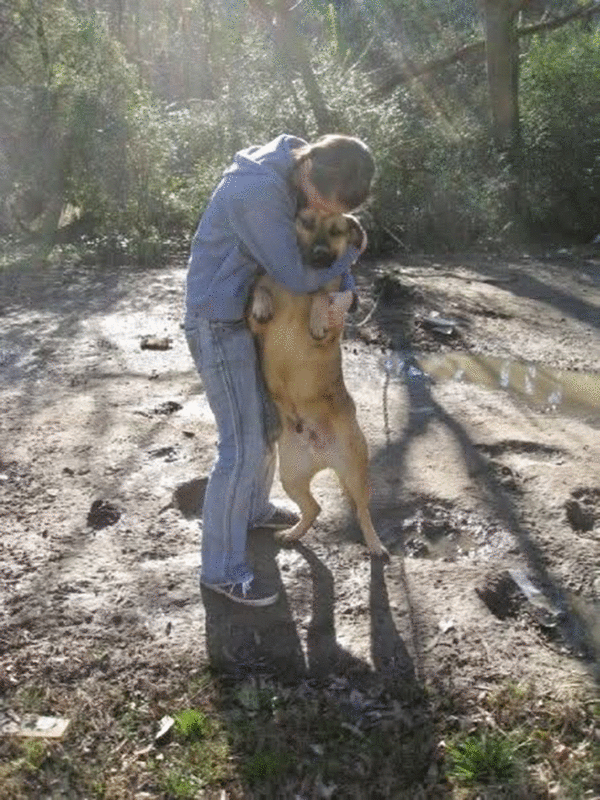
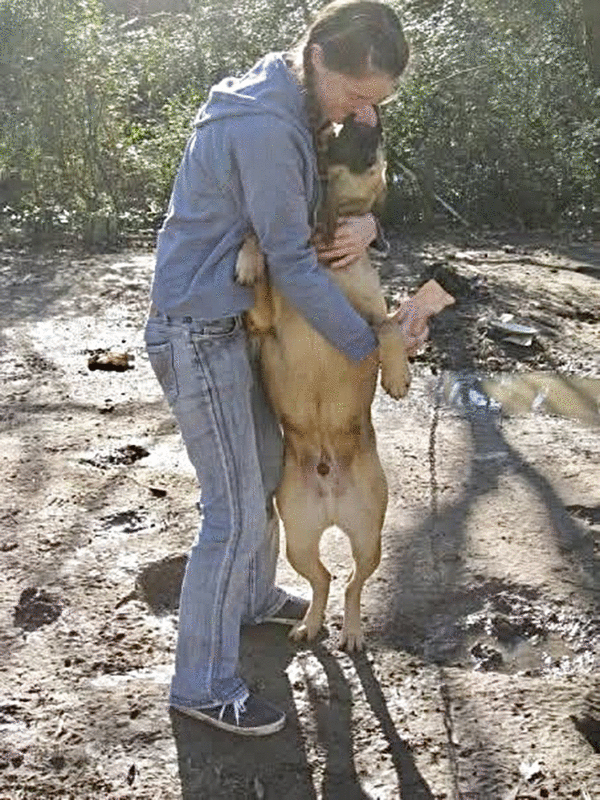
I first met Joe when he was six years old, having spent his entire life attached by a heavy logging chain to a hollowed-out air conditioning unit in a backyard in Virginia.
His surroundings more closely resembled a mud pit due to his restless circling and the patchwork of holes he had dug trying to fill the long, lonely hours. Whenever I approached the shaggy brown German shepherd, he would throw his paws over my shoulders and lick my face, whimpering with excitement, often urinating on himself due to some combination of exuberance and fear. He had likely seen how cruel humans can be.
Joe was one of the first dogs I met as a volunteer fieldworker with PETA’s Community Animal Project. Our job was to visit chained dogs and alleviate the daily neglect they endured, however we could.
We cleaned and filled food and water bowls that usually contained little more than leaves and dirt. The dogs’ rail-thin frames and insatiable hunger and thirst made me wonder how many times they’d looked in those bowls and found nothing.
We gave them sturdy wooden doghouses for protection against the scorching sun, driving rain or freezing snow. In the wintertime, we stuffed the doghouses with straw for a bit of meager insulation; in summer, we hung tarps to create a small square of shade. We plucked away ticks, tried to ward off fleas and medicated wounds caused by flies eating at their ears.
Occasionally, Joe would have an inch of thick, brown water in a bucket and, on the ground, remnants of stale bread. More often, he had nothing. I would stroke his fur, feeling his protruding bones, while he gratefully kissed my hand and cried, desperate for the affection I could give him.
Every time we were near his area, I brought Joe treats or a toy to play with and, always, what he wanted most: a kind touch. Every time, I begged his owner to let me give him an indoor home and the care he deserved. His owner refused. I saw Joe any chance I could for years, until the day his owner informed me that he had died. Almost 20 years later, my heart still aches for him.
In the two decades I’ve spent volunteering to help chained dogs, what has impacted me most about their plight isn’t the lack of food and water, the ever-abundant buildup of feces and trash in their inescapable living areas, the biting insects that cause constant pain or even the unforgiving summer heat and piercing winter winds. What haunts me the most—what’s keeping me awake as I write this—is their utter loneliness.
Each dog handles the loneliness differently. Some cower in fear, having never known a kind word or touch. Their only goal is avoiding harm. Others pull so hard on their chains to reach me that they’re willing to choke themselves for a moment of connection. But every set of eyes seems to plead for something more. On each sad little patch of earth, it’s the loneliness that takes up the most space.
“Unchain a Dog” Month is a reminder that each of us has the power to change a dog’s fate. Animal advocates have won chaining bans simply by bringing the issue before the local government. PETA has resources to help every step of the way. Others visit chained dogs, as I did for Joe, providing necessities, taking them on walks for vital exercise and a chance to see the world beyond a tiny square of dirt and meeting their most critical need of all: companionship.
Our team has freed many dogs just by asking for the opportunity to give them an indoor home. Two are curled up next to me. Many others found caring adopters at local open-admission shelters. Other individuals have rescued dogs the same way.
It’s those wins that keep me going. That and the glimmer of hope that appears in each dog’s eyes, like it did in Joe’s, when someone shows up for them.
______
Julia Novak is a volunteer with PETA’s Community Animal Project, 501 Front St., Norfolk, VA 23510; PETA.org.
_____
©2026 Tribune Content Agency, LLC.





















































Comments